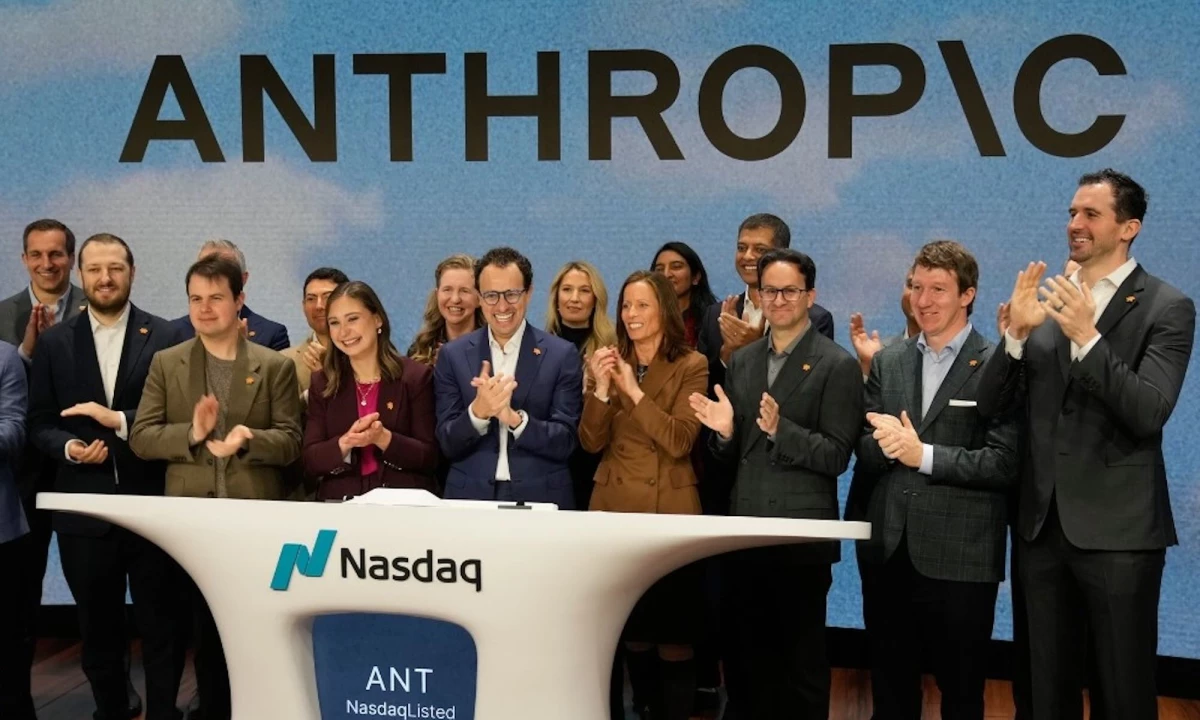

Anthropic priced its IPO at $83 a share on Wednesday night, above its $70 to $78 range.
The offering raised about $81.3 billion, the largest IPO total on record before overallotment shares.
It tops the $75 billion SpaceX raised in its June base deal, which later totaled $85.7 billion after underwriters exercised an overallotment option.
Orders reached nearly seven times the shares on offer.
The maker of Claude began trading on Nasdaq as ANT on Thursday.
Shares opened at $111.50 and closed at $97.17, 17% above the offer price.
Agencies using Claude for research, creative work, or campaign tasks can now check their vendor's finances every quarter through public filings.
Anthropic's S-1 filing details its losses, infrastructure spending, and future commitments, giving agencies a better picture of the financial pressures that could affect AI pricing.
Brands now read the same vendor numbers as their agencies, so AI risk becomes a shared agenda item in client reviews.
Here, we look at what the filing reveals, plus three checks agencies should run before tying client work to an AI vendor.
Anthropic's Finances Are Now Public
Anthropic reported third-quarter revenue of $16.96 billion, up 47% from the second quarter.
Its amended filing also reported a net loss of $23.29 billion.
About $21.9 billion of this loss came from non-cash changes in the value of convertible notes and similar instruments.
Anthropic's operating loss for the quarter was $567 million.
Its annualized revenue run rate reached roughly $81 billion by the end of October, up $10 billion from the end of September.
At the IPO price, Anthropic's fully diluted valuation was about $1.5 trillion, while the company also carries $6.2 billion in debt.
Thursday's close lifted Anthropic's fully diluted value to about $1.76 trillion, as reported by CNN.
During the first trading session, the stock ranged from $92.72 to $115.10.
The $81.3 billion figure covers the base offering, while underwriters also have an option to buy up to 147 million additional shares through December 18.
Anthropic disclosed about $900 billion in purchase and lease commitments, including roughly $70 billion due within 12 months.
These disclosures help teams judge the risk of a price change before it hits a client's marketing budget.
An agency running Claude across many accounts can read each filing once and brief every client, which spreads vendor monitoring across its roster.
Compute Costs Could Affect AI Pricing
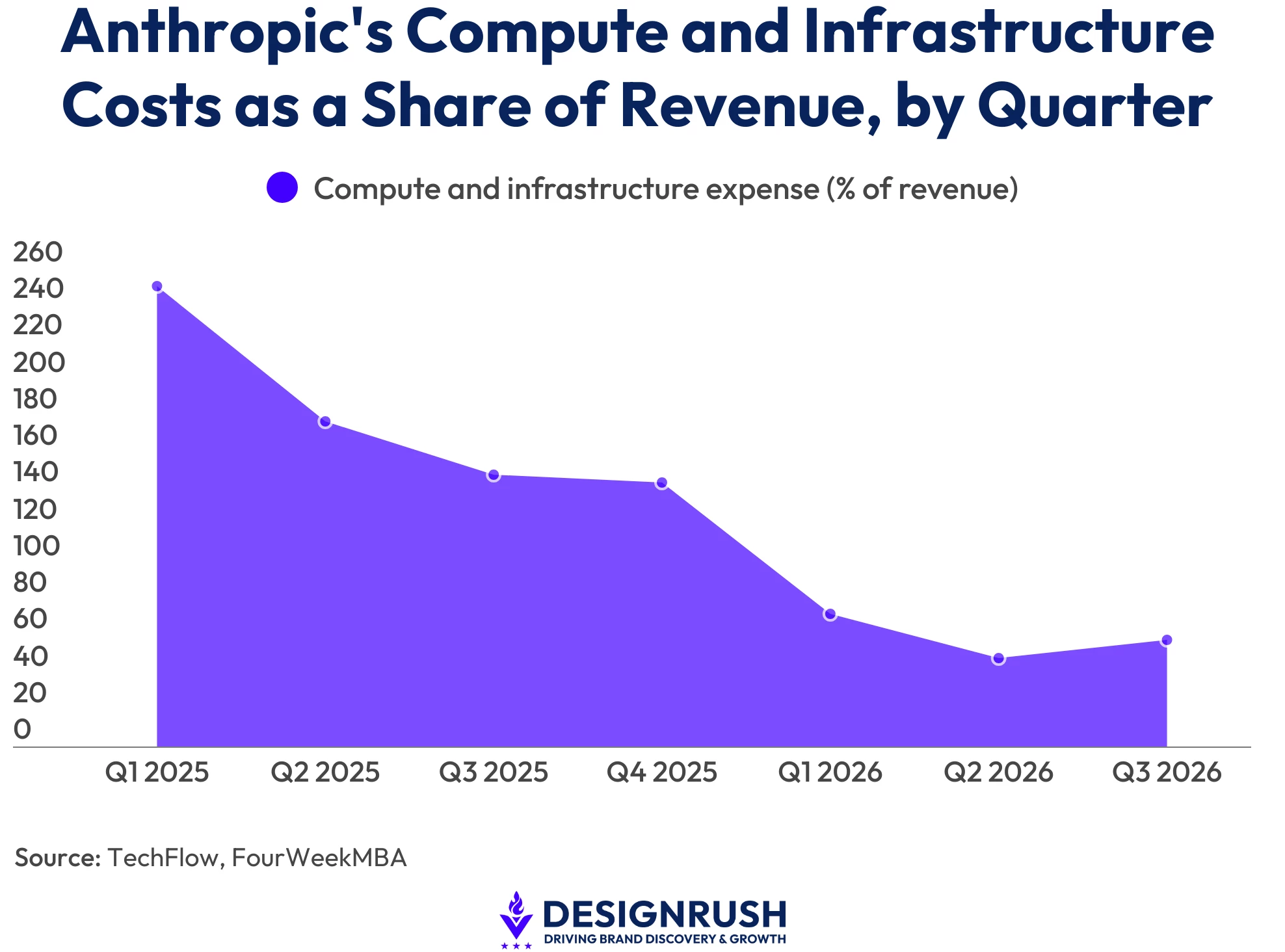
Anthropic spent $9.86 billion on compute and infrastructure in the third quarter, equal to 58% of revenue, up from 48% in the second quarter.
The company said that $5 billion of this expense came from short-term compute, which costs more than capacity secured through multiyear agreements.
Consumption-based services accounted for 79% of revenue during the first nine months of 2026, while subscriptions made up the remaining 21%.
🤖 How Anthropic Makes Money. Compute consumes 58 cents of every dollar of revenue. • Q3 Revenue: $17.0B (+47% Q/Q). • Compute costs: $9.9B (+77% Q/Q). • Operating loss: $567M. $ANT starts trading today. 📊 https://t.co/pPokZ7UbqU
— App Economy Insights (@EconomyApp) November 19, 2026
Agencies using Claude through its API pay according to usage, tying their bills to the same infrastructure costs Anthropic reports each quarter.
The filing, however, does not announce a price increase.
Anthropic says its own tests show Claude Opus 5.5 costs about 40% less to run than Opus 5 on typical workloads.
Agencies that price client work by task can monitor compute costs in each quarterly report, giving them an additional data point when reviewing their own AI budgets.
Brands hiring an agency for AI-heavy work should ask whether usage costs sit inside the retainer because this decides who absorbs a price change.
Customer Mix and Policy Rules Affect Agencies
Anthropic's five largest customers accounted for about 25% of revenue during the first nine months of 2026, while no single customer contributed more than 10%.
Cloud marketplaces operated by Amazon, Google, and Microsoft handled 48% of first-half revenue, alongside 58% of net receivables at the end of June.
Anthropic estimates that 5% to 7% of revenue came from customers later found to have breached its usage policy or commercial terms.
The company expects revenue from these customers to decline and warns that the crackdown may reduce its overall revenue.
Agencies buying Claude through a cloud marketplace use a sales channel responsible for nearly half of Anthropic's first-half revenue.
Brands, on the other hand, can ask their agency to keep their work on a separate Claude account, so enforcement against another client stays off their projects.
Shareholders Will Watch Claude's Ad-Free Pledge
Anthropic's February blog post says "Claude will remain ad-free" and promises that sponsored links will not appear next to conversations.
Its Super Bowl campaign in February closed every spot with the line "Ads are coming to AI. But not to Claude."
The founders' letter in the prospectus repeats this commitment for public investors.
However, one analysis of the S-1 found no binding commitment to keep Claude ad-free in the filing itself.
OpenAI has expanded ChatGPT ads since it began testing them with U.S. Free and Go users on Feb. 9.
A Comscore study found sponsored ads in 47% of tracked ChatGPT video game conversations in June, up from 3% in March.
The figures cover U.S. desktop activity from an opt-in panel, offering an early indication of how often ads appeared in those conversations.
Brands seeking visibility in Claude answers have to earn it organically, which makes a content and SEO agency the right hire for this channel.
Remarks from Anthropic CEO @DarioAmodei on our initial public offering: My co-founders and I started Anthropic because we believe that the most powerful technology of our time should be built for the benefit of humankind. Daniela and I lost our father to a disease that, just a few years later, became curable. I started my career in biology, hoping to help future cures come sooner. In the lab, I saw the vast thicket of complexity that scientists face when they’re trying to understand disease and develop new treatments. So many of the scientific tools that can cut through that thicket—tools for gene editing, gene synthesis, controlling brain cells with light—started as pure ideas. In other words, they came from thinking. From intelligence. Human intelligence has already made diseases like plague, smallpox, and polio history for most of the world. But progress on other diseases has been too slow for so many patients and their families. Going from a great idea to a treatment can take decades: it took many years from the first discovery of a strange repeating pattern in DNA to the approval of the first treatment for a disease using CRISPR. Nature is full of these patterns. But we’ve had too little intelligence to decipher most of them; too few scientists, with too little time. Now we can build that intelligence. Whether it’s protein folding, drug design, cancer genetics, or clinical trial administration, scientists across many areas of biology and medicine are finding Claude can help them do their research in a fraction of the time it would’ve taken just a couple of years ago. I believe sufficiently powerful AI, working in concert with humans, could compress a century of scientific and medical progress into a decade. I don’t want to get ahead of myself. At this point all we have are early results. Experiments and clinical trials will still take time. And although they involve slow and ponderous processes, I believe those processes can be substantially accelerated by AI. We hope that in the future fewer families miss a cure by just a few years. Medicine is just a particularly vivid example, but there are many others. Our customers—the world’s most ambitious companies, nonprofits, and individual people—are already applying the intelligence we’ve built to stimulate economic growth; lift people out of poverty; protect democracy and free societies; even make everyday services like the DMV work better. We’re proud to work alongside them. And I’m extremely optimistic about what we can do together in the future. At the same time, we have always been honest that this technology has very real risks. These range from misuse of the technology by individuals or nation-states, to economic disruption, to losing control of AI systems. We discuss these risks not because we think they are inevitable, but because we think they are avoidable. Avoiding them depends on the choices made by the people building AI. There is a gigantic difference between how AI will go if we pay little attention to safety, versus how it will go if we are obsessed with safety. And an obsession with safety and with public benefit has been woven into Anthropic’s DNA from the start. From safeguards against biological and cyber risks, to alignment training and testing, to looking inside our models like an X-ray, Anthropic has pioneered methods for understanding and steering the behavior of AI systems. There is much work still to be done, and the most difficult safety work lies ahead of us. The incredible talent of the company that has enabled us to build the most capable AI systems will need to be directed, even more so than it has already, towards double- and triple-checking that those AI systems are safe and secure. And to state it unequivocally, we will pace the training and deployment of AI systems, taking as long as is necessary to have confidence that they are safe and will remain under human control. We will not bend to either business or political pressure. Today puts the company in a stronger financial position, and in doing so only strengthens our resolve to do the right thing. If we can show it’s possible to make the right choices on safety and still build an incredibly successful company, others in our industry will be inspired to do the same. We call this a race to the top. When the race to the top is working properly, it doesn’t matter which company has the best models—everyone wins because everyone is building safely. The race to the top works best when driven from the front of the pack, and we fully hope and expect to do so, but the goal is to make the whole industry better, regardless of whether Anthropic is winning or losing at any given time. The advent of machine intelligence is one of the seminal moments in human history, and we have a rare opportunity to shape it for the better. This moment is bigger than any one company, or any one country. It will take all of us, working together, to ensure this technology goes well for us and the many generations to come. Starting today, we hope that you’ll join us on this mission.
— Anthropic (@AnthropicAI) November 19, 2026
Agencies can run these three checks before a client workflow depends on an AI tool:
Ask About Pricing Changes
Agencies should request written notice periods for usage-price changes and ask whether committed-spend agreements lock rates for the contract term.
Anthropic's S-1 says that some customers agree to minimum spend commitments in exchange for a committed price list.
Check Workflows Against Usage Rules
Agencies should list the client tasks running on each model and check them against the vendor's usage policy.
The New Stack reports that Claude Opus 5.5 automatically reroutes flagged cybersecurity and biology requests to Opus 4.8 or Opus 5.
Test a Backup Model for Each Task
Agencies should approve a second model for critical tasks and test its prompts and outputs in advance. This gives teams a fallback if pricing or terms change during a project.
Models Anthropic released from April to September drove more than 80% of its Q3 revenue.
Brands running an agency review can ask to see these checks in the pitch to learn how a shop protects client work when its martech stack changes.
Our Take: Can Agencies Trust Claude?
The biggest vendor risk in Anthropic's filing lies in its usage rules and access controls.
We'd trust Claude with client work, as long as every critical task has a tested backup model ready.
A backup adds testing hours and a second vendor bill, so agencies should price this redundancy into their AI budget.
Anthropic just raised $81.3 billion, so the odds of it running out of money mid-retainer look remote.
Model access has already slipped once this year.
Claude Fable 5 and Claude Mythos 5 launched on June 9, then Anthropic suspended both three days later to comply with U.S. export controls.
Each quarterly filing now gives agencies a set date to retest their backups and update client contracts.
Our earlier report on Claude's watermark policy covers another Anthropic rule that changes how agencies deliver client content.
Brands using AI tools need agency partners who understand the companies behind the technology.
Take a look at these top AI companies and agencies in our directory.