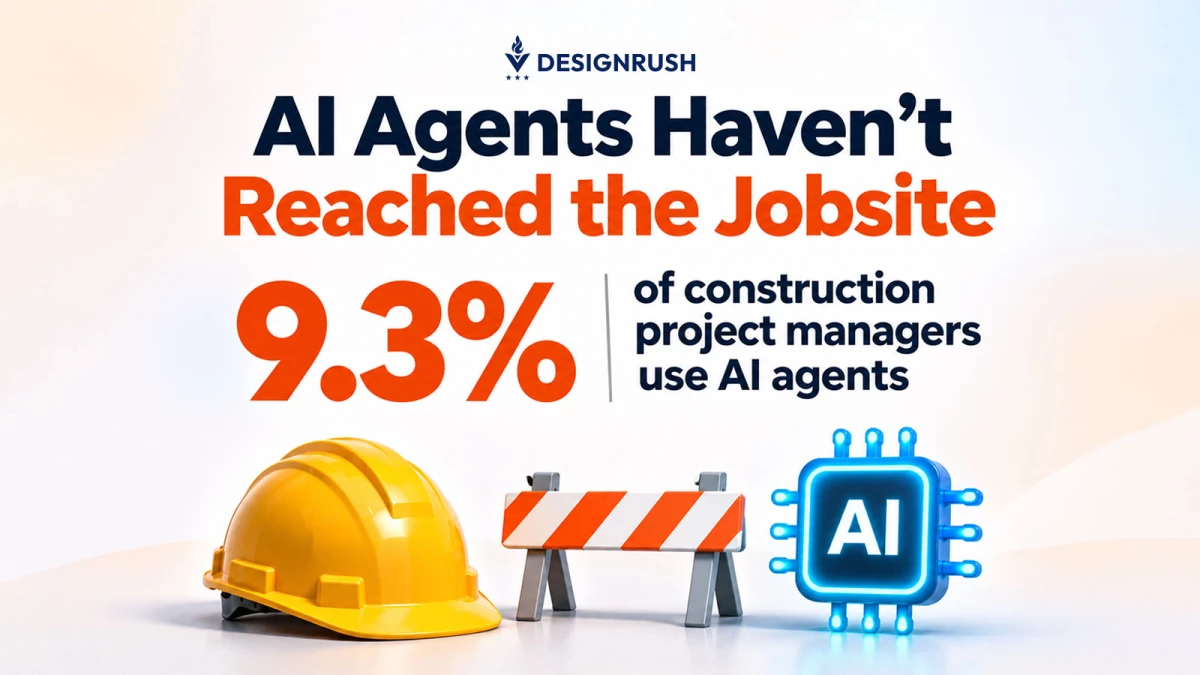

Construction firms are putting more money into AI, but agents still have little presence in day-to-day project management.
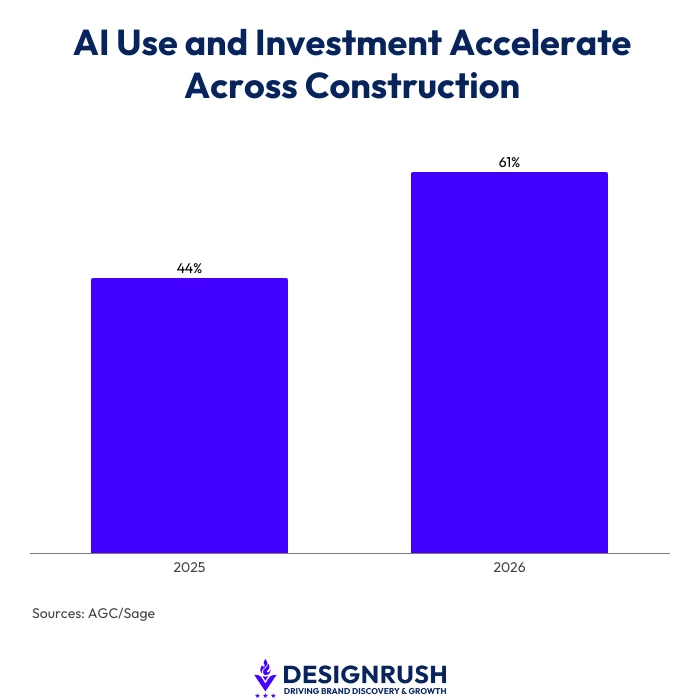
This comes as the Associated General Contractors of America and Sage found that 61% of respondents said their firms use AI or plan to increase investment in it, up from 44% in 2025.
But Mastt’s State of AI in Construction Project Management 2026 global survey found that only 9.3% use AI agents today.
Krazimo works on the kinds of AI-powered construction workflows where that difference starts to matter, including estimating, bids, and document-heavy work that can depend on data spread across several systems.
The company’s CEO and co-founder, Akhil Verghese, sees the harder problem beginning when AI moves from helping with one defined task to acting across the systems a contractor uses to run a project.
"Once an agent can pull from several systems and take action, the bar goes up," he says.
"For that to work, the data has to line up, and the boundaries have to be obvious."
Commercial Contractors Apply AI to Estimating and Bid Management
ServiceTitan found that 24% of commercial contractors use AI for cost estimation and budgeting, while 22% use it for bid management.
Both give teams a chance to check the work before it goes any further.
Krazimo’s construction projects use AI for first-pass takeoffs, bid and proposal drafting, and document intelligence across specs, submittals, RFIs, and contracts.
But the job gets harder when an AI agent has to pull from estimating, project management, and accounting.
So before it can act, it has to know which information it can trust.
Construction AI Agents Face Fragmented Data
Only 20% of commercial contractors operate on a single platform, with ServiceTitan finding that many rely on separate tools for accounting, project management, and estimating.
Mastt, meanwhile, found that 46.3% of construction project management professionals plan to start using AI agents.
"If the estimate lives in one system, project costs are somewhere else, and job history is sitting in spreadsheets, the agent doesn’t have one version of the job to work from," Verghese says.
"It can move quickly and still make the wrong call."
Mastt also found that accuracy and trust ranked as the biggest barrier to greater AI use among respondents.
Bounded Workflows Set Limits for Construction AI Software
Krazimo’s engineering approach favors deterministic workflows with constrained intelligence over one-shot agents.
Its construction estimating process follows that model, where AI produces a first-pass takeoff, but an estimator reviews it before the work moves on.
"If the steps are already known, keep them fixed," Verghese adds.
"Use AI where it helps with judgment or language, then make the next action explicit. You can test that."
The same principle allows contractors to increase autonomy gradually instead of giving an agent broad access on day one.
Four Checks Before Contractors Give AI Agents More Autonomy
Before an AI agent gets broader access, Verghese says contractors should have answers to four questions:
1. Which system wins when records conflict?
Decide which source controls when estimating, accounting, project, or historical data doesn’t match.
2. What can the agent do without approval?
Separate actions it can complete on its own from decisions that still belong to a person.
3. What evidence does it keep?
Record enough of the inputs, actions, and output for someone to review what happened.
4. What stops the workflow when something goes wrong?
Set a fallback for low confidence, missing data, or a connected system becoming unavailable.
"An agent should earn more responsibility through real work," Verghese says.
"If the team can’t explain what it did and what happens when it gets something wrong, it isn’t ready for broader access."