
Right now, every brand is contending with declining organic web traffic, and the focus now is on how to stay visible in the era of AI-powered search.
One thing is clear: search is changing fast, and often.
A recent study by brand visibility platform Semrush looked at manufacturing and industrial search trends.
It found that AI Overviews are growing across manufacturing searches and that, crucially, being mentioned isn't the same as being cited.
Of the 15 top domains tracked, only two appear on both the "most-mentioned brands" and "most-cited sources" lists.
We’re seeing that more people than ever before are turning to AI for answers, with about half of U.S. adults using AI chatbots, up from one-third in 2024, according to Pew Research Center.
A further 60% of U.S. adults read AI summaries at the top of search results.
For marketers chasing customer discovery, it means showing up in AI is one thing, but understanding what that visibility means for a brand is another.
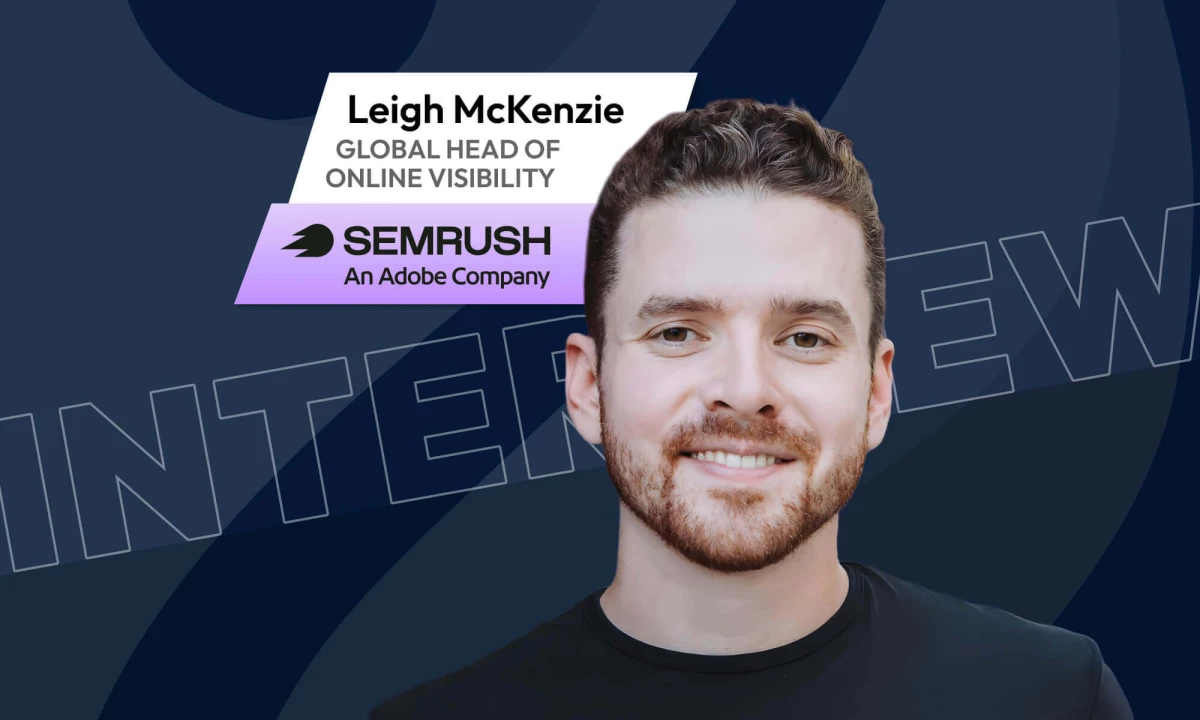
Leigh McKenzie, Global Head of Online Visibility at Semrush, an Adobe company, says marketers need to track how AI platforms represent their brands, which sources inform their answers, and whether that exposure contributes to leads and revenue.
DesignRush spoke with him about how Semrush is helping marketers navigate brand visibility in the AI era, and how to measure, track, and improve their brand’s performance.

Who Is Leigh McKenzie?
As Global Head of Online Visibility at Semrush, Leigh McKenzie helps brands get found, cited, and trusted across Google, AI search systems, and every modern discovery surface. His work focuses on practical tactics that turn visibility into revenue, from improving how brands appear in AI answers to strengthening search performance across channels. He has led large-scale visibility programs in SaaS, DTC e-commerce, travel, legal, and international markets, driving major revenue gains and scaling content to millions of users.
Why AI Citations Don't Guarantee Recommendations
There are two main AI visibility metrics that marketers should have their eyes on.
A mention is when AI names or recommends a brand. A citation is when AI quotes or uses a brand’s site as a source.
AI can recommend a brand without citing its website, or cite a website without recommending the brand.
Thus, an AI system might choose one brand for its source if the information is sound, but actually recommend its competitor in the answer if the competitor is considered more trusted.
"AI platforms want to recommend products, services, and solutions, but they also want evidence that validates those recommendations," McKenzie says.
"That evidence often comes from third-party sources like publishers, reviews, communities, experts, and other trusted websites.
"The strongest position for a brand is to be both frequently recommended and frequently cited. To do this, a brand needs both strong brand authority and strong content."
Building brand visibility gives marketers two things to pay attention to:
- What their own websites say about the business.
- What other credible sources say about it.
Owned content like product pages, company information, and published content explains what a brand offers.
Independent coverage and other credible references give AI systems more information to draw on.
Moreover, it’s crucial for this content to be consistent, as any misalignments are detrimental to the brand’s trust signals. That’s the easier part, as it’s within a marketing team’s control.
The next part is a little more challenging: third parties need to describe the brand in a similar way.
Whether it’s a review site, publisher, community forum, social media, or otherwise – these voices influence an AI search engine’s perception and trust of the same brand.
"The simplest way to think about it is that as a brand, you need to be clear about who you are, and other people need to be clear about who you are too. Those signals need to align," McKenzie says.
The manufacturing results won't necessarily tell the same story in every industry.
Buyers have their own research habits, and AI doesn't play the same part in every purchase.
Another Semrush study found that AI traffic is expanding faster than any other marketing channel, and it’s doing so across nearly every industry, with retail, apparel, food, and beauty seeing the largest increases.
Still, there's a difference between AI mentioning a brand and pointing users to the brand’s website as a source.
To build strong brand discovery in AI platforms, marketers need to grow both their brand mentions and citations, together.
Why Does AI Visibility Differ Between AI Platforms?
The same brand can show up across AI answers in very different ways. The reason? The platforms don't draw from and weight the same information sources equally.
Semrush’s AI Visibility Index breaks down how brands of all industries show up across four major AI platforms: ChatGPT, Google AI Mode, AI Overviews and Gemini.
The most recent edition of the report found that the brands and sources surfaced by AI vary significantly between markets, specifically the U.K. and U.S., and that visibility on one AI platform does not guarantee visibility on another.
Meanwhile, OpenAI has its own approach to gathering information, combining web retrieval with its available search infrastructure and developing partnerships and commerce integrations.
"OpenAI is building a different stack. It can retrieve information from the open web and search infrastructure available to it, while also developing its own partnerships, commerce integrations, and data sources," he adds.
"We shouldn’t expect every AI platform to rely on exactly the same sources or produce exactly the same recommendations," McKenzie says.
"For marketers, the takeaway is that AI visibility has to be measured across platforms, rather than assuming success in one automatically translates to another."
Some signals can still help across platforms. A clear brand identity, a strong reputation, authoritative content, and credible third-party references all contribute to how AI systems understand a business.
"There are some underlying signals that carry across platforms, including a clear brand, strong reputation, authoritative content, and consistent third-party validation," McKenzie says.
How Do You Know if AI Visibility Is Paying Off?
Brand mentions and citations show where a company appears in AI answers, but they don't show whether that exposure leads to business.
To help draw a stronger connection between brand visibility performance and business results, McKenzie recommends tracking four areas:
- Presence shows which prompts trigger a brand mention.
- Position looks at how AI describes the brand and compares it with competitors.
- Proof tracks the sources AI cites.
- Performance connects visibility to traffic, leads, and revenue.
"Traffic and clicks are still good metrics to track, but they don’t paint the whole picture," he says.
Mentions and citations tell marketers where a brand shows up, but they can't tell them if anyone actually converts.
Adobe’s Return on Brand Visibility (RoBV) metric brings conversions into the picture, giving teams another number to weigh against the visibility data.
The same discipline should guide what teams do with the data.
"The value of AI visibility data is that it can help marketers decide what to do next," McKenzie says.
"If you understand where competitors are winning, how your brand is being described, and which sources are shaping those answers, you can turn that into actions across SEO, content, PR, social, partnerships, and even product marketing."
Those actions need a connection to downstream activity. Teams can track branded searches, website visits, leads, and conversions after people encounter a brand through AI.
Attribution remains difficult, so a rise in mentions alone shouldn't be treated as evidence of commercial success.
McKenzie recommends reviewing AI visibility share of voice weekly to monitor brand descriptions, mentions, citations, and competitors.
Use the 4 Ps framework to think:
- Presence: Are you appearing for the right prompts?
- Position: How are you described and compared?
- Proof: Which sources are cited?
- Performance: Does visibility drive traffic, leads, or revenue?
Traditional SEO remains part of that work.
"SEO is far from ‘dead.’ If anything, it’s more important than ever in the age of AI and agentic search, because AI systems still depend heavily on the web," McKenzie says.
"The fundamentals still matter: being indexed, technically accessible, well organized for retrieval, and authoritative."
Winning visibility in ChatGPT can be a useful sign of progress, but it doesn't show the whole picture.
Marketers need to know how Google presents their brands, which outside sources support AI-generated recommendations, and whether that exposure leads to meaningful business activity.
Without those checks, a strong result on one platform can disguise missed opportunities elsewhere.