
A few weeks ago in Seattle, I was talking with a senior Microsoft executive about how they think about AI internally. He described a metric I had not heard framed quite that way before.
Microsoft actively tracks what percentage of their labor cost comes from tokens versus humans. The expectation is that the token percentage keeps climbing year over year.
And it’s not because they are cutting people. But because more work is being delegated to agents.
Around the same time, Dario Amodei was on Dwarkesh Patel’s podcast describing how Anthropic allocates its annual data center spend.
They have a fixed budget. The question is how to split it between training new models and serving inference for existing ones.
Two very different companies, but they’re facing the same underlying shift. AI is moving out of the “technology initiative” box and into the capital allocation conversation.
The question is no longer just what tools to buy. It is where the next dollar of productive capacity should go, be it people, software, infrastructure, or AI agents.
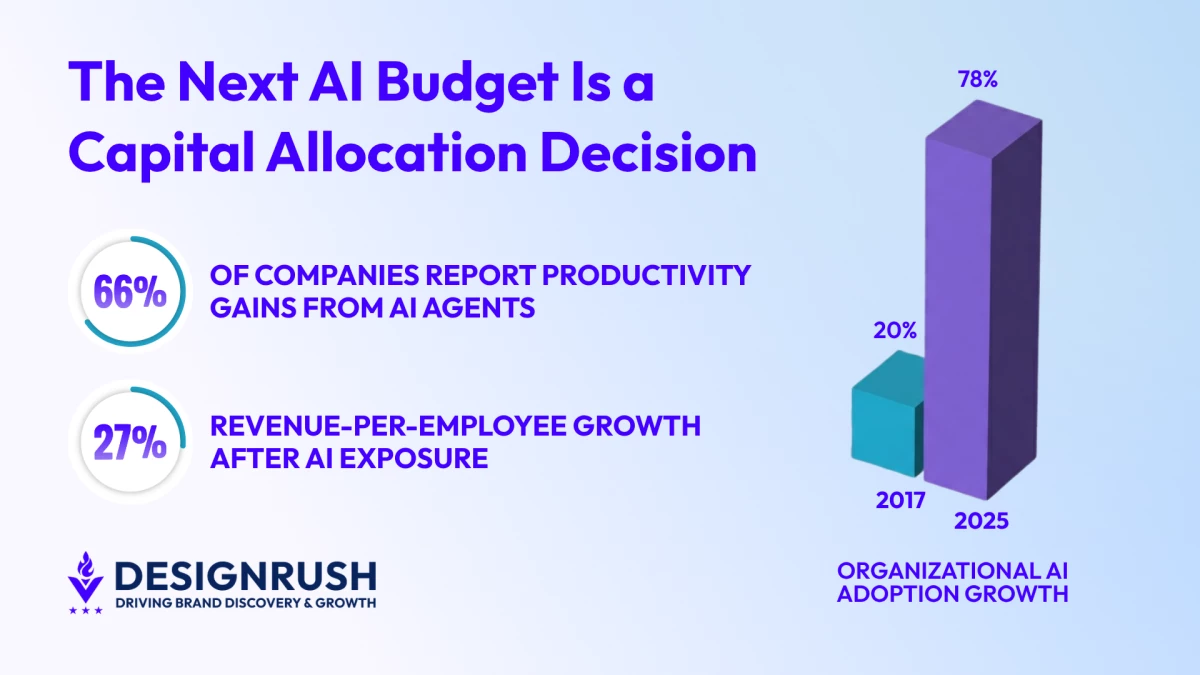
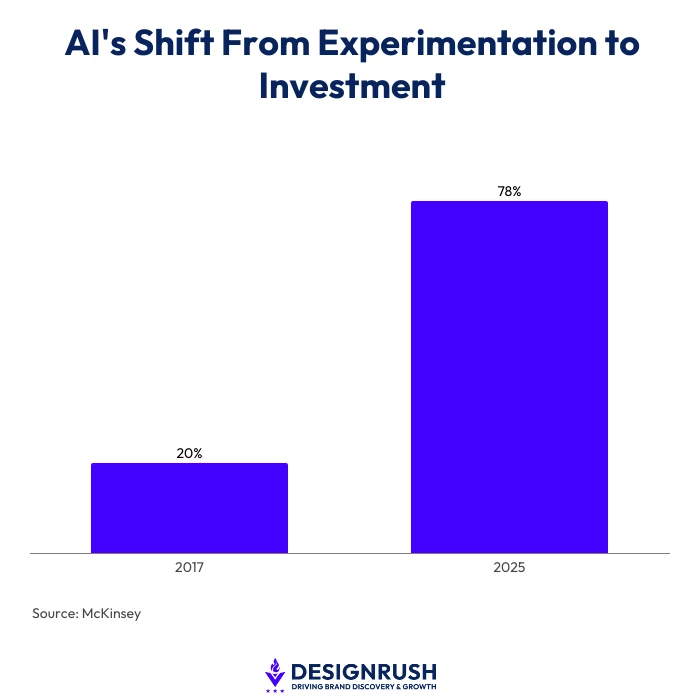
That conversation is becoming harder to avoid. AI adoption reached 78% last year, up from just 20% in 2017, according to McKinsey.
At that scale, AI stops being an innovation initiative and starts becoming a meaningful allocation of capital.
But for most companies, that shift has yet to happen.
AI still lives inside an innovation team, a tooling budget, or a CTO line item. The executives running the real allocation conversations, hiring, M&A, infrastructure, and operating leverage, are not always in the room when AI spend gets shaped.
That is the gap I keep seeing.
Why AI Spending Is a Business and Capital Allocation Decision
Three things make AI spend behave differently from a normal technology purchase.
First, the costs are recurring and scale with usage.
A SaaS contract usually has a fixed annual price. Token spend grows as adoption grows. The more useful your AI implementation becomes, the more it costs to keep running.
That’s a conversation to have with your CFO and not just the procurement team.
Second, AI competes directly with headcount.
Every meaningful AI investment is implicitly a decision about whether the next 10% of work gets done by a person or by an agent.
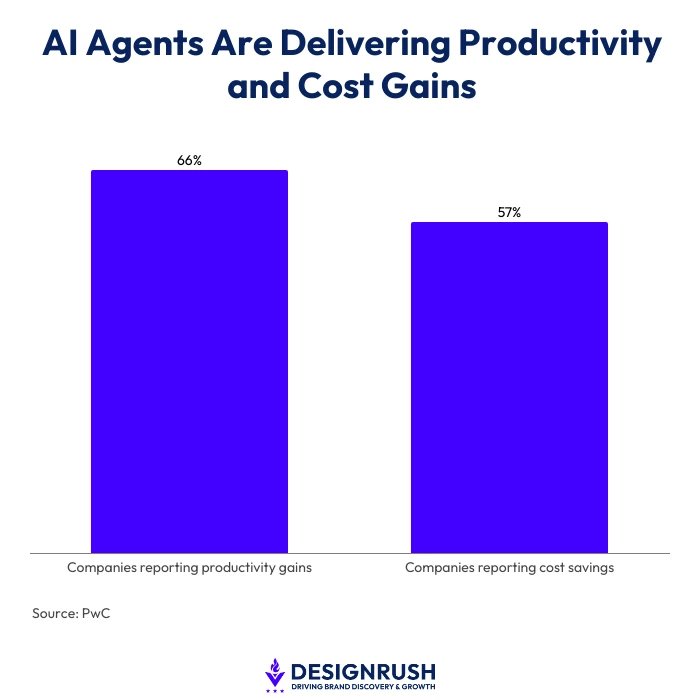
That trade-off is already showing up in executive planning, with PwC’s 2025 AI Agent Survey finding that 66% of companies using AI agents reported measurable productivity gains, while 57% reported cost savings.
Companies that pretend this is not a trade-off often end up with both a full hiring plan and a growing AI bill.
Third, the ROI window is much shorter than people assume.
A bad AI bet can quietly drain the budget for two or three years. A good one can reshape the cost structure just as quickly.
On the other hand, high performers, roughly 6% of companies attributing more than 5% of EBIT to AI, were nearly three times more likely to redesign workflows around AI rather than simply bolt it on top, according to McKinsey’s 2025 data cited by IntelligentNoise
Same dollars in. Very different outcomes.
The 4 Stages of Enterprise AI Adoption
Across the clients we work with at Cheesecake Labs, I see four maturity stages. The right capital allocation looks different at each one.
Stage 1: Lost
This is a team paying $20 a month for ChatGPT accounts, with no strategy, no measurement, and no clear owner.
The risk here is not overspending. The risk is missing the curve entirely.
The right move is small and deliberate. Pick two or three workflows that matter, set a real experimentation budget, and put an owner on it.
Stage 2: Experimentation
These are companies spending real money to figure out what works.
For a team with a digital engineering function, that can mean up to 20% of an engineer’s salary going to tokens. There is tool sprawl, many failed pilots, and a lot of uncertainty.
That is actually fine at this stage.
That pattern is more normal than most executives think.
Roughly 67% of organizations remain in either testing or partial implementation stages of AI adoption, according to PwC’s 2025 GenAI Business Leaders Survey
This is where Cheesecake Labs was through most of 2025 and in Q1 of 2026.
The discipline is to be very clear about what is working, including which experiments produce signals, which do not, and what the cost per unit of useful work really is.
Stage 3: Scaling specific use cases
These companies have a small number of workflows running reliably on agents, with token costs optimized, observability in place, and clear governance.
This is where Cheesecake Labs is now.
The allocation question shifts from “are we trying enough things?” to “are we doubling down on the right ones and killing the rest?”
Most companies fail here by holding onto experiments that never earned their cost.
Stage 4: Agent-native operations
These are companies running end-to-end agent workflows as if the agents were team members.
They have redesigned onboarding. Some of our clients have reduced new-hire ramp-up from months to hours because agents now hold the context and walk people through it.
They ship more with leaner teams. They validate new ideas faster. They have the governance and security in place to trust agents with meaningful work.
The productivity impact is starting to show up at the macro level too.
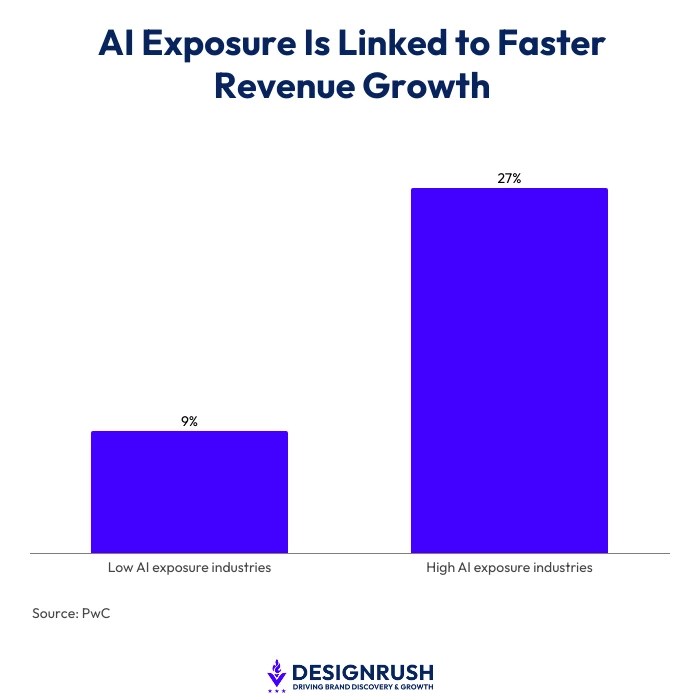
For example, industries more exposed to AI recorded revenue-per-employee growth of 27%, compared to 9% in less AI-exposed industries, per PwC’s 2025 Global AI Jobs Barometer.
The most interesting thing about Stage 4 is that the impact rarely shows up in one clean budget line. These companies are often keeping headcount flat while the business grows.
The capital that would have gone to hiring is going somewhere else. Some of it funds agent infrastructure.
Some of it pays for redistribution, moving the people they already have onto higher-leverage problems.
The most advanced clients I see are running stable headcount and posting their best years.
The Most Common AI Spending Mistakes Companies Make
The trap I see most often is companies trying to jump from Stage 1 straight to “let’s buy everything.”
Five AI tools. Three pilots. Two consultants. No measurement framework. No workflow redesign.
Six months later, there is a real bill, no clear wins, and the team is back to working the way they always did.
A few specific failure modes show up repeatedly.
1. Buying tools instead of redesigning processes
AI layered on top of a broken workflow usually just makes the broken workflow faster and more expensive.
2. Optimizing for hours saved instead of dollars produced
Hours saved are easy to estimate and very easy to overstate. The better question is what got done that would not have otherwise. Revenue generated, products shipped, customers served, decisions improved?
3. Treating token spend as discretionary when it becomes operationally committed
Once a workflow depends on an agent, the token line is locked in. Budget for it the way you would budget for a hire.
4. Skipping change management
The hardest part of AI adoption is not technical. It is getting senior engineers, product people, and operators to redesign how they work after 10 to 15 years of doing it a certain way.
Without leadership cover and explicit permission to experiment, fail, and change the process, teams revert. Then you are paying for tools nobody uses.
A Framework for Allocating AI Investment
For executive teams looking at their 2026 AI budget, I would split the spend into three buckets.
1. Foundational
This is the infrastructure and tooling every team needs to be productive with AI, including developer environments, model access, baseline observability, security, and governance.
This is non-negotiable, like email or cloud infrastructure.
Fund it.
2. Differentiating
This is a small number of workflows where AI changes the economics of the business, not just the speed of execution.
These are the real bets.
Concentrate the spend, measure the outcomes, and decide to scale or kill on a 90-day cadence.
3. Experimental
This is a capped budget for genuinely unknown territory.
Treat it like venture investing. Most of it will fail, but the goal here is optionality, and the cap should be small enough that failure does not matter.
The companies that get this right are not necessarily the ones spending the most. They are the ones whose spend maps clearly to business outcomes.
Why AI Adoption Requires More Than Technology Investment
Adopting AI is real work.
It costs money for tokens, money for tooling, and a lot of internal effort to change how people operate. Done wrong, the bill goes up and profitability does not.
If leadership treats AI as a technology rollout, it usually fails. If leadership treats it as an investment that needs time, change management, and direction, it has a much better chance of earning its keep.
That is the part most AI conversations skip.
AI strategy is not just about whether to buy. It is about how to allocate capital, attention, and patience across an investment that compounds in both directions.
The CTOs who win this cycle will be the ones who can walk into the CFO’s office with numbers, trade-offs, and a clear investment thesis, not just enthusiasm.