
As many as 68% of B2B technology buyers say they always or often use AI to compare products and solution features across vendors, according to IDC.
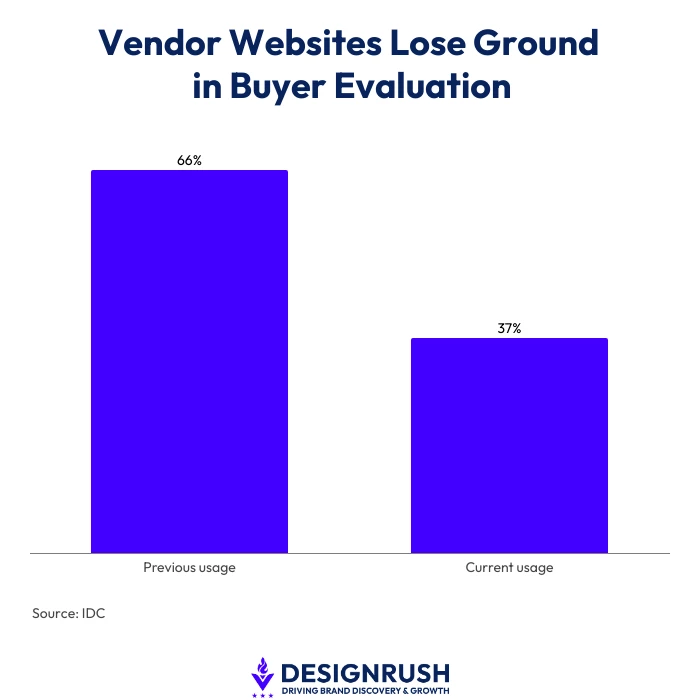
Vendor websites are playing a smaller role in that process, with usage as an evaluation source falling from 66% to 37%.
As a senior-led, award-winning design agency working with technical B2B and enterprise companies, ANML’s website projects often involve organizing complex product information for buying committees and finding clearer ways to explain technical offerings.
ANML Founder and Head of Creative, Doug Hughmanick, explains that many B2B tech buyers now arrive with part of the evaluation already done.
"By the time someone gets to the website, they may already have a shortlist and a pretty strong idea of the category," he says.
"They are coming in with specific questions and want to get to the part they still need to understand."
AI Research Starts Before the Vendor Site
AI is already part of the research process for many B2B tech buyers, with IDC finding that 70% use it always or often when looking into industry and technology trends.
That continues once vendors enter the picture, with 46% using tools such as ChatGPT and Gemini during evaluation, while 45% consult industry experts and analysts.
"AI tools are reading your site too," Hughmanick says. "When the product pages are clear and well structured, they’re what ChatGPT or Gemini ends up quoting back to the buyer."
Buyers also tend to treat vendor material as marketing, so many arrive to check one specific thing they found elsewhere, such as a feature, an integration or a product claim.
The website is therefore entering the process later, after other sources have already helped narrow the field.
Product Claims Face More Scrutiny
Senior leaders are adding more checkpoints to verify information before making a purchase, IDC found.
Legal review is part of that process, with enterprise legal buyers writing AI clauses into guidelines, which create formal triggers to challenge unsupported vendor claims.
But those claims may also be read by people with very different responsibilities.
"Someone checking the business case may only need the main point, while a technical buyer may want to see exactly how the product works," Hughmanick adds.
"The proof has to be there without making every visitor work through the same amount of detail."
B2B Sites Need Direct Paths to Answers
Hughmanick says teams should be able to answer three questions about the buyer's path through the site:
1. Can someone verify a claim without starting another search?
Supporting evidence should be close enough for a buyer to check while the question is still relevant.
2. Can a buyer keep going when more detail is needed?
Technical documentation and deeper product information should be available without forcing every visitor through it.
3. Does the next step match what is still unresolved?
Depending on what the buyer already knows, that could be documentation, a trial, a demo, or a conversation with sales.
"If someone has already narrowed the field, making them piece the comparison together again is friction you created yourself," Hughmanick says.
Build the Website Around the Questions B2B Tech Buyers Have
AI can help B2B tech buyers narrow their options, but it cannot replace the experience of seeing how a vendor's claims hold up against the details of a real business need.
That's where a company's website does the work that AI can't, especially when the decision involves multiple stakeholders and significant investment.
And the trick is to make the answers easy to find, the evidence easy to check, and the next step worth taking.