
Anthropic confirmed this past week that Claude now embeds an invisible watermark in the text it generates.
The technique it will use is a version of Google DeepMind's SynthID-Text approach.
The policy covers every Claude model launched from August 2 onward and applies worldwide across Claude's products, with no opt-out available.
Models released before this date sit inside an EU transition period, and Anthropic says it will add watermarking to them over the coming months.
The mark skips passages where only one word will do, so factual copy and code carry far less of it than open-ended prose.
The most important factor is that the watermark can remain attached when the generated text is copied and pasted elsewhere.
We’ve written an FAQ to answer some of the questions we've received about watermarking.
— Anthropic (@AnthropicAI) August 14, 2026
In summary:
• We’re implementing watermarking to comply with the EU AI Act. Other major model developers have signed the same Code of Practice and will also be implementing watermarking;…
Anthropic is also using the C2PA standard to add digitally signed provenance metadata to supported image files.
The rollout has already raised concerns among people who use Claude to edit content or produce code, as the mark can indicate AI involvement in professional work.
Anthropic explained that proofreading usually leaves too few of Claude's own word choices for the watermark to attach to.
Agencies and brands using it for client work now have to treat AI provenance as part of the content workflow.
A Regulatory Trigger With Global Reach
Article 50 of the EU AI Act applies starting August 2.
It requires providers of certain AI systems to add machine-readable marks so that AI-generated or manipulated content can be detected.
Non-compliance can bring fines of up to €15 million or 3% of a company's global annual turnover, whichever figure is higher.
Anthropic signed the EU's voluntary Code of Practice on Transparency of AI-Generated Content.
And the watermark rollout is part of its implementation of this commitment.
The rule originated in Europe, yet Anthropic extended the policy to users around the world, saying it has no durable way to scope the watermark by region.
Every Claude user and every Claude-generated output can therefore be affected, regardless of where the content is created or where the client operates.
Around 190 organizations signed the same Code of Practice by the end of July.
But most signed the deployer section, which covers labeling AI content instead of marking it.
According to Anthropic, other major model developers will also roll out their own watermarks.
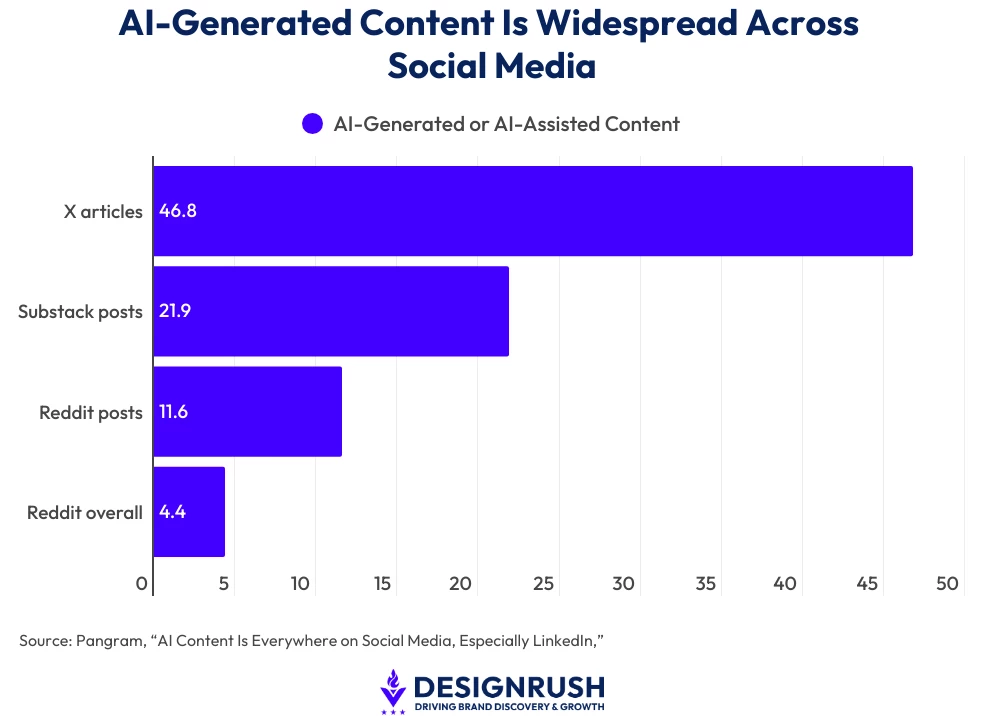
On Substack, for instance, 21.9% of posts in Pangram's dataset were AI-generated or AI-assisted.
It was the lowest combined rate of any long-form platform that Pangram measured, and two-thirds of everything it flagged came from LinkedIn.
Substack CEO Chris Best pinned the launch on a gap between what readers assume and what they get, which he calls "Claudefishing."
Substack handed AI detection to its readers without a regulator asking, and its subscriber-funded model gives it a reason other platforms don't have yet.
Implications to Client Work
Brands and agencies using Claude for client deliverables now have another factor to consider before content reaches the client.
Claude-drafted copy and heavily edited text may still carry a detectable mark.
Meanwhile, images generated through Claude arrive with signed metadata that a screenshot or format conversion can strip.
The mark indicates that Claude processed the content, which does not necessarily mean Claude produced the underlying work.
Anthropic shared that the watermark holds no identifying information and can't be traced to a person, organization, or chat.
Anthropic added that it plans to release technical detection tools, meaning Claude's involvement in a piece of content can become verifiable.
Article 50 puts a matching duty on the companies doing the publishing.
Agencies running AI-generated text on matters of public interest owe their own disclosure under the same rule.
Synthetic images and video have the same duty, and the same €15 million or 3% fine applies.
Verification and disclosure together change how agencies describe their creative processes.
Pitch decks, client contracts, and claims about "in-house creative" work can face new scrutiny when the underlying content has a verifiable AI signal.
Watermarking without quality loss is a bit unintuitive, doesn't feel like it should work.
— Thariq (@trq212) August 15, 2026
I made this artifact with Claude to help me understand how it works, sharing in case it's helpful. https://t.co/hEPeCHgGRMpic.twitter.com/ALReoOH6tB
The amount of editing needed to remove or weaken the watermark also remains unclear.
Teams can't yet tell clients whether a particular editing pass will remove the signal.
Claims that an AI trace can be fully removed should therefore remain unverified until Anthropic releases its detection tools.
Client contracts with AI-disclosure clauses, which are becoming more common, will now have technical verification behind them.
This offers protection for agencies that disclose AI use and exposure for agencies that stay quiet.
Here are three important areas agencies and brand marketers should start auditing in their workflows now:
- Add AI provenance to project records: Record which tools were used, by whom, and at which stage of production.
- Set an internal review point: Decide who checks AI involvement before content reaches a client or publisher.
- Define escalation rules: Give account teams a clear process for handling clients who ask about detected AI use.
These checks will give agencies a clearer process for handling AI use as detection becomes part of routine content production.
Our Take: Is This the End of Claude for Workflows?
To be honest, we don't think Claude is going away from agency workflows anytime soon because of this development.
The watermark only puts pressure on what agencies can promise clients about authorship.
Those who already disclose AI use lose nothing here.
A clear proof is that Business Insider confirmed only four cancellations, even as dozens of users announced theirs on X and Reddit.
Claude users are canceling their subscriptions, citing Anthropic’s new AI watermark
by u/EditorEdward in BetterOffline
Agencies may still use Claude heavily, but they could become more selective about which stages of production run through it.
For example, a copywriter might use Claude to brainstorm an outline and then write the final piece independently.
Or a developer might use it to troubleshoot code without sending the resulting output to a client.
An agency could also decide that certain confidential or highly regulated projects need a different workflow.
These options would make the watermark less of a death blow for Claude and more of a dividing line between different kinds of AI-assisted work.
Agencies choosing AI vendors will want partners who can answer disclosure questions before a client asks them first.
Explore these top AI companies in our directory.