
Your agency’s report shows your brand appearing in AI answers, but before you go and approve another month's worth of work, ask what those recommendations actually did for customer queries and sales.
In an Adobe October 2026 report, AI-referred traffic to U.S. retail websites was up 71% year-on-year in September 2026.
Adobe’s analysis covers over 1 trillion visits to U.S. retail sites, 100 million SKUs, and 18 product categories.
That growth gives retailers a good reason to look at AI as a channel for customer acquisition.
For an agency client making the decision to buy, they are going to need evidence that is specific to their own customers, their own services, and their own sales.
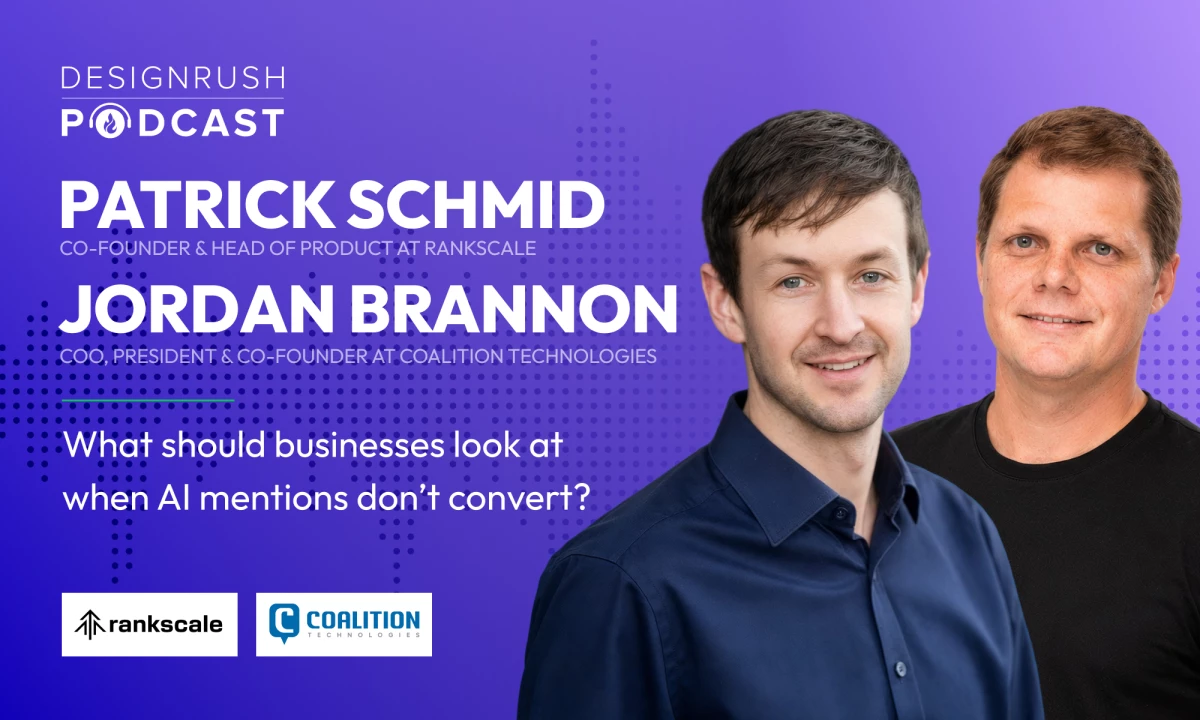
We spoke to Patrick Schmid, Co-Founder and Head of Product of Rankscale, and Jordan Brannon, Co-Founder and President of Coalition Technologies, on the DesignRush podcast about how businesses can evaluate an agency’s AI search claims.
"I would make sure your agency is really focused on the bottom line. Who really cares if you're ranking for a very obscure prompt response if you're not getting any leads or e-commerce sales out of it?" says Brannon.
Schmid’s own experiment gives yet another reason to look at those claims. After an agency list had picked up an AI citation, he simply changed the page to have himself appear before the list of agencies.
Key takeaways:
- Does the agency monitor questions that are relevant to your customers?
- Ask how it looks at the link between the recommendations, the queries and the sales.
- Make sure you understand the tactics behind the results it's reported to have achieved before you commit any budget.
Watch the full episode on YouTube or listen on Spotify.

Who are Patrick Schmid and Jordan Brannon?
Patrick Schmid is Co-Founder and Head of Product at Rankscale, an AI search visibility analytics platform. Jordan Brannon is Co-Founder and President of Coalition Technologies, a digital agency that provides SEO, advertising, and web services.
How Should Businesses Evaluate AI Search Reports?
Before a business can even begin to evaluate an AI recommendation, it needs to know which potential customer that recommendation would be for.
Brannon says it starts with the audience.
“That's a question we have to wrestle with on a per-client basis. Different LLMs seem to be popular with different models and different industries and verticals. So we really would try and figure out which one best matches their audience.”
For a company investing in generative engine optimization, the questions an agency tracks determine what its report can say.
A reference to a service the company does not actually provide is of very little value to the buyer.
The agency should be able to explain how the questions it selects are, in fact, relevant to the products, locations, and purchasing decisions that concern the account.
Then there is the issue of consistency. An answer that you have captured for a presentation may be different when you ask the same question again.
Schmid cautions:
"Let's say if you ask it just once, that's just a snapshot. It doesn’t tell you anything, but the more runs you have or the more answers you gather with the same prompt, you can imagine that the spread of answers decreases over time."
Ask for the prompt set, the platforms covered, and how frequently the testing is carried out. That information is the basis on which you can judge whether the presence being reported is in fact recurring.
Even at that stage, the report has only established that the business was in fact there. The customer’s next move will require another investigation.
How The Customer’s Route Can Complicate Attribution
A person who finds the company from an AI answer will presumably come to the company's site via Google at some point.
Schmid says, "Like someone (who) types something in ChatGPT, they do the research, do not click, but then search for the brand on Google, and you have it as brand traffic in your analytics or direct traffic in analytics."
The actual visit can show up in the analytics without the earlier AI interaction being credited.
If you're an agency looking at the ROI of your digital marketing, then you need to be able to explain what you can trace and where the evidence breaks down.
Platform reporting provides some extra information.
Microsoft introduced AI Performance in Bing Webmaster Tools in February 2026 to report citations across the various AI experiences that are supported.
The announcement makes it very clear that the citation counts do not in any way indicate the position of a citation within an individual answer.
Those records can be of some assistance in looking at visibility. The queries and purchases will still need to go through their own assessment.
Brannon recommends examining customer activity.
"I would start by looking at what you're actually seeing in terms of customer acquisition and order acquisition.
"Are you getting subscriptions? Are you getting inquiries? Are you getting phone calls? Are you getting placed on your website?"
At Rankscale, Schmid also asks customers how they discovered the company:
"We give a free text field, and we get so many answers we haven't thought about."
Customer responses can provide context to the analytics and sales records. Ask the agency to separate out the recorded results from their own interpretation of them.
Every Recommendation Has a Method Behind It
Tracing the customer activity leaves one other question: what did the agency do to get the recommendation?
Schmid’s agency list experiment is all about that.
He points to publishing a list, getting a citation, then moving his own listing. His experience illustrates why the buyer should look at the source of an AI endorsement.
He also cautions against depending on manipulation.
"But of course, all those manipulations are short-term, and you say they work until they don't anymore."
For a business making a decision on a proposal, the approach is part of that decision.
You need to know which pages the agency intends to change, what external sources it's going to go to, and why it thinks that work will enable the customer to find the business.
Brannon says the reasoning deserves scrutiny: "And I think talking to an agency about those strategies, making sure you understand why they think they should do this thing is really important."
Any businesses looking at generative engine optimization agencies on the DesignRush Marketplace can pose those questions to the proposed account team.
You can request a sample report and an explanation of the work that went into the report prior to committing to the agency.
What happened after Schmid moved himself ahead of the agency list?
Watch the full conversation on YouTube or listen on Spotify for the result and both guests’ advice on evaluating AI search claims.