
Google's AI Overviews cut organic clicks by 39.8% on queries where they appear.
That comes from a randomized field experiment by researchers at the Indian School of Business and Carnegie Mellon University.
This means the traffic that does reach a website matters more than ever. Whether that traffic arrives at all now depends on structure, not just content.
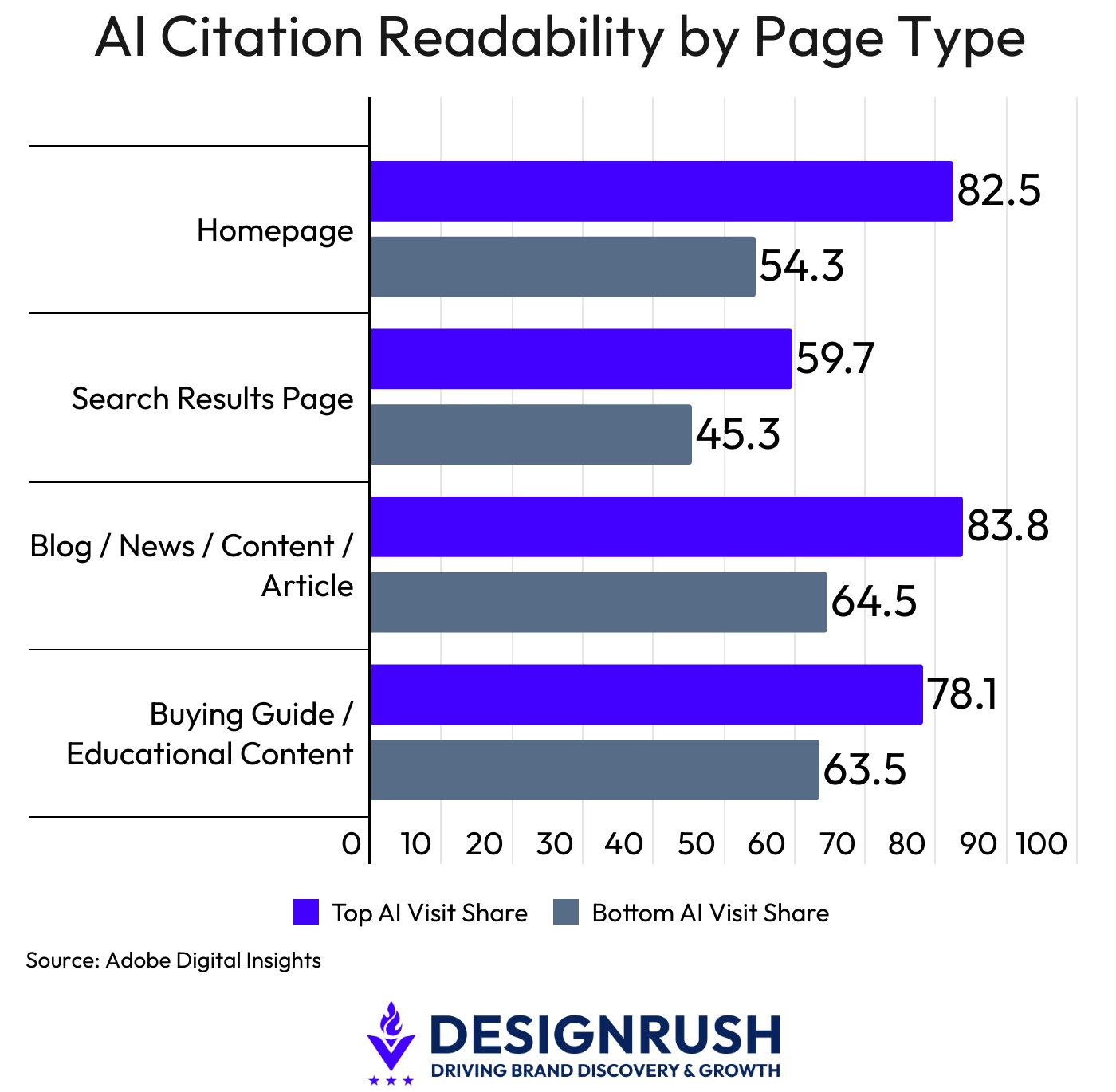
Adobe measures how easily AI systems can parse and cite a homepage, scoring it out of 100 based on how clearly a page states its brand context and structures its content.
The best-performing companies hit 82.5 AI visit share, while the worst closer to 54, according to Adobe Digital Insights.
The same split shows up on blog pages and buying guides.
And closing that gap is exactly the work DD.NYC ® does for enterprise clients like Workday, work that used to depend on just one reader understanding it clearly.
Anjelika Lours' Kour, the agency's Creative Director and Managing Partner, now designs for a second reader too.
In this DesignRush interview, she explains what changes structurally when AI reads a site first, and what still separates a site built for people from one built only to be cited.

Who Is Anjelika Lours' Kour?
Anjelika Lours' Kour built her reputation on a simple standard. Nothing ships until it works both commercially and creatively. That standard carried her from Ecuador to Hong Kong to Manhattan over a two-decade career at the intersection of design, strategy, and business.
She now runs DD.NYC ® as Creative Director and Managing Partner, leading work for clients including Scholastic, Workday, and the FIFA World Cup 2026 NYNJ. Her work has earned recognition from the Webby Awards, the Anthem Awards, and Pentawards.
Robots Were Reading Websites Long Before AI
The idea of building for a machine reader is not new to Kour's team. Search engines have graded websites on structure and clarity for over two decades.
It only changed which machine is doing the reading.
"We're thinking a lot about how websites are perceived by AI systems and language processing models," she says.
"Honestly, we've always thought about robots reading our pages long before AI was even a subject matter, language processing existed before AI started exploring the internet."
From the early days of the agency's work, Kour says they considered how Google's SEO robots read their sites. That discipline extends now to a different kind of reader.
"It's still ultimately robots getting information, just in different ways, and we're thinking about how to make that work for both robots and the humans reading the site," Kour adds.
The shift is less about a new audience appearing than about the same discipline extending to a system that synthesizes an answer instead of just indexing a page.
Trust Signals Replace the Old Keyword Approach
Getting picked up correctly by AI search means changing what a page is built around, not just what it contains.
But what does a website need structurally to get picked up correctly by AI search or chat tools?
"This is an ever-changing answer, but some things that have worked well are around trust, so question and answer format versus the old keyword search approach from SEO," Kour says.
"More FAQ integration, and we always build in strong structure so SEO tools can break down the site properly."
That structure works precisely because AI systems read the same thing a person does, not a hidden layer underneath it.
None of the major AI systems parse structured schema data during live retrieval. That includes ChatGPT, Claude, and Gemini, according to a controlled study Ahrefs ran across 1,885 pages.
They read the same visible text a person would see on the page.
The FAQ format earns its place for a simple reason. It mirrors how people actually phrase questions to an AI system.
The Human Still Gets the Deep Dive
Fewer clicks does not mean the click stops mattering. A person who sees an AI summary and wants more than a paraphrase still lands on the actual site.
And that visit now carries more weight than a routine click ever did.
"For now, it's still going to be relevant to speak to the humans who are looking at the site, and to build something immersive and story-driven for them," Kour says.
Websites that speak only to LLMs will start to look thin next to the ones still built for a person first.
"AI tools are great, but the actual user will still deep dive into where the AI got its information, so that environment needs to be top-notch, and the smarter ones will choose to invest there," she adds.
That visit is where a generic, AI-summarized answer either gets confirmed or falls apart.
A site built with that visit in mind, not just for a citation, is exactly what earned DD.NYC ® a Webby nomination for its FIFA World Cup 2026 site.
Consistency Is What AI Learns to Trust
Brand voice does not disappear when part of the audience is an algorithm. It just gets tested differently.
"Continue being consistent in your messaging across every channel, so you build social proof, and AI will also see that you're always being referenced in the same way," Kour says.
In other words, that repetition builds social proof a language model can recognize.
The model is, after all, pattern-matching a brand's own claims against how consistently the rest of the internet describes it.
The clearest version of this shows up when a brand that says one thing on its homepage and something else on a landing page gives an AI system conflicting signals.
A human reader piecing together who a company is would get just as confused.
The Tell That Gives an AI-Built Site Away
Asked what mistake she sees most often, Kour goes straight to a specific failure mode: businesses assuming an AI-generated site can substitute for one built by people.
"People think AI-built websites are on par with fully designed and developed sites built by humans," she says.
"It's obvious when a site is built by Claude or another AI tool, there's a finesse missing and things that could clearly be improved on."
The tell is not structural. Search engines and AI crawlers can parse an AI-built site well enough.
It is the human-facing layer, the details a person notices without being able to name them, that shows the gap.
That layer is the reason Kour treats AI tools as a starting draft rather than a finished product.
A team still has to take that draft through design decisions an algorithm cannot make on its own, the ones that decide whether a visitor trusts what they are looking at.