
For years, marketers described the website funnel as a predictable sequence.
A visitor entered through the homepage, explored a service or product page, reviewed supporting information, and eventually completed a form.
Real journeys were never quite this orderly, but the model gave marketing teams a useful way to organize content and conversion paths.
In 2026, even that simplified model is becoming harder to maintain.
Gartner predicts that by 2028, 90% of B2B buying will be intermediated by AI agents.
Adding to this, they also expect products to become machine-readable as AI systems take a larger role in searching, comparing, and evaluating vendors.
At the same time, Deloitte Digital reports that 60% of consumers say social content, recommendations, or communities influence how they discover new brands, with search increasingly used for validation.
But these findings do not mean that the traditional funnel has completely disappeared.
Instead, it means that businesses can see and control less of what happens before someone reaches their website.
These days, a visitor may first encounter a company through an AI-generated answer, a LinkedIn post, an industry community, a comparison, or a recommendation.
And when that visitor eventually reaches the website, the entry point might be a case study, integration page, article, pricing page, or technical resource rather than the homepage.
From my perspective as a WordPress developer and architect, this changes the central lead-generation question.
The goal is no longer simply to move every visitor through one predefined sequence. The website must now recognize and support intent wherever it appears.
That raises five questions for every business running lead generation through WordPress.
1. If You Do Not Control the First Touch, What Should the Website Control?
Businesses may have less control over where the journey starts, but they still control what happens when someone reaches their platform.
The website should therefore control clarity, continuity, and provide the next useful action.
In our work at IT Monks, we treat important pages as individual decision environments, and not merely as steps that make sense only after someone has visited the homepage.
A visitor landing directly on a service page should not need to reconstruct the company's entire story before understanding:
- Who the service is for
- What problem it addresses
- What the company actually delivers
- Why its claims should be trusted
- What limitations or requirements apply
- What the visitor can do next
This does not mean repeating the entire homepage on every URL, but giving each important page enough local context to work independently while connecting it to the larger website.
WordPress architecture matters here. If every page is assembled manually with unrelated layouts, CTAs, proof elements, and navigation patterns, maintaining that consistency becomes almost impossible.
Here, a structured component system can provide reusable service summaries, trust signals, case-study references, process explanations, and next-step modules.
Marketing teams can then adapt them to the purpose of each page without recreating the entire conversion structure every time.
Essentially, the funnel hasn’t disappeared, but has now become distributed across more entry points.
2. What Should a CTA Do When the Visitor Already Knows What They Want?
A CTA is often treated as a copywriting detail, where teams debate whether a button should say "Contact us," "Get started," or "Book a call."
The more important question, however, is what operational process begins after the click.
I think of a CTA as a contract between the page and the business. It tells the visitor:
- What will happen next
- What information they must provide
- How much commitment is required
- Who will respond
- How quickly they should expect a response
- Whether the next step fits their current level of intent
A visitor who has already compared vendors through an AI assistant may not need another general company presentation.
They may want to confirm an integration, understand project feasibility, obtain a realistic estimate, or speak with someone who can answer a technical question.
Sending all these visitors to the same generic contact form creates unnecessary friction and also removes context that the sales team could have used to respond effectively.
WordPress should support a governed CTA system rather than a collection of unrelated buttons added manually across the website.
Each CTA should offer a next step that matches the intent of its page. A visitor exploring website migration, for example, should reach a migration-specific form or assessment rather than the same generic contact form used across the entire site.
WordPress can pass context such as the source page, service, and request type into that form and then into the CRM. This helps the business send the request to the appropriate team and measure which CTAs produce qualified conversations and revenue.
The CTA is the visible starting point, whereas the form, CRM routing, and follow-up are the conversion workflow that begins after it is clicked.
3. Where Does Lead Qualification Begin Before a Form Is Submitted?
Many teams treat qualification as something that begins after a visitor submits contact information.
But by then, the website has already had multiple opportunities to help both sides determine whether there is a fit.
Qualification should work in both directions, where the business needs to understand the visitor's requirements and intent, while the visitor also needs enough information to decide whether the company is suitable for the project.
A serious prospect does not always complete a long form. At the same time, someone who fills out every field is not automatically a suitable lead.
Earlier qualification can come from a combination of explicit choices and meaningful behavior, including:
- The services or solutions explored
- Project size or complexity selected in a calculator
- Integrations or technical requirements reviewed
- Relevant industries or case studies visited
- Pricing ranges or engagement models examined
- Geographic, regulatory, or timeline requirements
- Return visits to high-intent pages
- The next action selected by the visitor
This should not become invasive surveillance or an arbitrary lead-scoring system, but be based on clearly defined signals that relate to actual sales fit.
WordPress can support this through structured content taxonomy, consistent analytics events, progressive forms, CRM field mapping, and guided selection tools.
Instead of asking every visitor twenty questions immediately, the platform can collect relevant context as the visitor moves closer to a decision.
One of the most valuable functions of a good website is also helping unsuitable prospects disqualify themselves.
Clear scope, realistic timelines, service requirements, pricing expectations, and technical limitations may reduce the raw number of leads while increasing their quality.
For business owners, that is usually a better outcome than maximizing form submissions that sales will never convert.
4. If Every Important Page Can Be an Entry Point, What Must a Good Page Contain?
A good page can no longer depend entirely on what the visitor supposedly read before reaching it.
I describe this as local completeness, where every strategically important page should function as a portable decision unit.
To achieve this, it needs five things:
- Orientation: Who is this page for, and what situation does it address?
- A clear answer: What does the business offer or recommend?
- Evidence: What results, expertise, examples, or data support the claim?
- Boundaries: What is included, excluded, required, or dependent on context?
- A relevant action: What should the visitor do if the page has answered their question?
This structure is useful for people, but it is becoming equally important for machines.
Deloitte Digital's research on AI-driven discovery backs this up, and explains that generative AI is changing how organizations are discovered, evaluated, and compared.
It recommends clear content structure, metadata, taxonomy, and signals of expertise so AI systems can interpret information accurately.
Likewise, Gartner says that products will need to become machine-readable for AI-mediated procurement.
For WordPress teams, machine readability is not solved by installing one schema plugin. The content itself needs a coherent model.
A case study, for example, should store the client situation, industry, problem, solution, technologies, constraints, and results as meaningful information rather than burying everything inside one unstructured text field.
A service page should clearly identify the audience, use case, delivery model, evidence, and next step.
Structured fields, semantic headings, logical internal links, accessible page components, author information, and clear update ownership help search engines and AI systems understand the page.
They also make content easier for marketing teams to reuse and maintain.
The page should remain visually compelling, but design must communicate the underlying information rather than hide it.
5. If Traffic Does Not Tell the Full Story, Which Signals Actually Matter?
A growing share of discovery and evaluation can now happen outside the website.
AI systems may summarize a company without producing a referral visit, while social content or communities may influence a buyer even when the eventual session appears as direct traffic.
Deloitte Digital describes people moving among AI tools, social platforms, retail environments, and content ecosystems, sometimes during the same session.
It also notes that traffic patterns are becoming harder to predict as discovery, evaluation, and action move closer together.
But this does not make measurement impossible. It makes pageviews and session counts insufficient on their own.
Deloitte's Marketing Trends report recommends paying greater attention to micro-conversions.
For a WordPress lead-generation platform, these might include:
- Moving from an informational page to a relevant service page
- Reviewing a case study connected to the service being considered
- Using a calculator, comparison, or configuration tool
- Selecting a specific CTA rather than a general contact option
- Starting and completing a qualified form
- Returning to high-intent pages
- Booking and attending a consultation
- Becoming a sales-accepted lead
- Progressing from a lead into an opportunity and customer
The most important shift is connecting website activity to CRM and sales outcomes.
Without that connection, a marketing team may know which page receives the most traffic but not which page contributes to qualified opportunities. It may optimize for form completion while sales quietly rejects most of the submissions.
A useful measurement system does not need to reconstruct every individual journey perfectly. It needs a consistent event model, agreed definitions, CRM feedback, and enough context to identify where serious prospects progress or hesitate.
Self-reported attribution can also help, where a simple question such as "How did you first hear about us?" may reveal influences that standard analytics cannot observe.
The objective is not perfect attribution, but better commercial judgment.
WordPress Must Become a Connected Lead-Generation System
Deloitte’s Tech Trends 2026 report found that 38% of organizations were piloting AI agents, but only 11% had them in production.
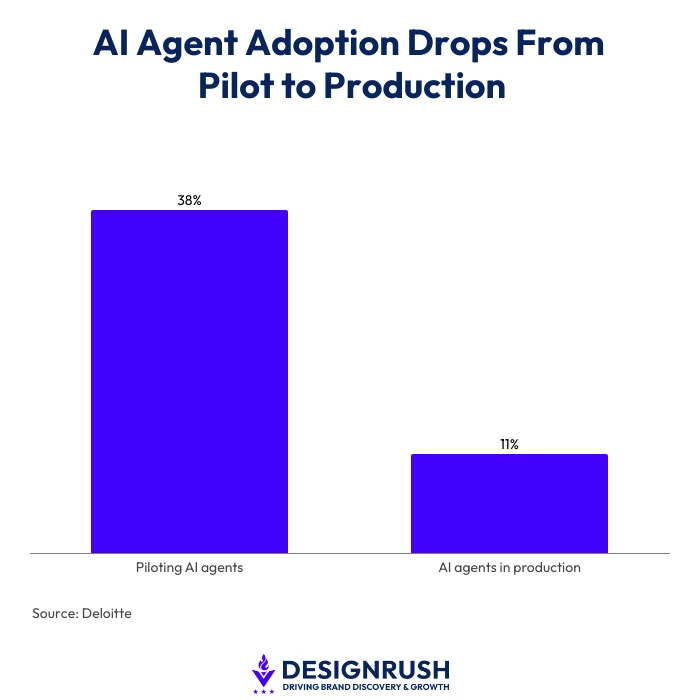
It also identifies a central reason for the gap, where organizations frequently automate broken processes instead of redesigning them.
Likewise, the same warning applies to lead generation.
Adding an AI chatbot to a fragmented website will not create a coherent customer journey. Automating a generic form will not improve qualification. And personalizing several disconnected pages will not fix inconsistent content, weak routing, or missing CRM feedback.
Before adding more tools, business owners should examine the system underneath them:
- Is the content structured consistently?
- Can important pages work as independent entry points?
- Are CTAs connected to defined business processes?
- Does qualification begin before the final form?
- Are website events connected to CRM outcomes?
- Can marketing teams change pages without breaking tracking or routing?
- Is there clear ownership of content, conversion logic, and integrations?
These are architecture questions as much as marketing questions.
The website funnel is not dead. What is disappearing is the assumption that every prospect will enter at the beginning, follow the same sequence, and reveal every step along the way.
In 2026, the strongest WordPress platforms will not attempt to force every visitor into one rigid path. They will provide clear information, relevant proof, and an appropriate next step wherever intent appears.
That is the real shift in lead generation, where designing one funnel can help build a system capable of supporting many journeys.