
You usually don't find out your regional website setup is fragile until you try to change something small.
- A pricing update needs to go live in six markets on the same day, and somehow it doesn't.
- A campaign does well in one country, so marketing wants to reuse the landing page somewhere else, except it was hand-built years ago by a different agency using a different CMS, and nobody quite remembers why.
- Why does the German site show different course availability than the Japanese site for the same class? There isn't a clean answer, because the booking data lives in three different places and those places don't talk to each other.
That was close to where EC English, which runs language schools and study-abroad programs in several countries, stood before we got involved.
Naturally, they ended up with several regional sites, each with its own content, habits, and relationships. Some sites connected to the ERP tracking course inventory or the CRM tracking leads, while others had no link at all.
Our team at IT Monks rebuilt the whole thing as a single WordPress Multisite platform spanning eight languages, with a booking flow wired directly into both of those systems.
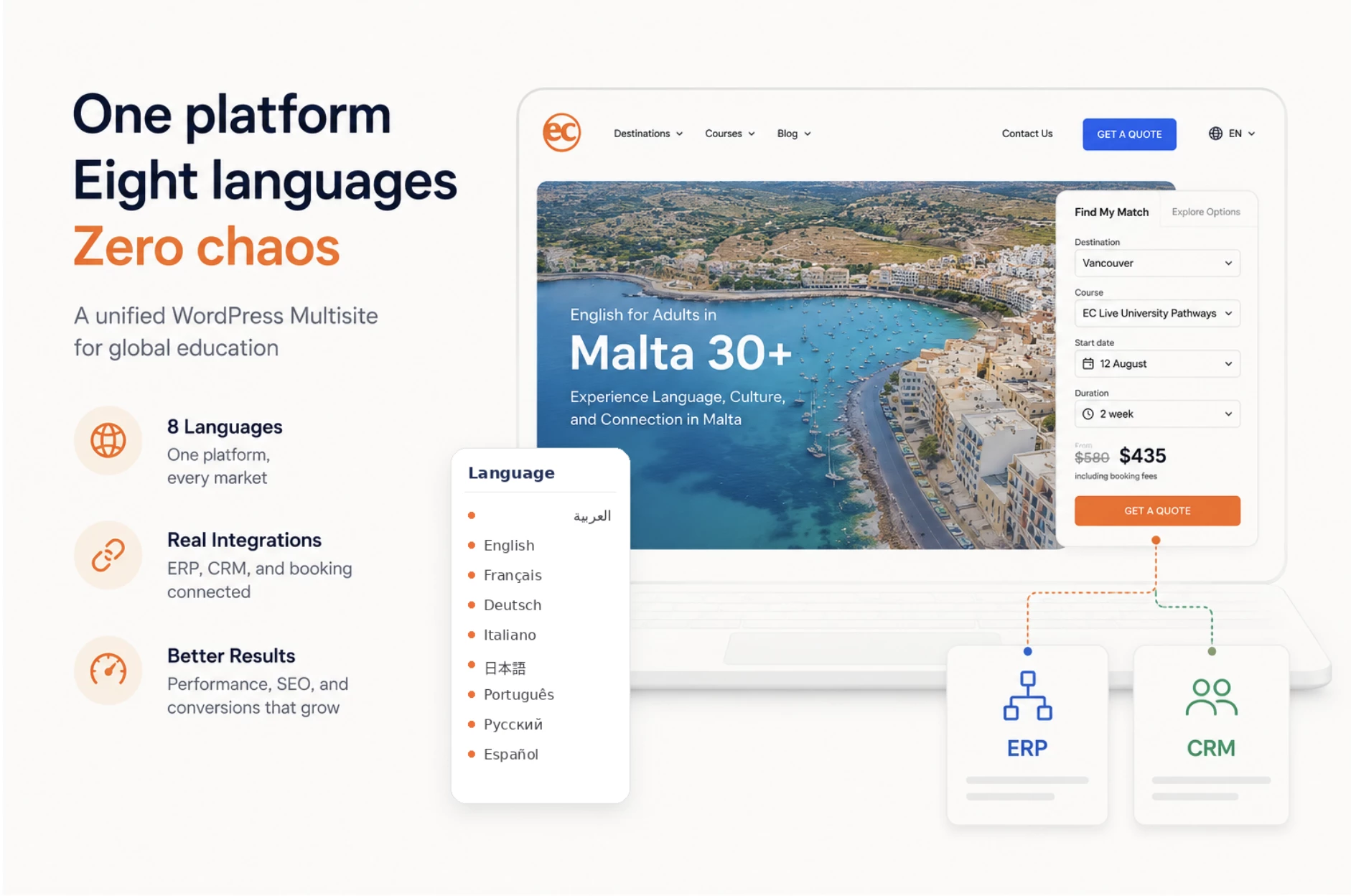
After that project, I believe that a few lessons are worth sharing with anyone weighing whether to consolidate regional sites without breaking what made them functional in the first place.
What Breaks When Regional Sites Run Without a Unified Platform
The problem with independently managed regional sites is not necessarily that any individual site is bad. It is that every market gradually develops its own version of how the website works.
- Content operations drift apart. A campaign or page update that takes an hour in one market may require a completely different process in another. Teams stop working from the same templates and publishing logic.
- Design and performance become inconsistent. The most recently redesigned site usually performs best, while older regional versions slowly fall behind.
- Booking information becomes harder to keep consistent. Pricing, course information, availability, and user requests can pass through different systems or manual steps, creating more opportunities for mismatches.
- Local autonomy turns into technical fragmentation. Giving regional teams control is useful. Giving every region its own technical stack is much harder to maintain.
The goal of consolidation should not be to make every market behave the same way. It should remove technical differences that provide no business value while keeping the local differences that do.
Multisite Works When You Separate Platform Control From Content Control
One mistake companies make during consolidation is assuming that “one platform” also means “one central team controls everything.”
It does not have to.
In the EC English setup, each regional or language-specific site could operate within WordPress Multisite while sharing the same underlying infrastructure and core components.
Local marketing teams could manage content and campaigns without waiting for developers every time they needed to publish or change a page.
That creates two different layers of ownership.
The central layer controls what should remain consistent: core components, integrations, templates, technical standards, and platform maintenance.
Regional teams control what genuinely needs local knowledge: copy, campaigns, offers, and market-specific content.
That is a much more useful definition of consolidation than simply putting everything into one CMS. You centralize the infrastructure, not every decision.
Building for Right-to-Left and Left-to-Right at the Same Time
Supporting eight languages also changes how you have to think about the interface.
Right-to-left support is easy to underestimate because it sounds like a translation requirement. Technically, it goes far beyond translated copy.
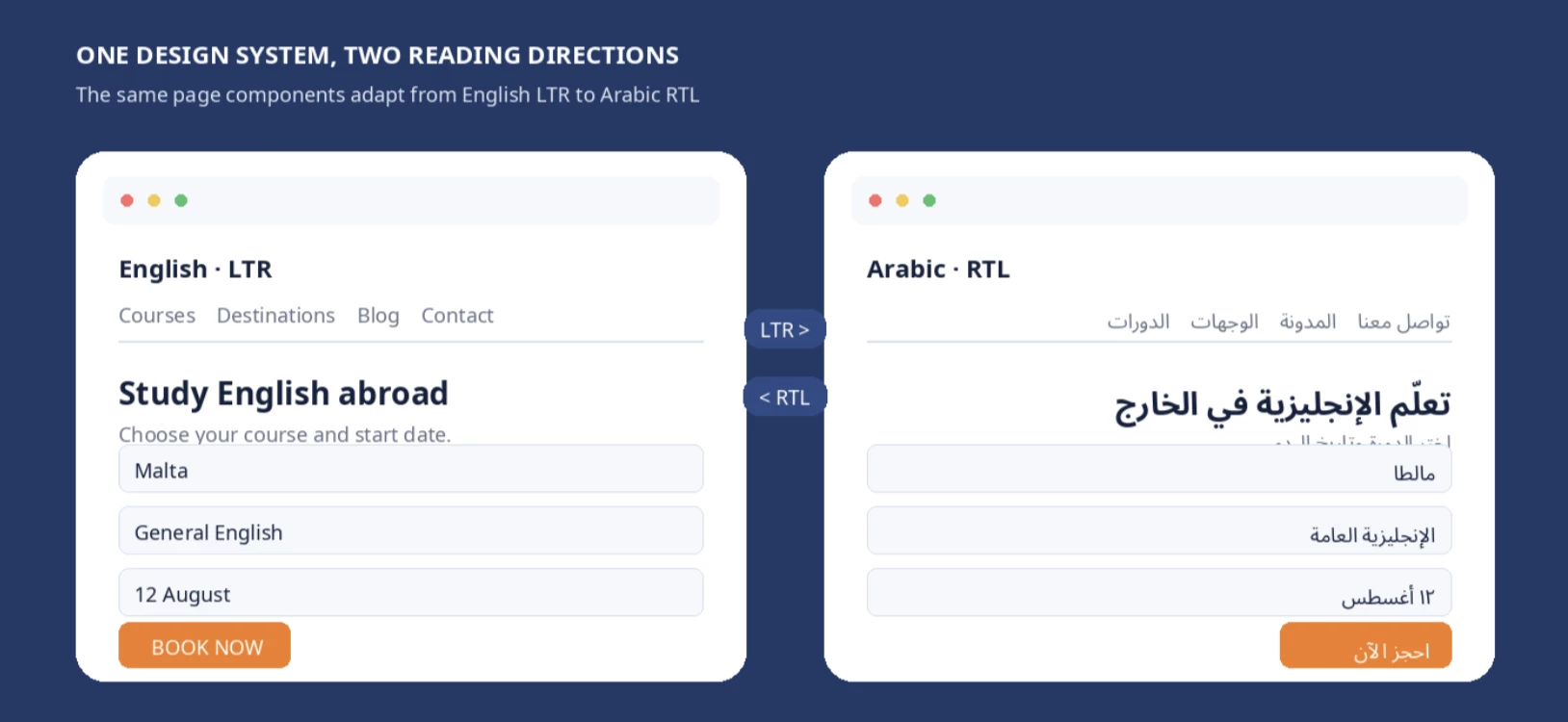
Navigation direction, text alignment, form layouts, breadcrumbs, pagination, directional icons, and component positioning may all behave differently in an RTL language such as Arabic.
If you handle those rules separately after the left-to-right version is finished, you effectively start maintaining two variations of the same interface.
The better approach is to make direction part of the component logic from the beginning. The same navigation, booking components, and page templates should respond correctly to either LTR or RTL content.
For us, that was the key architectural point: build a new component once, not rebuild it for each reading direction.
A Booking Form Is Not the Same as a Connected Booking Flow
This is where the backend matters more than what the visitor sees.
A conventional booking form can collect someone’s details and send them to a sales team.
The website has technically done its job, but the employee receiving that request may still have to check pricing, confirm course information, enter lead data into another system, and continue the process manually.
A connected booking flow removes those handoffs.
For EC English, the booking experience was connected to internal ERP and CRM systems so that the website could work from the same operational data instead of acting as a separate layer.
Course information, pricing, booking data, and lead information could move through the process without someone manually reconciling the website with another source.
From the user’s side, it still feels like one booking journey.
However, the difference is much bigger. The website is no longer just collecting a request for somebody else to process. It becomes part of the workflow used to manage the booking internally.
The CRM connection also improves what happens after the booking.
When lead and booking information enters the CRM directly from that journey, marketing attribution is easier to trust because the source of the lead does not have to be reconstructed later from disconnected forms and manual records.
More Backend Logic Cannot Mean a Slower Website
The more a website depends on APIs, dynamic pricing, booking logic, and payment integrations, the easier it is to slow the front end.
That doesn't mean you have to sacrifice performance. It means considering performance while designing the architecture, not testing it at the very end.
Not every piece of dynamic data needs to block the initial page load. SEO-critical content still needs a clean technical structure.
And mobile performance cannot be treated as a reduced version of the desktop experience.
The EC English project had to solve both problems at once: support a feature-rich booking platform while keeping page speed, mobile usability, and technical SEO strong enough to work across multiple markets.
The Takeaway
The lesson I took from this project is that consolidating regional websites is not primarily a CMS decision.
It is an ownership and systems decision.
You have to decide what should be shared, what should remain local, which system owns which data, and how information moves from a visitor’s action on the website into the systems the business actually uses.
Get those boundaries right and eight language versions can behave like one platform without forcing eight markets to work like one team.
Get them wrong, and you have not really removed the fragmentation. You have just hidden it behind a new interface.