
With an aging system, executive teams are bound to face the same problem.
Their software still runs; it processes orders, holds customer records, and manages workflows without crashing. So, technically, it does the job.
But outdated systems come with real drawbacks, such as:
- Slower feature releases (sometimes doubling the time to ship)
- Complex security issues
- Higher costs to maintain aging or obsolete systems
Experiencing these sorts of issues regularly can get expensive. Technical debt now accounts for around 40%of the average IT department's spending, according to the Software Improvement Group.
Because these systems deteriorate over time, the costs often get absorbed into routine sprint planning and annual budgets. These “hidden” costs make it easy for the amount spent (or wasted) to balloon undetected.
What Decision Makers Need to Realize About Modernization
Leaders need to be aware of the problems that arise with aging systems.
Otherwise, they risk falling into this classic trap:
Spending too much time (and money) protecting the past rather than prioritizing future builds.
As VP of Marketing at Disruptive Advertising, my experience working alongside engineering teams on growth-focused modernization projects has taught me how to help them:
- Refactor codebases built on a strong base
- Rebuild architectures that are broken or obsolete
- Figure out if custom code needs replacing
- Lower risk on high-dependency legacy systems
There are also four key metrics to help tech leaders identify the right modernization strategy. Keep reading to learn how these may apply to your setup.
Refactor Codebases with a Solid Foundation
When a system's core architecture is solid and just cluttered with years of messy code, refactoring is the fix.
Why? Refactoring is surgical, targeted work to clean up technical debt while keeping the existing foundation completely intact.
The benefit is, users don’t notice, since nothing about how the software looks or behaves actually changes.
For example, in most of our modernization projects, the refactoring process only requires touching about 10 to 20% of the codebase. So, teams don't have to freeze features or make customers wait.
This holds at every scale of business.
Software engineer Valentin Minko points out that even Facebook chose this route during their hyper-growth phase.
Its team built custom tools, Hack and the HipHop Virtual Machine (HHVM), to optimize the setup from the inside. As a result, the platform kept running for billions of users and there was no downtime.
On a more everyday retail scale, Capital Numbers, a software development company, documented a U.S. restaurant chain with over 200 locations. Its site had a 12-second load time, and staff synced data between systems by hand, daily.
Rather than migrating to a new platform, developers refactored the existing codebase and automated the data pipelines:
- Load times dropped to under five seconds
- The manual sync disappeared
- No customer experienced a broken checkout page
That's the appeal of refactoring: real improvement, without anyone outside the engineering team ever knowing something changed.
Rebuild Crumbling and Obsolete Architectures
Sometimes the codebase needs a total overhaul.
This involves throwing out the legacy system altogether, often by starting fresh, usually on a flexible, cloud-native architecture.
While at times difficult to accept, leaders generally commit to this path once hard truths are revealed about the existing setup.
Three things typically show this is the right move:
- Outdated tech stack. It runs on unsupported platforms or languages nobody uses anymore.
- Security patches. Vendors have stopped releasing them, leaving known vulnerabilities exposed.
- Missing expertise. The engineers who understood this system have retired or moved on.
As a rule of thumb, this is required once technical debt, or the accumulated cost of shortcuts and workarounds built into old code, has corrupted more than 80% of a codebase, according to BayOne's research on legacy modernization.
At that point, the old code actually costs more to refactor, in developer hours, than it would to rewrite from scratch.
In addition to the three signs above, scale is another trigger when teams hit this same wall when a legacy system can't keep up with business demands.
A bank mainframe built for batch processing is the classic example. It can't support real-time payments, because its architecture was built for a different era of commerce.
Know When Custom Code Is Expensive Nostalgia and Needs Replacement
Custom code only earns its keep if it helps a team win deals, protect a proprietary algorithm, or deliver something customers can't get anywhere else.
In my experience, marketing teams are often the first to feel the drag when custom systems fall behind. Campaigns stall out waiting on engineering time that's tied up elsewhere.
Standard utility workflows are a different story. Basic payroll, general ledger accounting, internal ticketing. None of this sets a business apart.
Holding onto custom code built for tasks like these is expensive nostalgia, plain and simple.
If a modern SaaS platform can handle 80% of a team's operational workflows right out of the box, it's probably time to pull the plug on the custom build. Every line of custom code retired is one less line someone has to maintain.
Minimize Risk on High-Dependency Legacy Systems
In some legacy systems, the codebase is too poorly documented or too tightly wired in to touch directly.
And so, one change to a legacy database can set off a chain reaction across every connected system.
In this case, the smartest move is isolation.
Teams wrap an API layer around the legacy system and treat it like a black box. That way, developers can build modern, cloud-native services around it without ever touching the core.
The numbers back this up. 93% of financial institutions now run hybrid or multi-cloud setups, according to the Cloud Native Computing Foundation (CNCF).
That's how big institutions deliver digital experiences to consumers without risking the stability of their core transactional engines.
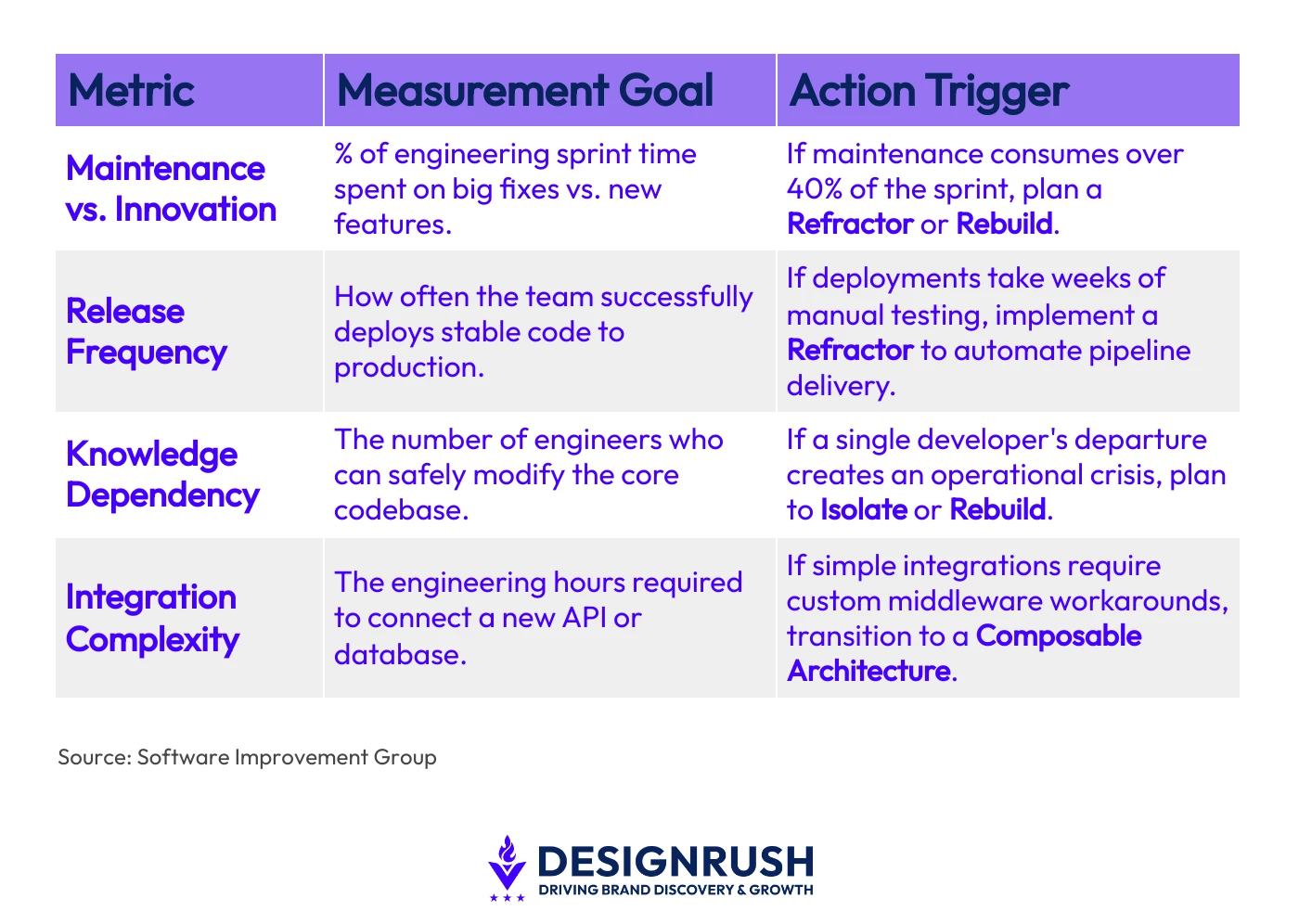
4 Metrics to Guide System Fixes
What should leaders actually look at before making the call?
Rely on the four metrics outlined below.
Modernization Metrics Explainer
- Maintenance vs. Innovation: signals whether the team is building
- Release Frequency: shows whether shipping code has become a slow, manual grind
- Knowledge Dependency: flags how much risk sits with just one or two people
- Integration Complexity: reveals how much friction the current setup adds to everyday engineering work
From Metric to Decision
This simple system allows organizations to assess where each metric currently stands and check it against the trigger, or the specific number that signals it's time to act.
Once a number crosses that line, it indicates whether to refactor, rebuild, isolate, or bring in a composable layer.
What matters most is a system that lets teams ship value without dragging technical debt behind them.
Final Thoughts: Fixing Legacy Tech Debt
None of these paths are wrong. They just answer different questions.
So the real risk isn't picking refactor over rebuild, or rebuild over isolate.
It's not picking anything at all, and letting the decision get made by default while the costs keep climbing.
In my experience, budget size rarely decides this. What matters is naming the problem honestly before choosing a fix.
That's the whole point of the four metrics above: less guessing, more deciding.
All that’s left to do? Pick a path. Then, go build what's next.