
Legacy Systems and Modernization: Key Findings
- Legacy systems are slowing performance and limiting innovation, making it harder for companies to adapt and scale, as outdated infrastructure struggles to support real-time demands and modern business needs
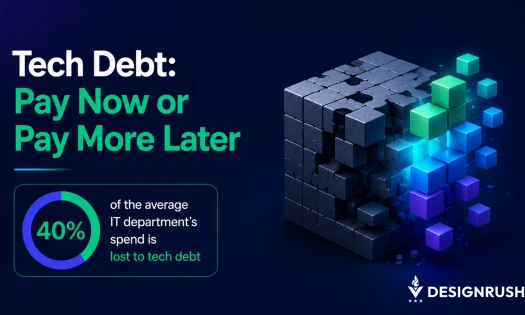
- Technical debt is consuming IT budgets and leaves little room for innovation, as most resources are tied up maintaining legacy systems instead of building better user experiences
- Companies are turning to external partners to modernize legacy systems, helping reduce long-term costs, improve agility, and free up internal resources for innovation
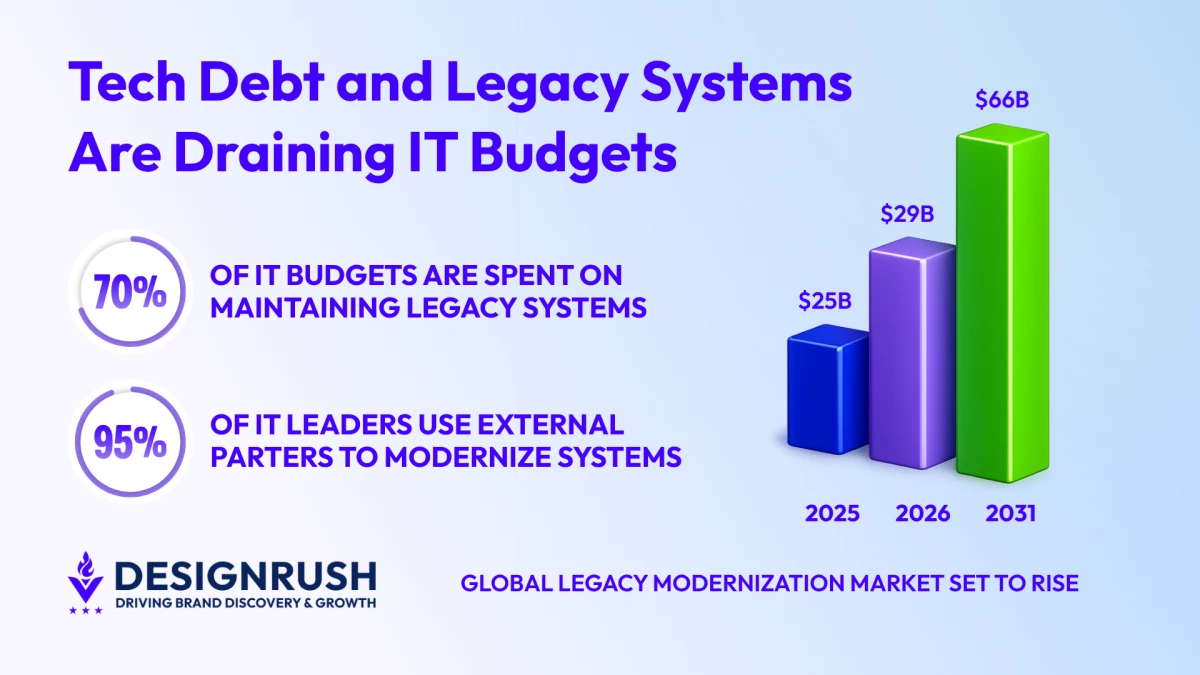
Up to 70% of IT budgets in banking are now spent maintaining legacy systems and managing technical debt, according to Accenture’s Banking Trends 2026 report.
For many leaders, a figure like this is hard to ignore. It leaves little room for innovation and turns IT budgets into a holding pattern where keeping systems running takes priority over building what comes next.
Chris Gieger is co-founder of UX Team, a leading evidence-based UX and UI design agency, and believes this is where many enterprise teams begin to feel the strain.
“Legacy systems don’t just sit in the background. They directly impact the user experience by dictating restrictive workflows and features, which limit how efficiently teams get work done,” Gieger says.
While banking may be where the impact is most visible, the same pattern shows up across industries, particularly those still operating on aging infrastructure.
Gieger showcases one of the many modernization successes UX Team has been a part of in the post below:
Editor's Note: This is a sponsored article created in partnership with UX Team.
Legacy Systems Drive Up Costs and Slow Business
Legacy systems were built for a time when stability mattered more than speed.
That’s not really how businesses run anymore.
Now everything leans on real-time data, connected platforms, and systems that can actually keep up as things change. Older infrastructure just wasn’t built for that kind of demand.
Now, to keep things going and improve digital transformation strategies, teams layer new tools on top of what’s already there.
And while that may work for a while, it adds up quickly. Systems become harder to change, more expensive to maintain, and a lot less flexible than the business actually needs.
“Work slows down in ways that aren’t always obvious at first,” Gieger says.
“Delivery timelines stretch. Costs increase gradually. Teams spend more time maintaining systems than improving them. And when conditions change, even small adjustments take longer than they should.”
Despite legacy systems becoming outdated, they contain a trove of useful data that can help inform decisions for the platform modernization journey. Gieger explains how in the video below:
How Legacy Systems Hold Back Digital Transformation
Across many industries, the same pattern is starting to emerge, highlighting how deeply legacy systems continue to hold companies back.
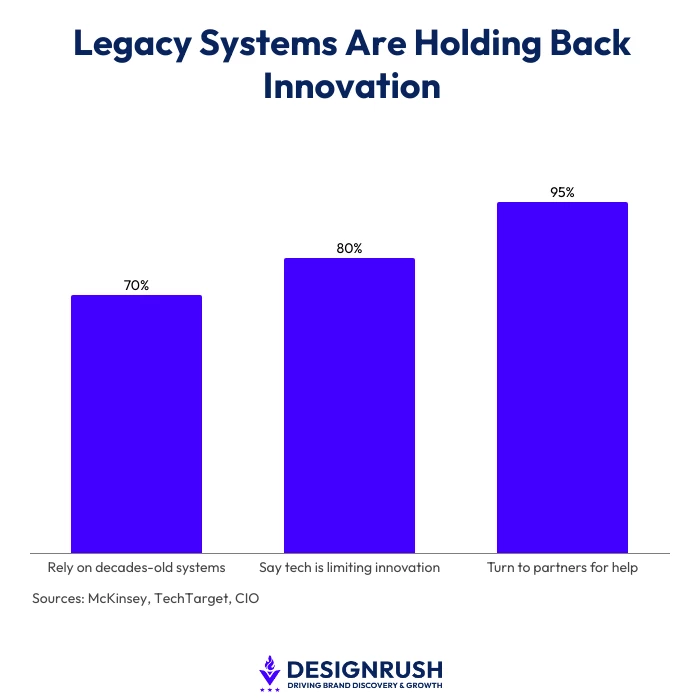
Some of that pressure comes from just how long these systems have been in place. Around 70% of Fortune 500 companies still rely on software that is more than two decades old, according to McKinsey.
That reality shows up in day-to-day execution, with 80% of organizations saying that outdated technology is actively limiting their ability to innovate, according to TechTarget. This makes it more difficult to test and scale new ideas.
At the same time, more companies are looking outside their organizations for help. According to CIO, 95% of IT leaders are turning to external partners to modernize legacy systems and reduce technical debt, reflecting how complex these transformations have become.
Gieger points to this as a turning point in how technical debt is understood.
“Technical debt can no longer be seen as a background issue, but something that directly influences how quickly organizations can move and compete,” he says.
Why More Companies Invest in Modernization
More organizations are rethinking how they treat legacy systems. What was once accepted as a fixed cost is now being questioned.
More companies are now investing in legacy software redesign and modernization. The focus isn’t simply on replacing old systems, but on rethinking how products are designed and built, so the business can move at the speed it now demands.
You can see it in how companies are now spending.
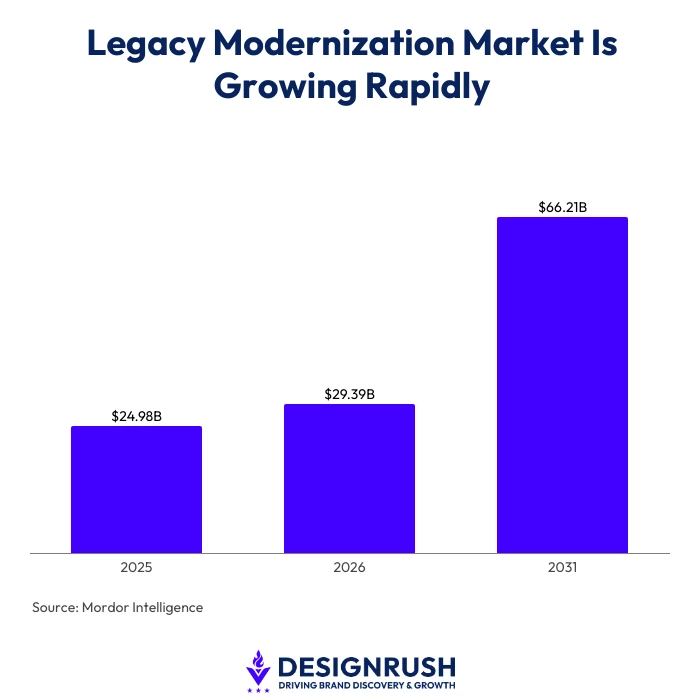
According to Mordor Intelligence, the global legacy modernization market is expected to grow from $24.98 billion in 2025 to $29.39 billion in 2026, and reach $66.21 billion by 2031.
“That often means moving toward cloud-based environments, simplifying complex architectures, and creating systems that scale without constant intervention,” Gieger says.
“The impact is felt across the business. Teams move faster. Decisions happen with better data. And new ideas don’t get stuck in long development cycles.”
Why Companies Turn to Agencies for Tech Debt
The challenge of modernization is also reshaping who companies turn to for help.
The modernization of legacy systems requires careful planning, technical depth, and the ability to make changes without disrupting core operations. For many organizations, that balance is difficult to manage internally.
As a result, more companies are turning to partners who not only specialize in legacy software redesign and enterprise system modernization, but they bring to the table fresh ideas, perspectives, and experiences that a lot of companies desperately need.
These partners help organizations reduce long-term costs, improve agility, and free up internal teams to focus on growth and innovation.
Teams with deep enterprise software expertise, such as UX Team, are increasingly being brought in to rethink how these systems are structured and experienced.
“We’ve made it a priority to help organizations reduce friction, improve usability, and move away from short-term fixes toward more deliberate, long-term transformation,” Gieger says.
Gieger explains why system modernization can’t be delayed in the post below:
What Business Leaders Need to Do to Move Faster
For executives, this is no longer just a technology concern but more so a question of growth.
Figuring out where systems are slowing the business down is starting to matter just as much as the numbers on a financial report.
It’s forcing leaders to take a harder look at how budgets are being spent, and whether enough is going toward what the business will need next, not just what it needs to keep running today.
Because the real question isn’t about maintaining what’s already there. It’s about what kind of business those systems need to support in the years ahead.
Want to know more about how to modernize your legacy system?
Take a look at our list of the Top Software Development Companies of 2026.