
A lot of the conversation around AEO and GEO right now is focused on websites.
Businesses are rewriting content, improving page structure, adding schema, answering more specific questions, and making sure AI platforms can clearly understand what they do. All of that is important, and companies should absolutely pay attention to it.
However, I think there is a much larger piece of the AI visibility conversation that is getting overlooked.
Your website tells Google, ChatGPT, and other AI platforms what you want people to know about your business. The rest of the internet helps determine whether anything supports those claims.
Think about it this way.
A company can describe itself as an industry leader on its website. It can say it provides the best service, has decades of experience, and is one of the most trusted companies in its market.
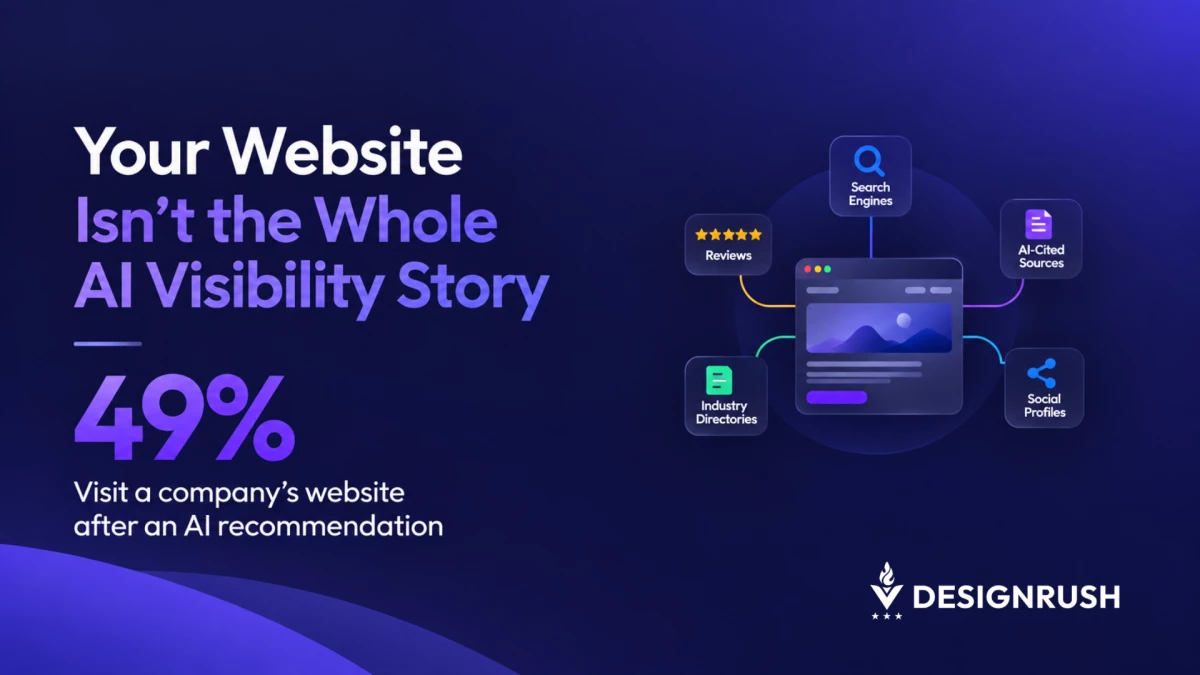
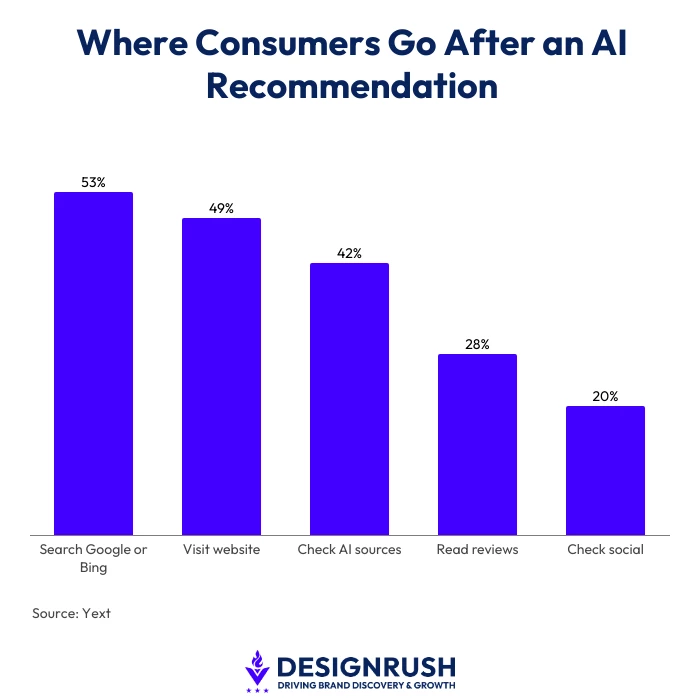
The website still plays an important role. Yext found that 49% of consumers visit a company’s website after receiving an AI recommendation.
But they don’t stop there. Yext also found that 53% search Google or Bing, 42% click the sources cited by AI, 28% look at reviews, and 20% check the brand’s social profiles.
However, what happens when you leave the website?
Are customers actually talking about the company? Are there any reviews?
Has the company been mentioned in any reputable publications? Does it appear in the right industry directories?
Are its executives contributing expertise anywhere else? Is its business information even consistent across the internet?
That larger digital footprint is what really counts.
Businesses need to stop thinking about AI visibility as something that happens only on their website. Your website may be the center of your digital presence, but it is no longer the entire story.
Your Website Alone Can’t Build AI Visibility
I have been involved in digital marketing since we founded Lounge Lizard in 1998, and I have watched businesses make some version of this mistake during almost every major shift in search and online marketing.
Companies tend to focus on the thing they can control.
When websites became important, everyone wanted a better website. When SEO became important, companies became obsessed with keywords and rankings. When social media took off, businesses suddenly wanted to post daily.
Now that AI search is becoming a priority, companies are turning their attention to upgrading their websites for AI.
Again, that is not the wrong thing to do.
A strong website still needs clear messaging, useful content, a solid technical structure, accurate information, and an experience that helps both people and search engines grasp what the company actually does.
The mistake is believing that the work ends there.
Let’s say a business spends six months building out detailed service pages and thought leadership content. The website says the company is highly experienced, trusted by customers, and recognized throughout its industry.
Then you search the company elsewhere and find almost nothing.
Maybe the Google Business Profile has not been updated in three years. There are very few reviews. Industry directories contain outdated information.
The leadership team has almost no presence outside of the company website. There is little media coverage, and the social channels have been inactive for months.
That reality paints a very different picture.
Your website is the version of the story that you control.
The rest of the internet is where other people help confirm, challenge, or add context to that story.
As AI-generated answers become another way people research companies, products, services, and expertise, I believe that distinction will become increasingly important.
Third-Party Mentions Add Credibility Beyond Your Website
This is where the conversation needs to move past traditional website optimization.
Any company can publish an article saying it is an expert in something.
If Lounge Lizard wanted to publish 50 articles tomorrow claiming we know web design, digital marketing, SEO, or conversion strategy, technically we could.
But simply saying something repeatedly on your own website does not automatically make the claim more credible.
Now consider something different.
An industry publication interviews a business owner. Leadership is invited onto podcasts. Journalists quote its executives. Industry organizations list the company as a member.
Other businesses reference its research or ideas. Clients independently discuss their experiences working with the company.
Suddenly there is a much broader collection of information supporting what that company says about itself. That’s the social proof needed to back up your website’s claims.
This is why I believe digital PR, earned media, professional associations, industry directories, podcasts, interviews, and third-party citations are becoming increasingly relevant to AI visibility.
And I don’t think businesses should look at this strictly as backlink building.
There has been a tendency in SEO to reduce almost every third-party mention to the value of the link attached to it. Sometimes the link is important, but that is not the entire value.
The mention itself is what provides the context.
If multiple respected sources consistently associate a person or company with a particular subject, service, product, or industry, a much clearer picture begins to develop.
A company can define its own positioning, but third parties help validate it.
Reviews and Local Search Shape Brand Reputation
Reviews are another area that I think will receive much more attention as brands become serious about AI visibility.
Businesses have always understood that reviews influence customers.
Someone searching for a restaurant, contractor, doctor, marketing agency, hotel, or local service provider will naturally pay attention to what previous customers have said.
But reviews also create a large amount of information about the business itself.
Customers may repeatedly mention certain services. They may talk about customer support, response times, product quality, expertise, value, or individual team members.
Over time, those reviews create a very detailed picture of what customers actually associate with the company.
The same is true for platforms such as Google Business Profiles and other relevant review or business listing sites.
They can reinforce things such as:
- What the company does
- Where it operates
- Which services it provides
- How customers describe the experience
- Whether the business information is accurate
- How active the company appears
That information matters because reputation does not live exclusively on a company’s website.
Imagine a business website that talks extensively about providing exceptional customer service. Then imagine hundreds of independent reviews saying customers cannot get anyone on the phone.
Which version of the company should people believe? Most people would believe the actual customer reviews.
More importantly for this conversation, which version should an AI system have greater confidence in?
I am not suggesting there is a simple formula in which businesses need a certain review score to appear in an AI-generated answer. The technology is considerably more complicated than that.
However, what I am saying is much simpler.
If your website says one thing about your company and the rest of the internet consistently says something completely different, that disconnect matters.
Social Media and Business Listings Add Brand Context
Social media fits into this conversation as well, although probably not in the way some marketers would like to present it.
I would be wary about making claims that posting more often on LinkedIn or Instagram will suddenly cause a business to appear in AI answers.
That turns a much bigger strategic issue into another marketing shortcut.
The value is in the larger body of information a company creates over time. For instance:
- What subjects does the company consistently discuss?
- What expertise does its leadership demonstrate?
- Which products or services come up repeatedly?
- Are customers interacting with the brand?
- Is the business participating in industry conversations, or does its digital presence stop at the company website?
All of these things help to create context.
The same goes for industry directories, association websites, conference speaker profiles, professional organizations, partner websites, local listings, and other places where businesses naturally appear online.
Companies do not need to create 40 profiles to say they exist on 40 platforms.
I have seen enough abandoned social accounts and half-completed business listings over the years to know that more is not always better.
Businesses should focus on the places that actually matter to their customers and their industry, and ensure those profiles are accurate, credible, and consistent.
One social post, one directory listing, and one customer review probably mean very little.
But when dozens or hundreds of independent signals tell a similar story about a business, that story becomes much more difficult to ignore.
Build AI Visibility Beyond Your Website
AEO and GEO are still relatively new terms for many businesses, and naturally, companies want a checklist such as the following:
- Add schema
- Create FAQs
- Improve your service pages
- Write content that answers questions
- Optimize your company and leadership bios
Of course, those are all worthwhile things to do.
However, businesses should be careful not to treat AI visibility like another technical marketing project that can be completed entirely within the walls of their website.
The strongest digital brands have never operated that way. Their website is one piece of a much larger presence.
They earn media coverage. Customers talk about them. Leadership shares expertise. They participate in their industries. Their company information is consistent. Their reputation goes beyond what their own marketing department publishes.
That same approach now has another benefit. It creates a stronger web of information surrounding the company.
Businesses should continue investing in their owned presence, including the website and content they control.
At the same time, they should be paying attention to their verified business information, reputation, media coverage, industry visibility, social activity, customer reviews, and third-party mentions.
I would argue that AI visibility is becoming just as much about reputation as it is about optimization.
And in some ways, this is not actually a new marketing concept at all.
Way before generative AI was even a common topic, successful businesses understood that you could not build a reputation by simply telling everyone how great you were.
Other people had to believe it, too.
AI is simply giving businesses another reason to take that idea seriously.
The companies that gain visibility in this new search environment will not necessarily be the companies publishing the most content or using every new AEO tactic first.
I believe the advantage will go to businesses that create a clear and consistent presence wherever customers, publishers, platforms, and now AI systems encounter their brand.
Your website can explain your brand, but the wider web helps prove it.