
Agentic AI in Business: Key Findings
- AI agents are moving into real business operations, as organizations are already using them to handle tasks like document processing, transactions, and customer intake.
- Most companies are not ready to scale AI agents effectively, with many still stuck in early stages due to fragmented systems and a lack of governance.
- Starting with structured, rule-based workflows is the fastest path to value, with businesses able to build momentum by focusing on well-documented processes before scaling further.
AI agents are moving into enterprise operations faster than most organizations are prepared to manage.
OpenAI’s recent introduction of its Frontier platform is one of the most telling examples of that. At first glance, it may seem like just another enterprise AI release.
In reality, it’s designed to help businesses build and manage AI agents inside their core systems, with identity controls, access management, and integrations across business tools.
This is the kind of infrastructure companies typically use to manage people.
That detail says a lot about where agentic AI is heading. Rather than testing AI, businesses are baking it into their core operations.
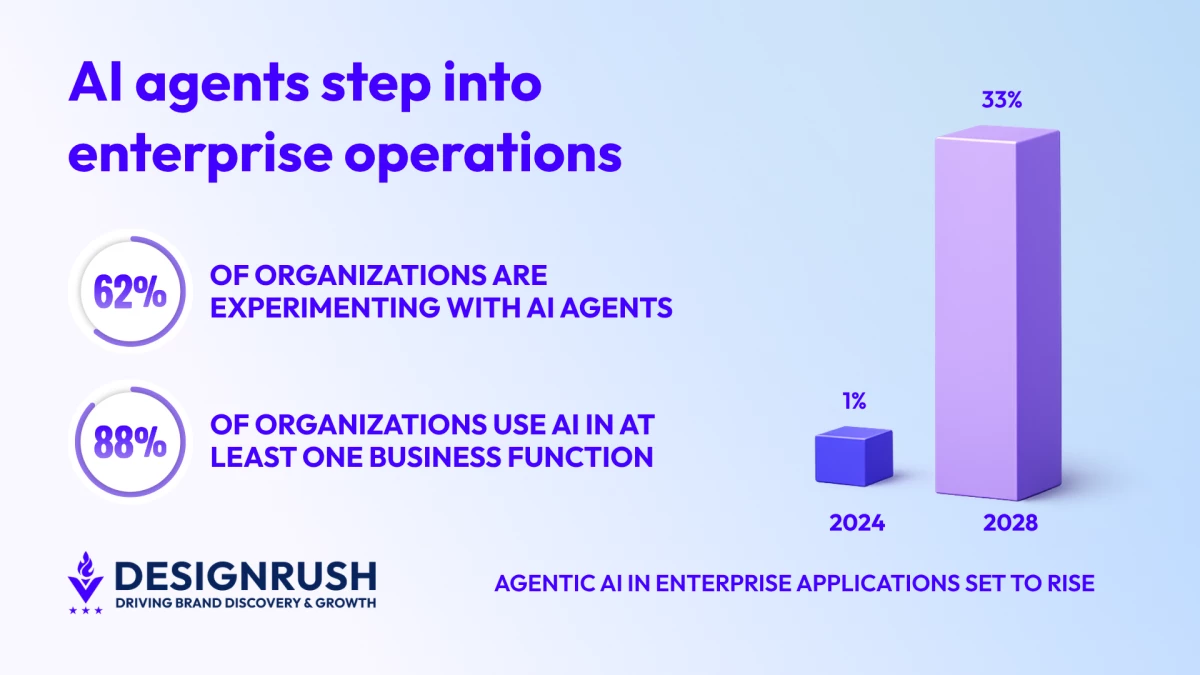
McKinsey reports that 62% of organizations are already engaging with AI agents, either through experimentation or early-stage scaling.
AI-native software development companies such as Unico Connect are witnessing this transition firsthand.
Organizations are now assigning AI agents to handle document flows, monitor transactions, and manage customer intake as part of ongoing operations.
And once that starts to happen, expectations quickly change.
Nvidia explains how to transform your business using agentic AI:
Editor's Note: This is a sponsored article created in partnership with Unico Connect.
AI Agents Are Becoming a Workforce That Needs Managing
The challenge companies face now is not capability. It’s control.
As Unico Connect CEO, Malay Parekh explains, the emergence of platforms built specifically for managing AI agents reflects a real demand.
“Businesses have moved past fragmented, one-off implementations and now need structured ways to govern their AI workforce. That includes identity controls, defined access, and clear accountability,” Parekh says.
In short, AI governance becomes essential.
Because once agents begin interacting across systems and making decisions, they no longer behave like passive tools.
They start functioning more like team members. And team members need oversight.
Adoption Is Rising, But Most Companies Are Not Ready
The implementation of AI is moving fast, and most companies can feel it.
According to the same McKinsey report, nearly two-thirds of organizations have yet to scale AI and remain in the experimentation or pilot phase.
It also found that 88% of organizations now use AI in at least one business function, up from 78% in 2024.
Gartner predicts agentic AI will spread rapidly across enterprise software, with 33% of applications expected to include it by 2028. That figure is up from less than 1% in 2024.
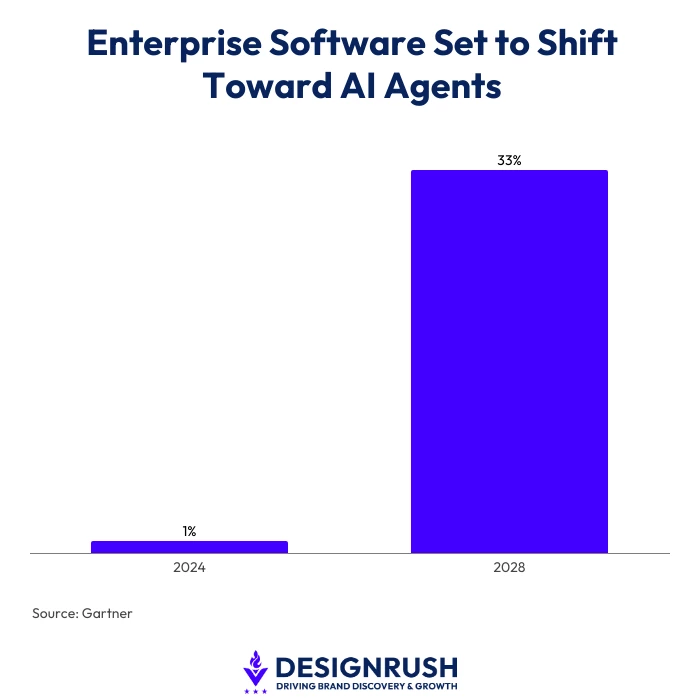
This shows that what matters now is not just adoption. It’s about how quickly companies can move beyond pilots and make these systems work in real environments.
Where AI Agents Deliver the Most Value
For organizations exploring AI agents, the instinct is often to begin with complex, high-impact decisions. But in practice, that tends to slow progress.
“A more effective starting point is work that is repetitive, rules-driven, and well documented,” Parekh says.
“This includes tasks where employees follow a consistent sequence, reviewing documents, extracting data, validating it, and passing it forward.”
These are usually the easiest places to see real value early on.
Parekh suggests starting small. Pick three to five processes, look at how well they’re documented and whether the data is actually usable, then begin with the one that’s set up to succeed.
It’s not a complicated approach, but it gives teams something to build on as they scale AI use across the business.
Why AI Agents Are Different From Traditional Automation
It’s easy to assume that AI agents are just a more advanced version of automation. But the differences run deeper.
Where traditional automation follows fixed rules, the process breaks when something falls outside of those rules. And while the introduction of AI chatbots improved responsiveness, they still rely on pattern matching.
AI agents meet this challenge by introducing reasoning.
They can interpret situations, decide on actions, use multiple tools, and adjust when conditions change. Instead of reporting a delay, an agent can investigate the cause, check inventory, identify alternatives, and propose a resolution.
That added flexibility, however, comes with responsibility.
“Agents still need well-designed systems to interact with, clear boundaries on what they can do, and monitoring to ensure they are performing as expected,” Parekh says.
“The technology is different, but the discipline required to deploy it remains just as rigorous.”
The Real Challenge of AI Agents Isn’t the Technology
Once implementation begins, a different set of challenges comes into focus.
The issue rarely comes down to building the agent itself, but enabling it to function effectively.
Most organizations operate across fragmented systems where data is not easily shared. Giving an AI agent access to the information it needs often requires significant integration work.
At the same time, the human side cannot be overlooked.
“Introducing AI agents changes how teams operate,” Parekh says. “People need clarity on what the system is responsible for, where it may fall short, and how to step in when needed.”
Without that, the adoption of AI slows.
Parekh adds that there are already cases where the technology performs well, but usage stalls because teams are not prepared to work alongside it.
Essentially, both sides have to evolve together.
IBM tells us why AI agents need human oversight:
How AI Agents Will Change the Way Businesses Design Work
As AI agents become part of everyday operations, the bigger change will not be technical. It will be in how work is structured.
Processes will be designed for a mix of people and AI agents working together. That will influence how systems are built, how performance is measured, and how decisions are made.
“Interoperability will therefore become essential,” Parekh says. “Products will need to work not just for human users, but for AI agents operating across different platforms, which changes how software is designed, integrated, and evaluated.”
Over time, the decision-making layer begins to shift as well.
“It will not always be people deciding which tools integrate best or deliver the strongest outcomes,” Parekh says. “In many cases, AI agents themselves will influence those choices.”
That changes how software is evaluated, and who it is really being built for.
Companies will start designing their operations around them, and that will shape how work gets done from the ground up.
Want to keep informed about all things AI?
Take a look at our list of the Top AI Automation Companies of 2026.