
The web has never been easier to build.
I can spin up a functional business site before lunch using half a dozen AI builders, and so can you.
So can your competitors. So can the kid down the street who's never run a business in his life
And yet, the brands I see actually winning in 2026 are doing the opposite of what the tooling suggests.
They're slowing down, spending more, and commissioning custom work when the templated option is sitting right there.
Emotion and craft matter more than automation. This is strategy.
When every competitor can deploy a credible-looking site in a matter of hours, "credible-looking" stops being a competitive advantage. It's the floor.
Brands gaining ground treat their website as a proprietary asset, built around their actual customers, and the trust signals their buyers are quietly scoring them on.
If you're staring at two quotes on your desk right now, one templated and cheap, one custom and not, here's the honest case for the second one.
Trust as a Core Metric
Trust is the most undervalued metric in web design because it rarely shows up on a dashboard.
There's no "trust rate" in Google Analytics. And yet it governs almost every decision a B2B buyer makes before they ever talk to your sales team.
Trust is built through specificity. For example, a photograph of your actual team in your actual office signals something a stock image cannot.
Content that names the precise problem your customer faces, in the language they use internally, signals that you've done this before.
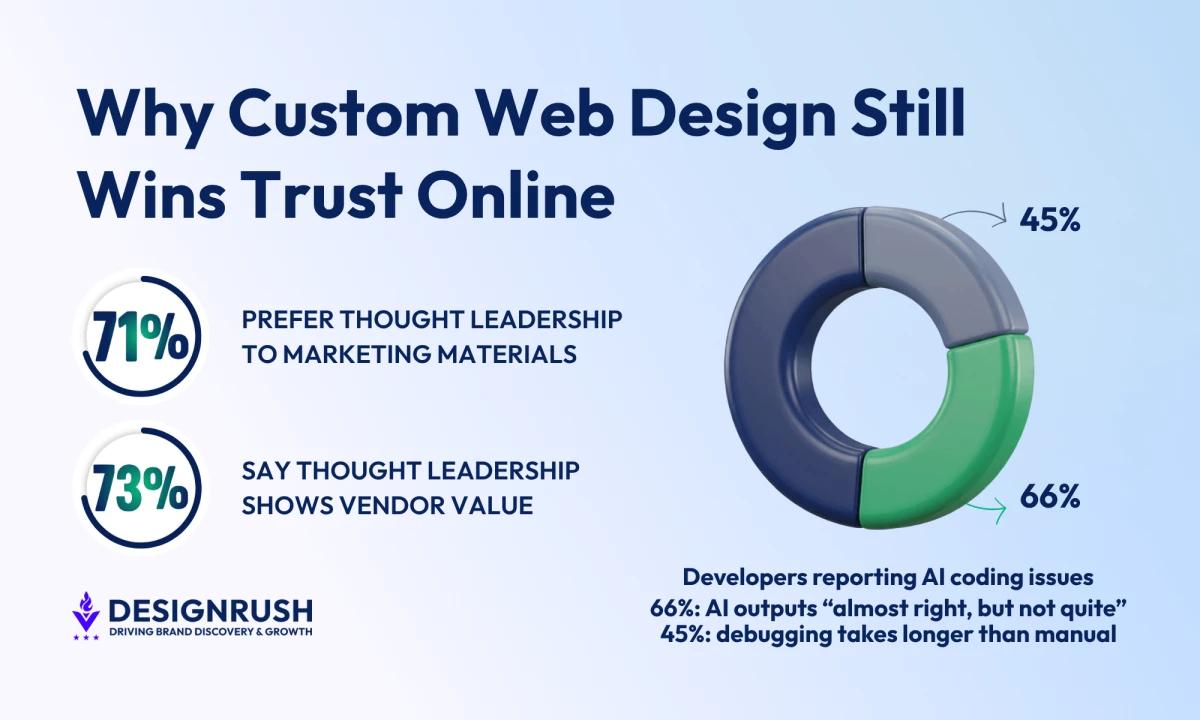
About 71% of hidden decision-makers say thought leadership is more effective than conventional marketing or sales materials at demonstrating a vendor’s potential value, according to Edelman’s 2025 B2B Thought Leadership Impact Report.
The same view is shared by 73% of target decision-makers.
Similarly, a case study with real numbers and real client names lands in a way a generic "Results" section never will.
Templated sites are structurally hostile to specificity. They're built to be filled in, not built around a story.
The layout exists before the content does, which forces your message to conform to someone else's idea of how a business should present itself.
Custom design inverts that by putting the story first. The design serves it.
In B2B sales cycles where a single contract may be worth six or seven figures, the cost of looking like everyone else shows up in lost deals.
The ones where a prospect quietly closed the tab and called your competitor because something felt off, even if they couldn't tell you what.
The Limitations of AI-Generated Experiences
AI-generated sites are impressive at what they do. I use AI tools every day inside my own agency and I'm not going to pretend otherwise.
But they're limited in ways that matter for serious businesses.
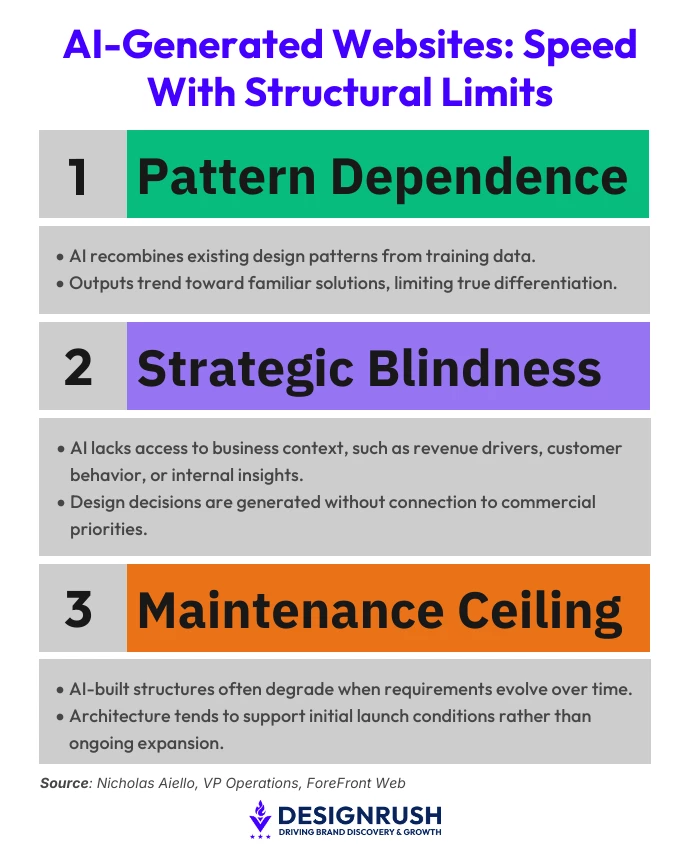
The first limitation is pattern dependence. AI design tools generate output by recombining patterns they've already seen.
This is useful for getting to "good enough" quickly, but it's structurally incapable of producing something the model hasn't encountered in its training data.
If your positioning depends on feeling distinct, you can't get there by asking a system optimized for the average to produce the exceptional.
The second is strategic blindness. AI doesn't know that your largest client comes from referrals in one vertical, or that your sales team loses deals on the pricing page.
It also doesn't know your founder's backstory is the strongest trust signal you have.
So, it can't weigh design decisions against business decisions because it doesn’t have access to those factors.
It's why a human strategist in a real discovery session catches what no prompt can surface.
The third is the maintenance ceiling. AI-generated sites tend to be brittle in ways that show up six or twelve months in.
The integrations are shallow, the content model doesn't flex, and the third time you try to add a new service line, you find out the architecture was designed for launch, not for growth.
The Stack Overflow 2025 Developer Survey highlights a recurring issue in practice.
Developers most often cite AI outputs that are “almost right, but not quite” as the main frustration, with 66% pointing to this issue.
Closely behind that, 45% report that debugging AI-generated code ends up taking longer than building it manually.
However, none of this is an argument against using AI in the design process.
The best agencies use it extensively for research, first drafts, code acceleration. We do too. The argument is against letting AI be the designer.
There's a meaningful difference between a tool and a strategy, and conflating the two is how brands end up indistinguishable.
Human-Centric Strategy Over Speed
Speed has been the dominant pitch in web design for the better part of a decade.
Launch faster, iterate faster. Ship the MVP and improve later.
For a venture-backed startup burning runway, that calculus makes sense.
But for an established business with real customers, real revenue, and a real reputation, it's often the wrong frame entirely.
A human-centric process moves at the speed of clarity, not the speed of tooling. It starts with conversations with your sales team about the objections they hear every week, and with your customers, about why they chose you.
You should speak with your leadership, about where the business is heading. That work is unglamorous. It doesn't produce deliverables you can screenshot.
That's the difference between a website that looks like your business and one that performs like your business.
The agencies still doing this work have watched enough fast-launched, AI-assembled sites quietly underperform to know the bottleneck was never production speed.
When you invest in custom design, you're paying for the hours of strategy, and the rounds of revision against real business goals, as well as the willingness to throw out the first concept because it didn't earn its place.
You’re also ensuring your story is told with intention, not squeezed into someone else’s template.
That's the part templates can't replicate, and it's the part that compounds for years after launch.
The Quiet Advantage
Building trust before the first sales call, qualifying the right prospects, and making the case for premium pricing without anyone on the sales team having to say it out loud.
That kind of website doesn't come out of a template. It doesn't come out of a prompt either.
It comes from a deliberate process, run by people who care about the outcome as much as you do.
Custom design isn't a defense against AI; it's a commitment to the parts of your business that AI can't replicate.
And those are the parts your buyers are paying attention to.