
Agentic AI Software: Key Findings
- Software is shifting from reactive to autonomous, meaning that systems are now being designed to understand intent and take action without constant human input
- AI adoption is rapidly moving into core business operations, with companies no longer experimenting but embedding AI agents into everyday workflows and infrastructure
- Companies must redesign their platforms for AI agents, which means building self-describing APIs, adopting event-driven systems, and implementing orchestration to manage multi-agent workflows effectively
At this year’s Nvidia GTC 2026, the conversation moved beyond just faster chips and bigger models. What people are really talking about now is how these systems are starting to act, not just react.
Software is no longer being designed to wait for instructions. It is being built to respond and execute.
This is being seen in how forward-looking custom software development agencies like Unico Connect are thinking about their platforms.
Malay Parekh, CEO of Unico Connect, says the focus is moving away from guiding users through interfaces. Instead, it’s moving toward systems that understand intent, make decisions, and execute tasks across environments.
“We are moving from software that waits for input to software that can understand intent and act on it,” Parekh says.
Check out the keynote highlights from Nvidia GTC 2026:
Editor's Note: This is a sponsored article created in partnership with Unico Connect.
AI Adoption Accelerates Fast
The move to embed AI into core business infrastructure is hard to ignore.
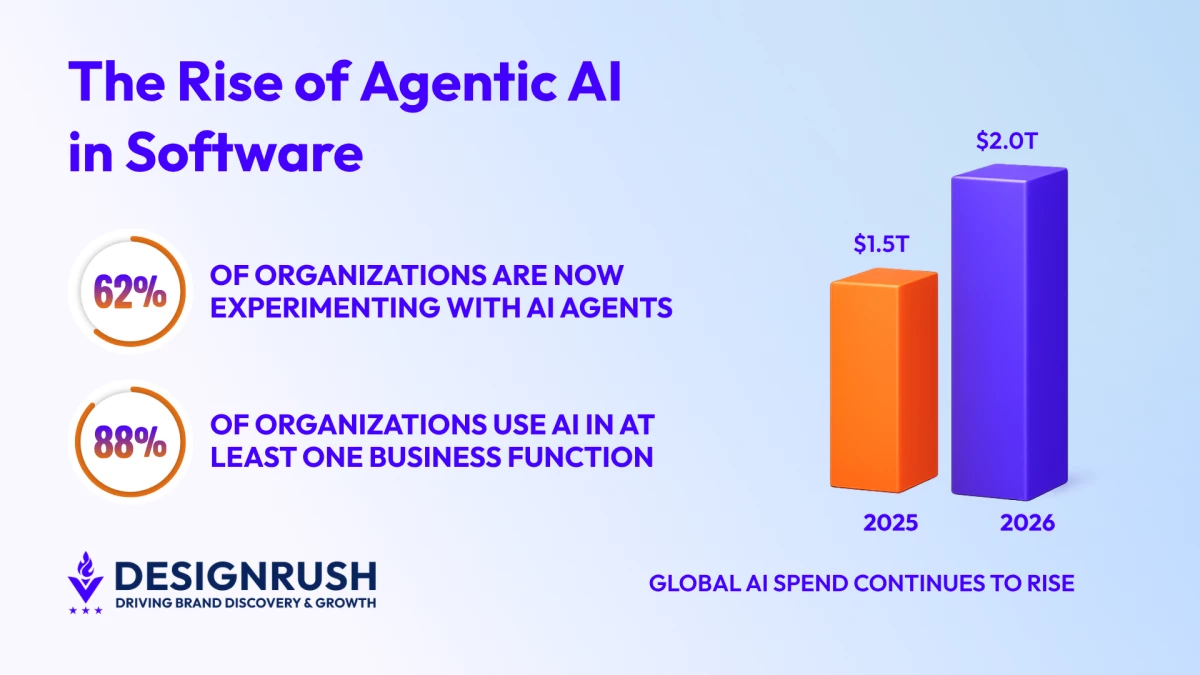
Global AI spending reached nearly $1.5 trillion in 2025 and is forecast to exceed $2 trillion by 2026, according to Gartner’s AI spending forecast.
Adoption is also accelerating.
McKinsey & Company reports that 62% of organizations are at least experimenting with AI agents, while 88% now use AI in at least one business function, up from 78% the year prior.
“This is no longer about adding AI on top of existing systems. It is about rebuilding those systems so they can operate with a level of autonomy we have not seen before,” Parekh says.
From Interfaces to AI-Driven Intent
For years, software design and development have followed a familiar pattern. Build an interface, guide the user, and rely on step-by-step interaction.
That model is starting to give way to something else.
Products are now being shaped around intent. What does the user want to achieve, and how can the system handle the steps required to get there?
“AI agents make that possible,” Parekh says. “They interpret context, make decisions, and carry out tasks across multiple systems without constant input.”
Nvidia is really leaning into this as competition heats up, focusing on systems that can handle complex tasks with very little human input.
It might not seem like a big shift at first, but it is. The interface matters less now. What really matters is the outcome.
Why APIs Must Evolve for AI Agents
As AI agents begin interacting directly with platforms, the limitations of traditional architecture become clear.
Most APIs today are built for developers. They assume human logic and clearly defined sequences.
“AI agents need systems that are structured, predictable, and easy to interpret,” Parekh says.
“That means APIs must evolve. They need to include context that helps machines understand not just what a function does, but when it should be used and why it matters.”
In practice, it means APIs need to be a lot clearer about what they do. They need to give agents enough context to figure out not just what to call, but when it actually makes sense to use it.
At the same time, the way systems communicate is starting to change. Instead of constantly checking for updates, agents can just react when something happens, which makes everything faster and a lot more efficient.
They can also subscribe to those changes and respond in real time, rather than polling systems over and over again. That shift alone changes how these systems work together.
And if a platform isn’t built in a way that an AI agent can understand, it’s very likely to get skipped altogether.
Google tells us about combining AI APIs to work together in the video below:
AI Orchestration Will Define Winners
As more agents come into play, coordination becomes the real challenge.
One agent can handle a task. Multiple agents working together can run entire workflows across systems. That might include managing inventory, placing orders, and coordinating delivery without human involvement.
But experts from Unico Connect remind us that, without oversight, this kind of system can quickly become chaotic.
“This is where orchestration layers come in,” Parekh says. “They manage how agents interact, prevent duplication, and keep processes aligned.”
In many ways, the orchestration layer becomes the nervous system of an agent-driven architecture, ensuring everything works in sync.
Frameworks like LangGraph and CrewAI are helping teams explore this approach. Still, the bigger challenge lies in understanding internal workflows well enough to coordinate them effectively.
In many cases, the biggest gains come from fixing broken handoffs and streamlining how systems connect.
IBM explains how multi-agent systems work:
Why AI Requires a New Product Mindset
For many companies, the hardest part of this transition is not technical. It is a shift in how products are designed and evaluated.
Traditional software is deterministic, where each action leads to a predictable result. AI systems are not. Outcomes can vary depending on context, which makes testing more complex and less linear.
This also raises questions around trust.
When an AI agent takes action on behalf of a user, people need to understand what happened and feel confident in the result. That requires clear communication and thoughtful design, not just strong engineering.
“Teams that recognize this early tend to move faster and treat AI as both a product and design challenge, not just a technical upgrade,” Parekh says.
What Comes Next for AI-Driven Software
Agentic AI is moving quickly from experimentation into the core of how software operates. As systems become more connected, coordination will matter as much as capability.
Some companies are already preparing for these changes.
They are refining their APIs, adopting event-driven models, and building platforms that machines can navigate as easily as people. Others are still layering AI onto existing systems.
Those that treat agents as an add-on will face growing integration challenges, while those building for an agent-first world are likely to accelerate growth more quickly.
As agent-to-agent interaction becomes more common, platforms that are easy for machines to understand will scale AI faster and integrate more easily.
Those who aren’t may be forced to adapt under pressure.
“In the near future, agent-to-agent communication could become as standard as API-to-API communication is today, fundamentally reshaping how digital ecosystems operate,” Parekh says.
The bigger change is in expectations. Software is no longer just a tool. It is starting to act with purpose.
The companies that design for that reality now will not just keep up. They will end up defining how software actually works in the years ahead.
Want to keep up with the world of AI and software development?
Take a look at our list of the Top Software Development Companies of 2026.