
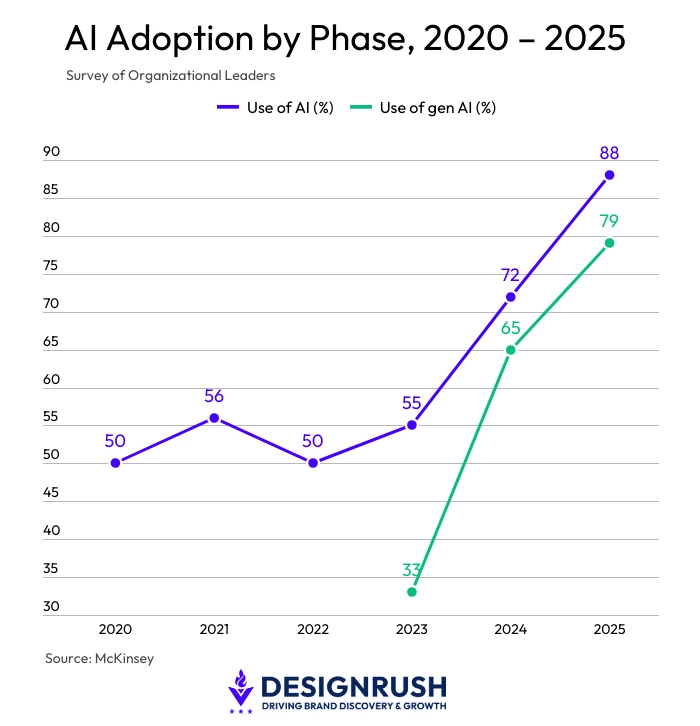
Eighty-eight percent of organizations are using AI in at least one business function, according to McKinsey's The State of AI survey.
Yet most remain in the experimenting or piloting phase, with only one-third reporting they have begun scaling AI throughout their organizations.
 The companies seeing the most value are nearly three times more likely to have fundamentally redesigned their workflows around AI, going beyond incremental adoption.
In an interview with DesignRush, Marcello Gracietti, CEO of Cheesecake Labs, shares how AI agents are changing what it means to be a senior engineer and what high-performing software teams look like today.

Who Is Marcello Gracietti?
Marcello Gracietti is CEO of Cheesecake Labs, an AI and software development company that has built more than 350 digital products for clients including PepsiCo, MoneyGram, and Wedgewood Pharmacy.
Founded in 2013 with offices in the United States and Brazil, the firm works across AI implementation, data engineering, blockchain, and enterprise modernization. A Wharton EMBA Fellow, Marcello focuses on the engineering and operational work required to move AI from pilot to production.
The Operating Model Is the Hard Part
Gracietti draws a clear line between companies capturing real value from AI and those still running pilots.
"The technical piece is the easy part. The hard part is the operating model," he tells DesignRush.
"[That’s why] companies winning with AI-driven development have engineers who think like systems architects, not just coders."
Engineers at high-performing organizations are functioning less like individual contributors and more like managers.
They delegate tasks to agents, supervise execution, and evaluate output quality. The team being managed happens to be a set of AI agents rather than people.
Gracietti sees the same friction repeatedly. A senior engineer who has worked the same way for a decade will try an AI tool once, hit friction, and revert.
As such, the companies seeing real leverage have built environments where teams are explicitly incentivized to experiment and redesign their process.
Gracietti cites two notable examples:
"AWS built an AI-native pod that designs every workflow from scratch with agents in mind. At Blue Origin, the CTO paused building entirely for a week so the team could learn AI properly," he says.
Although that sounds expensive, it’s a key initiative to encourage adoption rather than having people revert to previous workflows when something goes wrong.
The Rapid Advancement of AI Models and Agents
In the last 18 months, AI models and agents have gone through massive changes to better assist software developers.
Gracietti points to three distinct changes that unlocked agentic development:
1. Code prediction improved
The first change is that the underlying models got much better at code prediction.
This matters because code is a “sweet spot” for LLMs.
"There are hundreds of thousands of open-source repositories on GitHub, the vocabulary is small, and the feedback loop is instant. The code either runs or it doesn't, so the feedback loop to the AI is immediate," Gracietti says.
"That clean signal lets the models train fast and well. Most problems engineers face have already been solved and published somewhere, so the model has seen them."
2. Context windows expanded
Context windows that followed code expanded by an order of magnitude.
Frontier AI models now handle close to a million tokens, meaning an agent can hold an entire codebase, tickets, design files, and architecture docs in working memory simultaneously.
"Combine that with smarter memory management and skill systems, and the agent stops feeling amnesiac," Gracietti adds.
3. MCP connectors were standardized
More companies are publishing standardized Model Context Protocol (MCP) connectors that let agents reach into their data and can read Jira, query Confluence, open Figma, run tests, and push code.
"Once the right governance and security wrap is in place, the agent stops being a chatbot and becomes part of the workflow," Gracietti notes.
But none of these are individually transformative. The combination is.
"An agent with a million-token window, MCP access to your full stack, and a modern reasoning model gives you an extra teammate available at 3 a.m.," he adds.
Where AI Delivers Measurable Gains
Asked where AI-assisted workflows are generating the biggest gains, Gracietti points to three areas where the impact is concrete and measurable.
- Prototyping has compressed from weeks to days. Designers now generate multiple client directions in a single session.
- Specification writing has gone from the slowest part of the job to one of the fastest. Product managers run Claude Code connected to Jira, Confluence, and Figma.
- Testing has become a compounding advantage. Every new feature merges with less risk as the testing foundation matures.
"The brainstorming phase that once took our designers two to three weeks now takes two to three days. Spec writing that took our PMs two weeks takes a few hours. And cycle times compress because the team trusts the suite," Gracietti says.
For context, top-quintile companies achieving 16 to 30% productivity improvements and 31 to 45% gains in software quality, per McKinsey's research.
"Those are not outlier numbers anymore. They are what you should expect when the workflow is rebuilt," he adds.
Vibe Coding Has a Ceiling
The rise of prompt-driven development has produced a persistent misconception that AI has effectively replaced software engineering.
But Gracietti’s opinion is that coding is only one part of software engineering.
The rest, like talking to the business, designing across multiple systems, testing, and shipping safely, still requires smart people who understand what they are doing and why.
"Code generation is the most pleasant part of the job. Treating it as a synonym for software engineering leads to bad budget decisions," Gracietti says.
"The framing I use internally is simple. AI makes code cheap. We make AI work."
The vibe coding trap becomes clearest at scale. A prototype can exist in hours. AI can compress the validation phase to days.
But teams that skip proper validation by real software engineers tend to ship fragile products that collapse the moment they matter.
What High-Performing Teams Look Like Now
Engineering teams are getting smaller and more senior. A product manager, a designer, and two or three engineers fluent with agents can ship what once required a team of eight.
Gracietti weighs three capabilities more heavily in hiring than he did two years ago:
- Product judgment, because speed in the wrong direction compounds the problem.
- Agents and models fluency, because structuring context and designing feedback loops with agents is now a baseline skill, the way Git was a decade ago.
- Comfort with delegation and review, because senior engineers who built their careers writing code now need to hand that work to agents.
"The skill that matters most is systems thinking. [That includes] breaking a problem into pieces, handing the right pieces to an agent, and verifying the output. That is management work applied to agents," Gracietti says.
What the Next Five Years Mean for Engineering Teams
By 2030, Gracietti expects engineers will stop looking at code most of the time.
"We're still a few years out, but the trajectory is clear. Five years at the current pace is a lot. Frankly, this can happen in one to three years depending on the company's context. The engineer becomes the orchestrator of agents that write and execute code in real time," Gracietti says.
In this scenario, it will be experienced engineers who define the problem and constraints, deciding what success ultimately looks like.
"Agents handle the writing and the running. Humans handle the architecture, the trade-offs, the customer experience, and the judgment calls about what is worth building," he adds.
Engineering org charts will also look more like investment teams than factories. Smaller, more senior, and fully accountable for outcomes.
Agent orchestration becomes a discipline, the way DevOps is today. Head of agent operations can become a real role.
"Clients will start asking vendors for agent governance. Who is auditing the agents? Who is responsible when one is wrong? The bottleneck shifts permanently from writing code to integrating systems, aligning organizations, and shipping change safely," Gracietti adds.
That's the work Cheesecake Labs is built for: helping companies operationalize AI without breaking what already works.