
Uber’s engineering teams are adopting AI tools at a pace that wiped out an entire year’s budget in just four months.
The company reportedly exhausted its 2026 AI budget by April.
And this happened after Anthropic’s Claude Code spread across roughly 5,000 engineers faster than internal forecasts anticipated.
Uber CTO Praveen Neppalli Naga confirmed the overrun to The Information, saying the company had to revisit its assumptions on AI spending.
Uber’s wider R&D spend reached $3.4 billion in 2025, up 9% year over year.
The problem was the unpredictability of usage-based AI pricing once deployed at full engineering velocity.
Claude Code was introduced in December 2025, and usage jumped from 32% of engineers in February to 84% classified as agentic users by March.
By spring, 95% of engineers were using AI tools monthly, with roughly 70% of committed code originating from them.
About 11% of backend updates were fully agent-generated.
Meanwhile, monthly spend per engineer ranged from $150 to $250 on average, with heavy users reaching $2,000.
Naga himself said he had spent $1,200 in a single two-hour session during a demo.
The system worked as intended, handling refactoring, test generation, and backend builds at scale.
However, these capabilities created a financial problem that traditional software budgeting wasn't designed to absorb.
When AI Usage Outpaces Forecasts
Anthropic’s pricing structure adds another layer of pressure.
The company recently said that paid Claude subscribers will soon face separate credit meters for agent tools.
They will be billed at full API rates starting June 15, further tightening visibility into consumption-based costs.
Claude Code operates on token consumption, meaning costs vary based on how engineers actually use it.
Inside Uber, engineers were ranked on leaderboards by how much they used the tool.
The more tokens consumed, the higher the score, which gave engineers every reason to use Claude Code aggressively and no reason to hold back.
An engineer running basic autocomplete generates minimal spend.
Meanwhile, one orchestrating parallel agents across a large codebase can run up thousands of dollars in the same period.
This variability breaks traditional procurement logic.
Finance teams typically plan software spend on fixed per-user or per-license assumptions, and usage-based AI pricing doesn't fit this model.
Without caps or monitoring layers, costs fluctuate daily based on workload.
For enterprises, this turns productivity gains into unpredictable operating expenses.
"The value of AI isn't measured by how much it's used, but by whether it's helping teams work more efficiently and drive better outcomes," Andy Fowler, CEO and co-founder of AI-powered CRM company Nutshell, told DesignRush.
"Businesses should regularly evaluate which tools are saving meaningful time or improving results, rather than assuming higher usage automatically translates to higher value."
AI Spending Changes Big Tech's Hiring Priorities
The race to scale AI products is changing how companies structure teams, assign budgets, and measure productivity:
- Efficiency now drives restructuring. Companies are reducing overlapping roles to improve operational speed and lower costs.
- AI investment changes workforce planning. Businesses should retrain employees early to preserve expertise and reduce disruption.
- Employee trust affects adoption. Brands should communicate AI monitoring policies clearly to reduce backlash and retention risks.
Recent workforce cuts across tech and media companies show how aggressively businesses are adjusting staffing models due to AI investments.
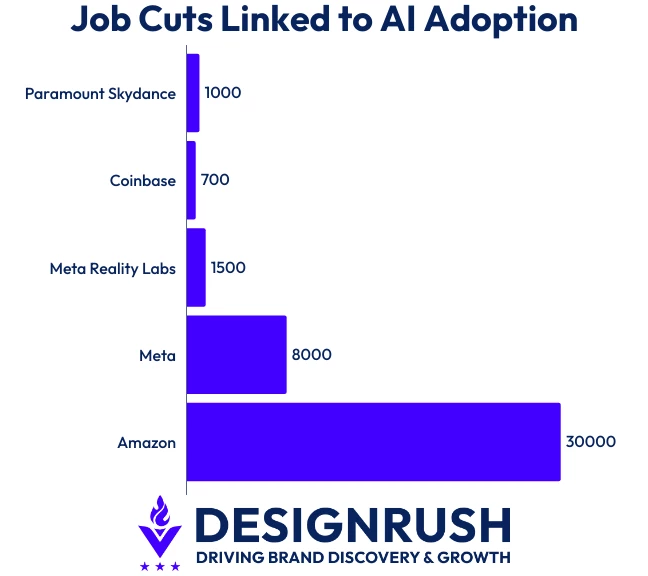
Coinbase, Amazon, and Paramount Skydance have all tied restructuring efforts to automation-driven workflows.
Layoffs are becoming more of a recurring mechanism in how companies adapt to AI-heavy operations.
At the same time, firms are under pressure to prove that automation improves productivity without weakening employee confidence.
"Usage is easy to measure, but it doesn't tell the whole story," Nutshell President Allyssa Kelley-Brown commented.
"Businesses should focus on outcomes such as time saved, faster response times, improved conversion rates, or increased productivity to understand whether an AI investment is actually paying off."
Our Take: Can Enterprise AI Spending Stay Sustainable?
Uber is continuing its AI expansion despite the budget overrun, and this decision comes with risks.
CTO Naga said the company is testing additional coding models as part of its move towards agent-led development, where engineers supervise more than they manually code.
This strategy may help Uber move faster internally, but it also increases dependence on tools with costs that can spike unpredictably at scale.
The company’s experience already shows how quickly AI adoption can outpace financial planning once usage becomes tied to everyday workflows.
The question now is whether enterprises can financially model them and scale well within their control.
In related news, Meta recently cut thousands of jobs as the company redirected more spending and internal resources toward its expanding AI operations.
Looking for agencies that can navigate AI-assisted campaign creation? Find top digital marketing agencies in our directory.