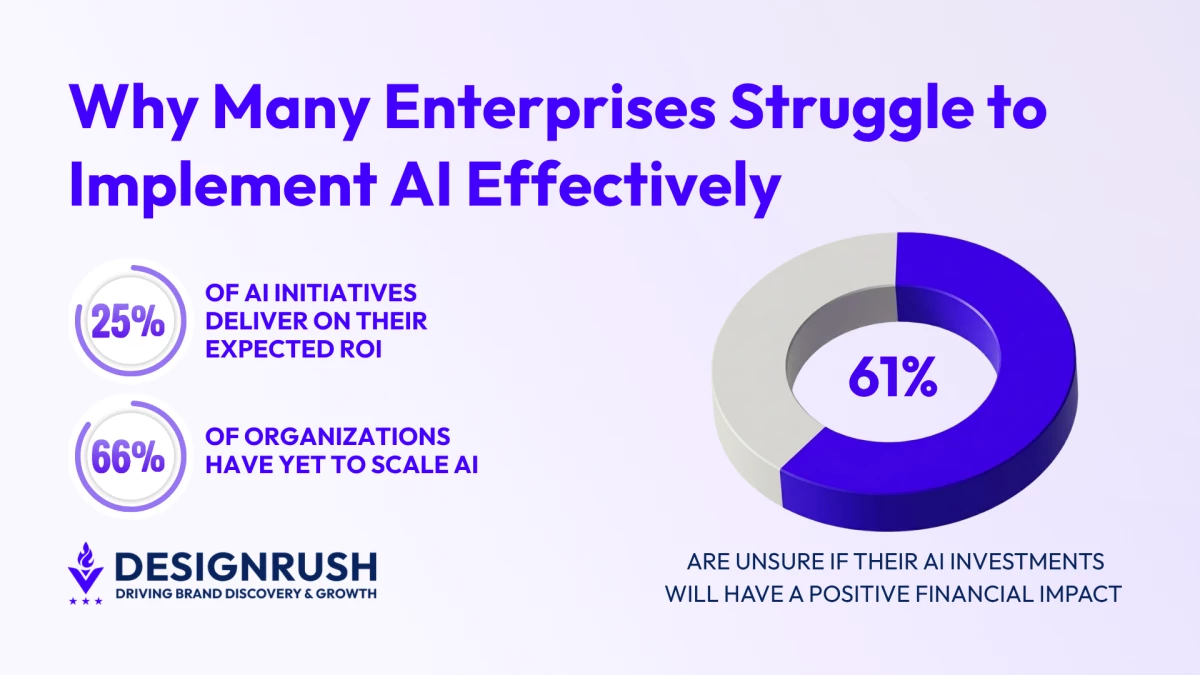

Only 25% of AI initiatives have delivered expected ROI, while only 16% have been able to scale AI across the enterprise.
Those numbers are from an IBM global study that surveyed over 2,000 CEOs, and they describe a deployment problem, not a technology one.
— IBM (@IBM) February 18, 2026
In the study, half the CEOs surveyed admitted their pace of investment left them with disconnected, piecemeal technology.
Despite all these statistics, organizations can’t afford to slow down on the AI front. Otherwise, they risk letting their competition get further ahead of them.
But why are so many organizations struggling to get the most out of their AI initiatives?
For many, the problems arise because of a misinterpretation of their pilot test results.
Pilots Don't Survive Real Data
A controlled pilot proves the conditions were right for a demo. It does not automatically prove the organization is ready to scale.
The breakdown occurs when AI encounters common problems plaguing operational data, such as:
- Missing records
- Conflicting fields
- Undocumented exceptions
This is addressed by enterprise AI developers, like Unico Connect, who incorporate ownership, governance, and integration planning into the project before launching a single workflow.
"The organizations that scale are the ones that design for the messy reality of production, not the clean conditions of a demo," said Malay Parekh, CEO of Unico Connect.
"That means defining who owns the system, what it costs to run, and what financial return it must generate before anything ships."
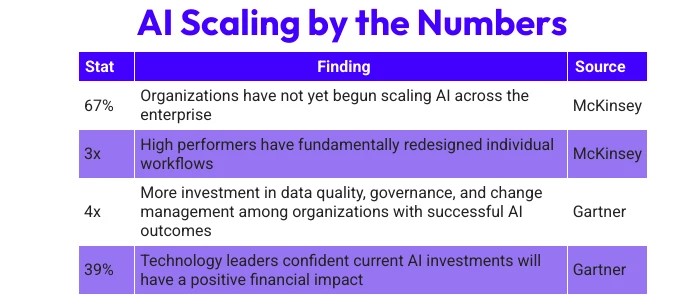
Case in point, Gartner's April 2026 research found organizations with successful AI outcomes invest up to four times more in data quality, governance, and change management as a percentage of revenue.
 What Enterprises Should Do Next
CEOs remaking the C-suite with an AI-first mindset have scaled 10% more AI initiatives enterprise-wide than their peers, according to IBM's 2026 CEO study.
To achieve the same AI-first mindset as these companies, Unico Connect says leadership should take the following steps:
1. Define Financial Targets Before Deployment
Successful programs tie AI to financial outcomes from the start, instead of accuracy rates or task completion percentages.
Before deploying AI, document metrics such as cost per transaction, cycle time, error rate, and FTE allocation.
"If you don't define what success looks like before you start, you will measure the wrong things after. ROI is not a post-deployment question. It is a pre-deployment design decision," adds Parekh.
2. Start Narrow and Expand Based on Proven Results
One of the most common mistakes organizations make is attempting enterprise-wide transformation before proving value in a single workflow.
Begin with a well-defined operational problem, establish measurable ROI, and then expand to adjacent processes only after demonstrating success over actual use cases.
"The fastest way to lose momentum is to deploy AI everywhere before proving it works anywhere," said Parekh.
"Organizations that scale effectively earn the right to expand by delivering measurable results in one area first."
3. Assign Clear Ownership and Accountability
Unlike traditional software projects that can often run with minimal intervention, AI systems require ongoing monitoring, refinement, and governance.
That means someone needs to be responsible for performance, output quality, cost management, and business outcomes.
Assign dedicated stakeholders who can bridge technical teams and business leadership.
Don’t Allow AI Agents to Fail Quietly
Large organizations are structurally rewarded for launching AI initiatives. A pilot announcement generates board attention, budget approval, and press coverage.
But a quietly failed deployment generates none of that.
Agents touch payroll, inventory, customer communications, and compliance workflows. When they fail, the failure is operational and immediate.
That’s why the most successful enterprises are those that launched with proper governance, baselines, and organization-wide ownership.