
Brand mentions are competing against Reddit threads, YouTube explainers, and LinkedIn posts.
A recent analysis of 30 million sources by Peec AI, an AI search analytics tool, revealed that Reddit, YouTube, and LinkedIn are among the most-cited sources across AI search tools, including OpenAI’s ChatGPT, Google’s Google Gemini, and Perplexity AI.
As AI systems send fewer but higher-intent visitors to websites, performance, crawlability, uptime, and conversion readiness have become a larger part of visibility strategy.
This is where established infrastructure providers like SiteGround, an all-in-one platform for online success, enter the conversation.
“AI systems look well beyond your website. Brand mentions correlate 3x more strongly with AI visibility than backlinks, because AI models process text, not link graphs,” says Nikolay Todorov, CEO of SiteGround.
“So unlinked mentions in reviews, Reddit threads, YouTube, and industry coverage carry real weight.”
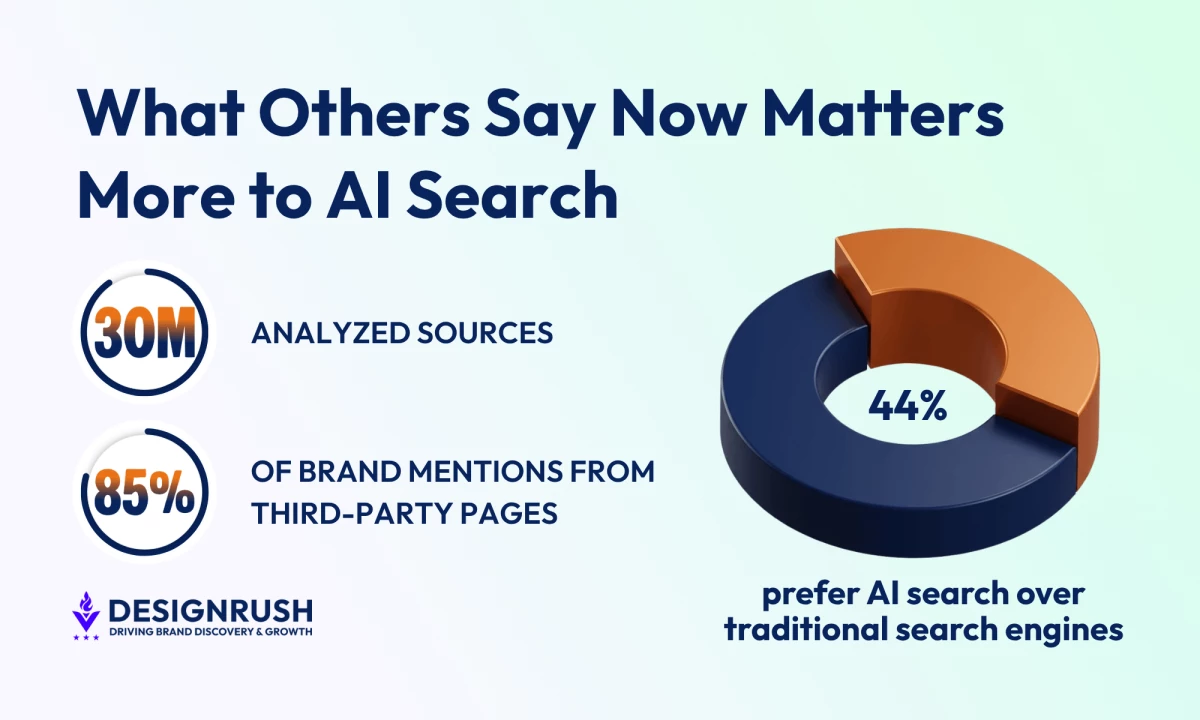
Up to 44% of consumers now prefer using AI search tools as their primary information source, McKinsey reported, compared to only 31% who still choose traditional search engines.
As such, AI systems are increasingly building answers from third-party discussions, reviews, and commentary instead of official company pages.
Traditional SEO relies heavily on rankings tied to owned websites, but AI visibility depends on how often a company appears across the wider web.
Research from Ahrefs and Soar found that third-party brand mentions correlate three times more with AI visibility than backlinks.
Web mentions showed the strongest connection to AI Overview presence, while branded anchor text, search demand, and discussions influenced whether companies appeared in AI-generated answers.
This is why PR coverage, customer reviews, podcast discussions, YouTube commentary, Reddit conversations, and industry reporting are important.
AI systems treat those signals as validation.
“About 85% of brand mentions in AI answers come from third-party pages, not your own site,” Todorov noted.
“Self-reported claims like ‘leading provider' on your own website carry little weight, while unresolved negative reviews actively suppress AI confidence.”
Up to 50% of citations in AI-generated search summaries currently belong to affiliate blogs, according to McKinsey.
This amounts to the combined share of user-generated content, academic research, retailer sites, news publishers, and brand websites.
It means that companies can’t assume that their homepage controls how AI systems describe them, as external discussion influences whether a business appears trustworthy enough to be cited in the first place.
What AI systems look for when citing sources
AI search engines extract content that is easy to crawl, easy to verify, and easy to reuse inside a direct answer.
And they do so based on a set of signals that mostly extend traditional SEO, Todorov explained.
These include:
- Pages should be crawlable and visible in search results before AI systems can consider them for citations because AI-blocking protections may reduce the likelihood of appearing in generated answers.
- AI engines run multiple related searches to build a response, increasing the value of ranking across clusters of connected queries rather than a single keyword.
- Titles, headings, and body text perform better when they closely match the user query and the type of answer an AI system is likely to generate.
- AI systems extract content more frequently from the first visible sections of a page.
- AI systems favor content built around concrete, verifiable claims rather than vague positioning language or overly cautious framing.
- Sections that explain a single concept clearly and independently are easier to extract, attribute, and reuse in generated responses.
- AI engines evaluate consistency across multiple sources and avoid content that reads as overly promotional, opinion-heavy, or difficult to validate.
And while schema markup and domain authority still help, AI systems evaluate whether the content can be reused confidently inside a generated response.
Overall, businesses need pages that answer customer questions directly in plain language.
FAQ sections can mirror the format AI systems already use when constructing responses, and consistent business information across directories and listings also helps AI engines verify identity and location details.
“To get cited in AI-generated answers, a small business needs to make its website extraordinarily clear about what it does, who it serves, and where it operates, because AI systems synthesize answers from sources they can easily parse and trust,” Todorov pointed out.
He also recommended writing for AI extraction rather than clicks.
That means shorter answer-first sections, descriptive headings, structured FAQ content, and language AI systems can reuse without heavy interpretation.
“Distributing content beyond your own site can increase AI citations by up to 325%,” Todorov added.
“Local businesses have a particular advantage since they can dominate geographic-specific queries more easily than national competitors.”
And the first step to doing all this starts by simply typing the most important customer questions into ChatGPT, Gemini, and Perplexity, and seeing what comes back.
“Most small business owners are surprised to find they're either completely absent or being described inaccurately,” Todorov said.
“That audit tells you exactly where to focus next: whether it's fixing your homepage clarity, building an FAQ page, cleaning up inconsistent business listings, or getting more reviews on the platforms AI is already pulling from.”
Why Fewer Visits May Become More Valuable
Earlier this year, Search Engine Land found that visitors arriving via LLM-generated referrals convert at rates as high as 18%.
This is significantly higher than traditional search traffic, which converts at roughly 2% to 3%, as per Apollo’s 2026 AI Search Benchmark Report.
These users often arrive after the AI system answered part of their question and validated the company as a credible option.
This means businesses may see fewer visits overall while dealing with more qualified buyers once someone lands on the website.
Then, the pressure moves onto infrastructure and conversion readiness.
Slow load times, downtime, poor mobile performance, and confusing page structures become more expensive when each visitor carries higher intent.
This means companies need websites that perform reliably enough to convert the smaller pool of high-intent visitors that AI systems are sending to them.
That pulls content strategy, reviews, PR, infrastructure, and reputation into the same equation.
Because appearing in AI-generated answers now depends on whether the wider web consistently backs up what the company claims.