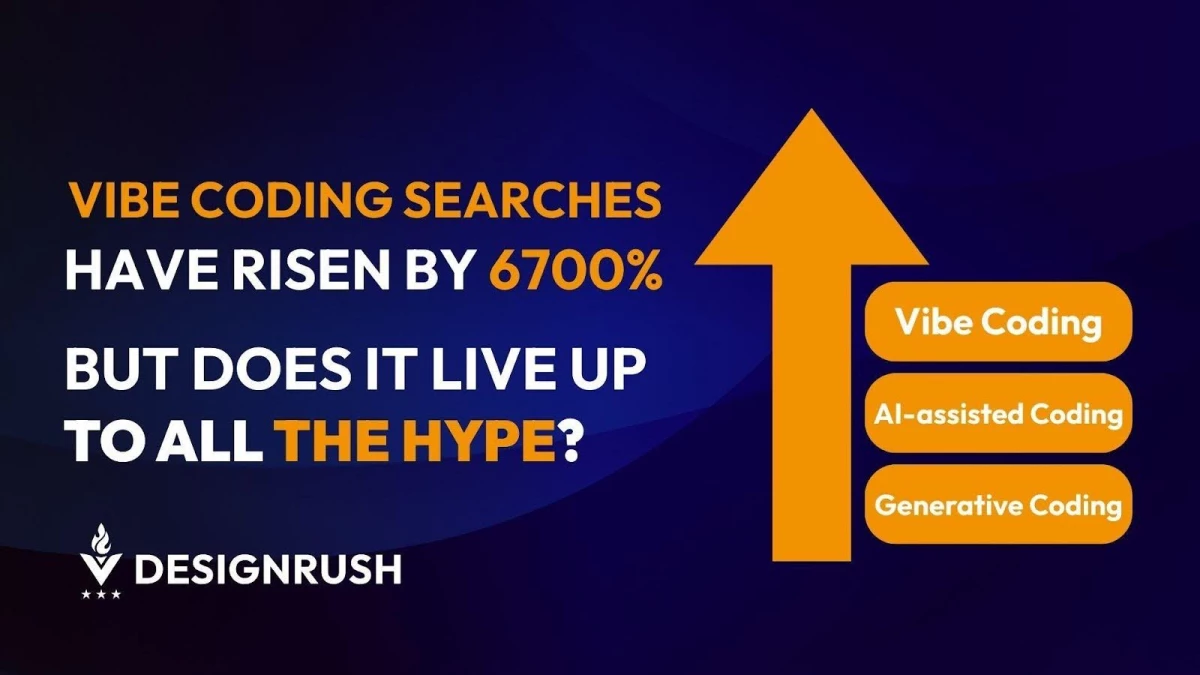

Vibe Coding Effectiveness: Key Points
- Searches for “vibe coding” surged 6,700% this year, signaling founders’ growing reliance on AI tools to fast-track prototypes.
- Prototypes built on vibe coding often collapse under real-world demands, exposing cracks in scalability, security, and team efficiency.
- The best approach is to use vibe coding as a launchpad, then transition quickly to structured development to avoid technical debt.
An Exploding Topics report revealed that vibe coding searches have increased by 6,700%, from March to May 2025.
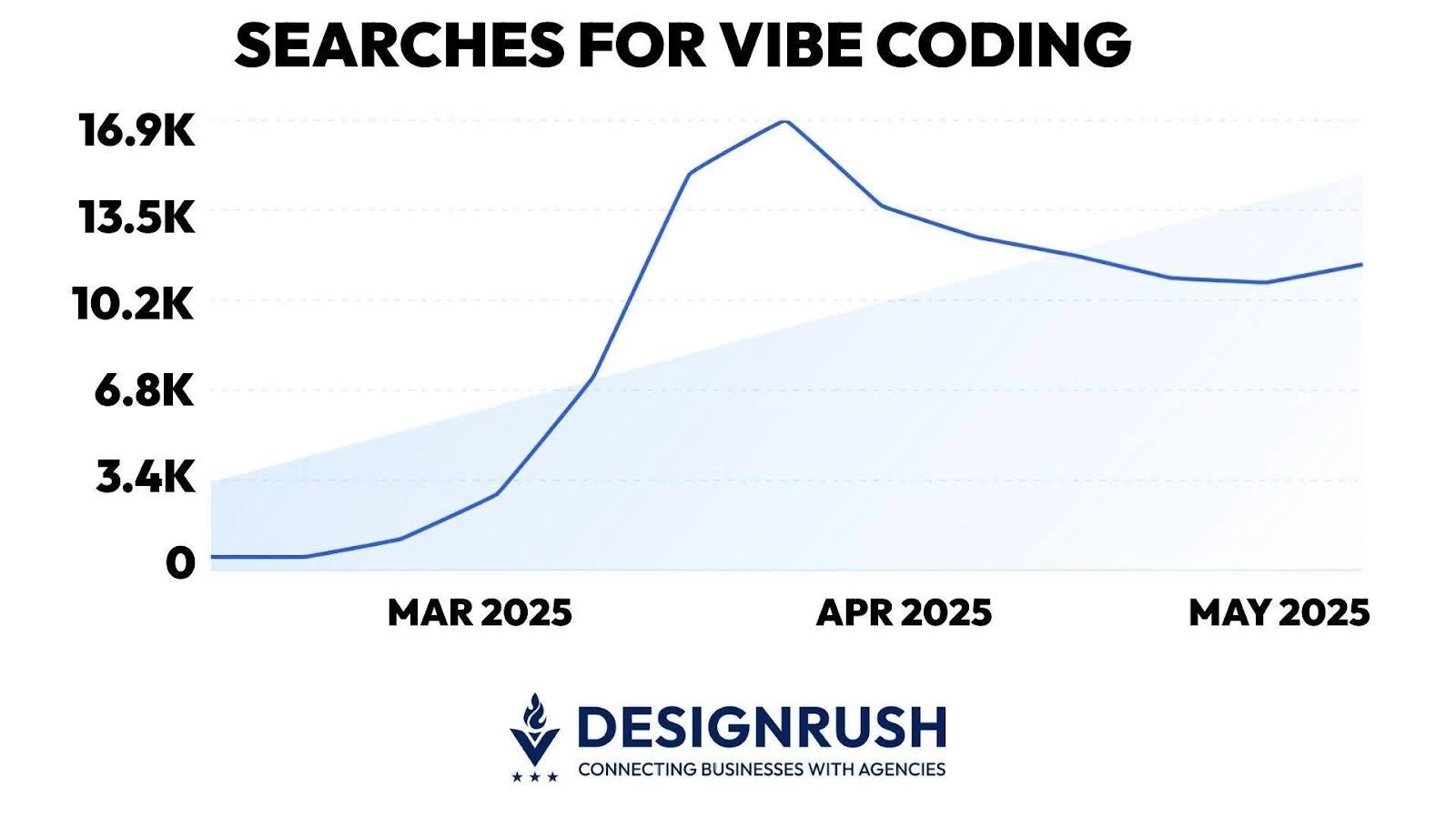
Vibe coding refers to AI-assisted coding tools that help non-technical founders build prototypes quickly.
The appeal behind this is obvious:
- Faster translation of ideas: Simple ideas can be turned into a functional demo in just a few days, which closes the gap between vision and execution.
- Free-flowing iteration: Founders are free to test, discard, or refine without barriers since there is no “sunk cost” other than time.
- Cost-efficient testing: Tests can be conducted early and often without the need to raise substantial capital.
And it works. Quite well, actually.
The same Exploding Topics report showed that the AI models used for vibe coding were passing 60% of rigid coding benchmarks or standardized tests that measure how well particular models were at completing coding tasks.
It was only a paltry 5% passing rate as recently as 2023.
Unfortunately, the advances in AI-assisted coding and the hype around it can mask some costly limitations.
In many cases, prototypes assembled this way encounter a variety of problems once scaled to full production or asked to be more than what it was initially vibe-coded to be.
This often leaves tech founders scratching their heads over broken programs with conflicting code.
That’s why agencies like Empat are seeing a surge in founders needing help to finish or scale their products.
“Vibe coding is at its best when it’s treated as a sketchpad. It helps validate whether the idea has legs, but it was never meant to carry the weight of a full product development cycle,” said Dmytro Naumenko, chief business development officer at Empat.
“The real value comes when teams know when to put the sketchpad down and invest in the kind of engineering that ensures the product can stand up to users, investors, and regulators alike.”
The Hidden Risks of Treating Vibe Coding as Product Development
Vibe coding accelerates early prototypes, but rarely holds up once additional features and scale are layered in.
Why? Small flaws that seem manageable at first quickly compound, becoming harder and costlier to fix later.
These cracks tend to show up in three critical areas:
1. Scalability gaps
Vibe coding often creates apps that look great at first, but behind the scenes, the code is messy and disorganized, which makes it hard to fix or grow later.
This introduces technical debt quickly, making it incredibly difficult to scale later on.
Additionally, vibe-coding tools are optimized to handle the most common use cases.
If the project requires custom logic and integrations, vibe coders may resort to using fragile workarounds, which only make scaling even more of a nightmare.
Without deliberate engineering, growth doesn’t strengthen the system. Rather, it exposes its weak points.
2. Security blind spots
Something people tend to overlook with vibe-coding tools is that these models are usually trained using a wide range of publicly available codes.
While it has likely been exposed to immaculate, expert-level code, it has also been exposed to code bases that may have been compromised by security vulnerabilities.
Since most vibe coders don’t have the right experience, these vulnerabilities are often left in the base.
3. Team bottlenecks
The longer vibe-coded prototypes sit at the center of a project, the more likely a team will be forced into bottlenecks that significantly derail progress goals or even the launch itself.
For example, teams have to delay performance tests or UX/UI refinement because they’re busy patching a glitch.
Worse, they can get trapped in an endless cycle where every new feature introduces bugs elsewhere in the code base, forcing constant debugging and rework.
All of this can easily lead to calling in a team of expert coders to take over the project, which somewhat defeats the purpose of vibe coding in the first place.
Redefine Vibe Coding as Your Opening Act
Overall, vibe coding works best when it’s viewed as a tool for proofs of concept (PoC) or prototypes, instead of the product development shortcut it's often presented as.
This shift in mindset is vital for founders who want to separate experimentation that sparks growth from the kind of tinkering that only piles up technical debt later on.
My name is Yaroslav. I`m the Backend Lead at Empat! Today, I will bust the myth that AI is coming for developers' jobs.
— empat (@EmpatTech) May 16, 2025
I shared our experience and provided an argument about why it`s not true.
Please take a look and tell us what you think about this post! pic.twitter.com/b0xLJxU4Vi
To summarize, follow these steps to help keep things organized and flowing smoothly:
1. Use vibe coding as validation
At this stage, use vibe coding to answer the most important question founders face: Does this idea deserve the time sink?
Create a PoC to demonstrate a product’s feasibility. This is the best time to showcase the basic principles of an idea, gauge market appeal, and generate interest from early investors.
From here, founders can continue vibe coding to make small adjustments based on first reactions to the PoC.
2. Transition to structured coding early
After the PoC has been validated, vibe coding can still assist with creating a prototype. However, this is also the time to start transitioning from pure vibe coding to structured coding.
The key here is to make the transition while the code base is still small enough to refactor without too many headaches.
This way, the project is able to ride the momentum vibe coding created without laying down pitfalls when development starts getting serious.
3. Bring in experts for MVP development
Once product-market fit has been established and the product is ready to move to the minimum viable product (MVP) stage, it’s highly advisable to bring in experts or start working with an experienced development agency like Empat.
“An MVP is essentially the foundation of the entire project. Everything that comes after will be built on top of it, so you can’t afford to have brittle code,” explained Naumenko.
“While AI and rapid coding help you get to this point quickly, experienced development teams ensure the product is secure, scalable, and aligned with long-term growth.”
The key takeaway here?
Founders who bring in the right expertise early avoid costly rewrites later and build confidence with investors, customers, and future partners.
Pass the Baton From Vibes to Code
For all its flash, vibe coding is still just a tool. It’s powerful but limited.
Founders who treat it as the end-all of their development cycle often learn the hard way that what looks solid is really a sandcastle, meaning it’s impressive at first, but unable to withstand real-world demands.
The companies that succeed are the ones that balance speed with structure, using vibe coding to spark ideas and structured engineering to make them endure.
That’s how quick wins become products investors, customers, and markets can count on.