
Anthropic’s new Cowork tool, built almost entirely by AI in 10 days, has given the “vibe coding” crowd plenty to cheer about, as well as plenty for product teams to worry over, TechCrunch reported.
The tool has become a tidy example of how quickly AI can now get a product off the ground, but the bigger question is what happens once the demo ends and real users start poking at it.
That’s why David Barlev, founder and CEO of Goji Labs, says teams still need discipline.
The firm, which has worked on more than 500 product launches, argues that AI can speed up execution, but it doesn’t replace the hard part of deciding what should be built in the first place.
Barlev puts it bluntly:
“The biggest risk is building something fast that shouldn’t have been built at all.”
That’s not anti-AI. But it’s a reminder that shipping sooner doesn’t magically turn a weak idea into a strong one.
Product Decisions Still Matter More Than Speed
The rush to build has a habit of nudging teams into making slightly questionable decisions.
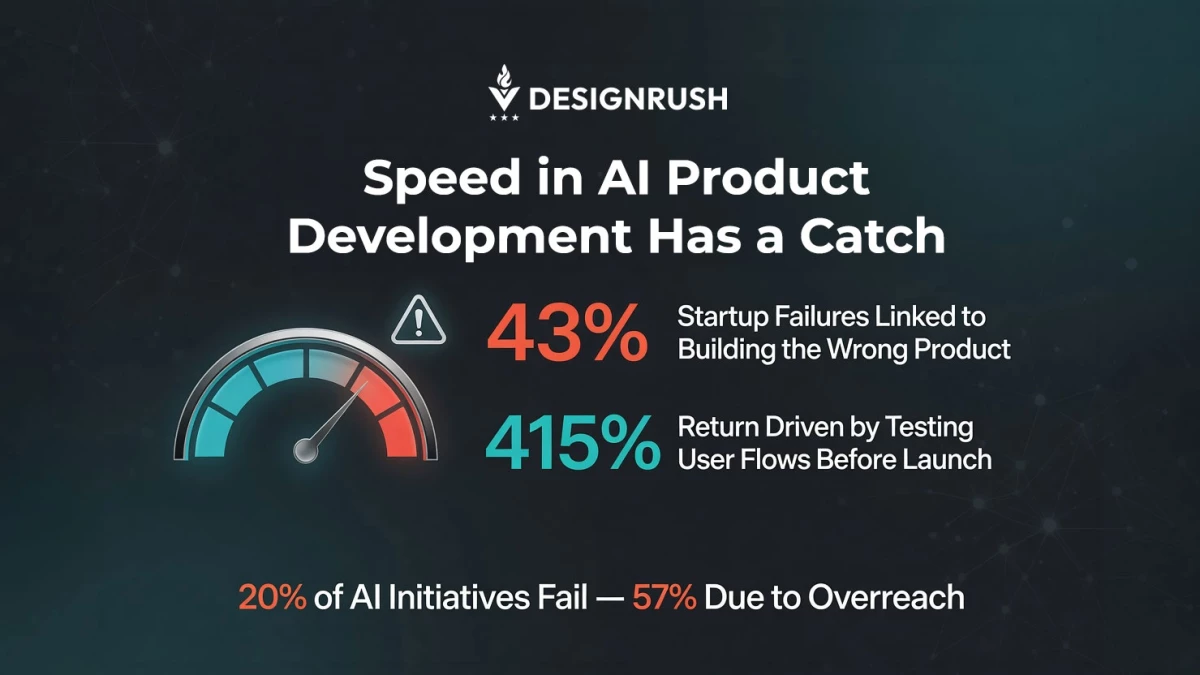
Case in point, 43% of startup failures stem from poor product-market fit, according to CB Insights.
That number is the kind of wake-up call founders only appreciate after they’ve spent months polishing a product nobody asked for.
AI can make the build faster, but it can’t rescue a product that never matched a real problem.
Barlev said the teams that do this well keep speed in its lane.
“Speed should be applied to the right layer,” he said. “AI is great for accelerating builds, but validation and architecture still need intention.”
That’s the real friction point for product leaders right now.
The temptation is to use AI to blast through the whole process and call that efficiency.
More often, it just moves the mess along faster, especially when validation is skipped.
A Forrester Consulting TEI study found that validating user flows and designs before launch delivered 415% ROI and $9.4 million in benefits, largely by reducing developer rework.
That value shows up early, when teams test flows properly and catch issues before they turn into expensive rebuilds after launch.
Risk Grows as AI Adoption Speeds Up
Gartner expects a quarter of enterprise generative AI applicationsto face at least five minor security incidents annually by 2028.
That kind of jump proves that faster product creation can also mean faster exposure when safeguards lag.
The product may look finished on the surface while the plumbing underneath is still doing interpretive dance.
Barlev says the early warning signs are usually seen in confusion from users, inconsistent flows, or “features that technically work but don’t connect to a clear outcome.”
“Another signal is when teams struggle to explain what the product actually does or who it’s for. That’s almost always a strategy gap, not a development issue,” he said.
This kind of failure doesn’t show up in a launch video. Instead, it shows up when customers hesitate, click around, and quietly leave.
The bigger operating question should behow teams use AI without handing over judgment to it.
McKinsey found that organizations seeing real impact from AI are nearly three times more likely to redesign workflows.
That suggests the better AI adopters aren’t treating it like a magic shortcut.
They’re changing how work gets done so that the tool fits into a process with priorities, checkpoints, and a clear sense of what success looks like.
That’s also why the current excitement around Cowork doesn’t eliminate the need for product strategy.
Less of the energy goes into raw code generation.
Rather, more of it needs to go into user needs, roadmap decisions, and the tradeoffs that determine whether a product can survive outside a showcase.
Fast builds can impress people, but clear, usable products keep them around.
“Human teams are still responsible for defining what matters,” Barlev said. “That includes user experience, tradeoffs, and long-term direction.”
He added, “AI can generate solutions, but it doesn’t understand context, trust, or business impact the way a product team does.”
That’s the part executives should keep in view.
The machine can draft the thing. Humans still have to decide whether the thing deserves to exist, who it’s for, and how it earns its place.
That’s also where UX becomes more than a design exercise.
What Product Teams Should Do Next
A product with weak flows, unclear logic, or vague purpose can still look modern in a demo. But once users get their hands on it, the cracks show.
The product may have been built in days, but the trust required to support it takes much longer to earn.
Twenty percent of AI initiatives fail, with 57% tied to projects that tried to do too much too quickly, according to Gartner.
Which means that tighter scope and clearer priorities tend to outperform ambitious builds that lack direction.
Anthropic’s Cowork tool shows how quickly a product can come together.
What it doesn’t change is what determines whether that product holds up once people start using it.
Teams still need clear user flows, defined outcomes, and a roadmap grounded in what they’re trying to learn.
Use AI to compress execution, not decision-making.
Test early, keep scope focused, and treat UX as part of the product’s business logic rather than a layer added at the end.
AI can get a product into the market faster, sure.
Whether it stays there depends on whether it works and whether it solves a real problem.