
Fluctuating traffic isn’t the core reason why scaling systems end up with failed jobs or states. Rather, it’s because of the rigidity of the base architecture.
No matter how fast the release cycles are, it fails to keep up with the pace.
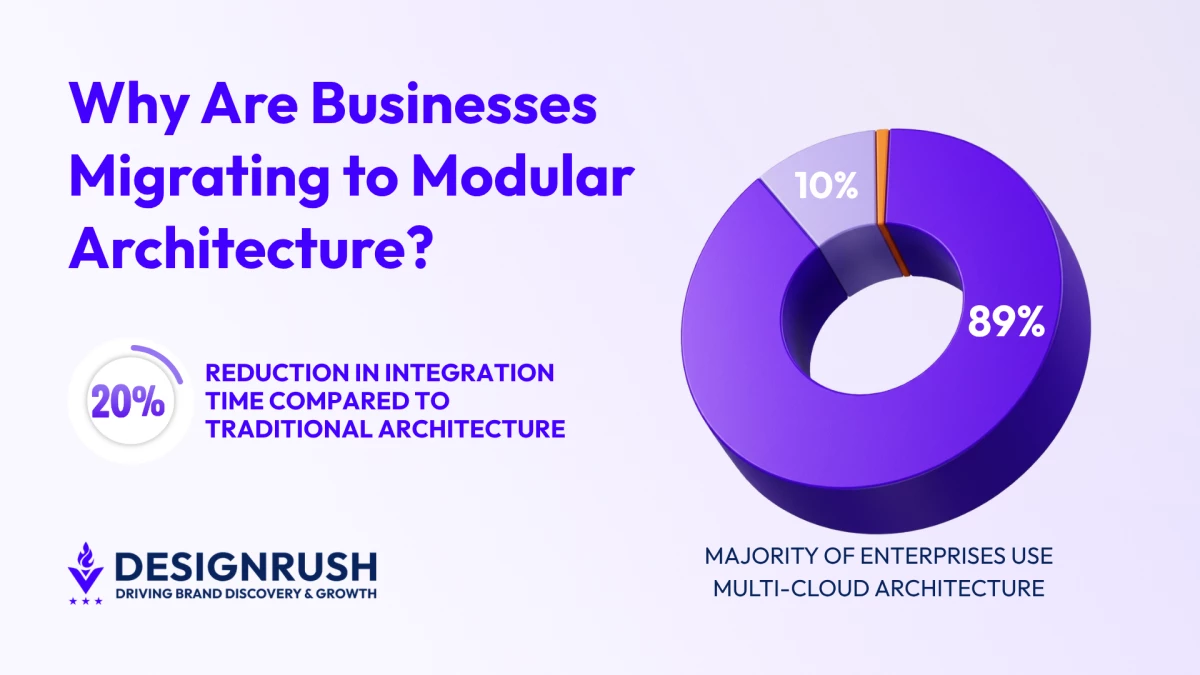
Flexera's 2024 State of the Cloud Report revealed that 89% of enterprises now operate across multiple cloud environments.
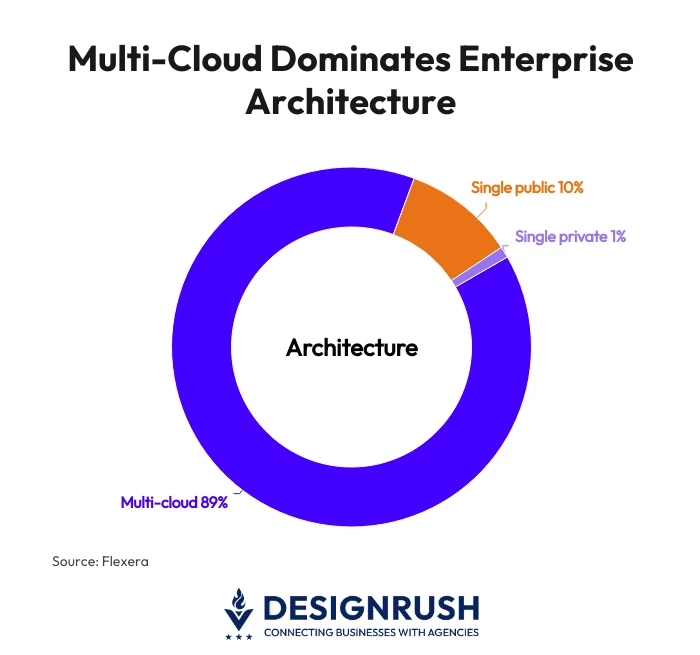
This shift not only signals an inclination towards a flexible infrastructure, but it also reflects a broad-scale reimagination of how software systems should accommodate growth.
For founders and digital leaders building web applications expected to scale, the architecture decision is not a detail to revisit after launch. It is a business decision embedded on day one.
Why Monolith Architecture Works
A monolithic architecture is where all application components are built, tested, and deployed as a single unit.
It remains a sound choice for most systems in their early stages because of its practical advantages:
- Features can be shipped faster without having to manage multiple distributed systems simultaneously.
- Issues can be debugged easily, as there’s no need to trace requests across the systems.
- Consistency will be at the optimal levels, thanks to reduced risks of data being out of sync.
For example, Amazon, now among the most referenced examples of large-scale distributed architecture, began as a tightly coupled monolith.
However, the company recently made the decision to decompose.
This decision wasn’t made because monoliths are fundamentally flawed.
It was made because the organization reached a scale at which a single deployment unit had become a coordination problem across hundreds of engineers.
That distinction matters since monoliths don’t fail because of traffic volume alone. They fail because of team scale.
The Signals That a System Has Reached Its Ceiling
The signs that a transition from a tightly coupled monolith into a different architecture is necessary tend to accumulate over time.
Specific indicators include:
- A feature change in one module triggers end-to-end regression testing of an unrelated module.
- Deployments are becoming scheduled events requiring coordinated release windows rather than a routine part of the development cycle.
- Multiple engineers end up blocking each other within the same codebase.
- A shared database is becoming a performance bottleneck for unrelated services querying it simultaneously.
Google's 2024 DORA (DevOps Research and Assessment) State of DevOps Report found that elite-performing engineering teams deploy to production multiple times per day.
Meanwhile, low-performing teams deploy once per month to once every six months.
Architecture is one of the primary structural factors separating these two groups.
A tightly coupled monolith does not make high deployment frequency impossible, but it makes it progressively harder as team size grows.
Alternative Architecture Options
1. Microservices: Real Benefits, Real Operational Costs
Microservices architecture decomposes an application into independently deployable services, each owned and operated by a separate team.
The benefits are documented and substantial. Teams can build, test, and release their services without coordinating changes across the entire engineering organization.
Individual services can be scaled based on actual demand rather than provisioning the entire system uniformly.
A great example of this would be Netflix.
Netflix's migration to microservices, detailed across multiple posts on their engineering blog, enabled continuous deployment at scale for a system now serving over 300 million subscribers across global markets.
However, the organizational preconditions required to realize that outcome are substantial.
A 2020 O'Reilly survey on microservices adoption found that 28% of respondents have already been using microservices for at least three years.
Another 61% of respondents claim they’ve been using microservices for a year or more.
Despite the incredible numbers, the top challenges quoted were not from a technical standpoint.
These were operational challenges such as debugging across distributed services, managing inter-service communication, and building the observability infrastructure required to monitor a distributed system reliably.
In a nutshell, microservices solve a team-scale and organizational autonomy problem by introducing a distributed systems problem in exchange.
Without the DevOps and platform maturity to manage that complexity, the trade-off is frequently unfavorable.
This is particularly the case for teams under 50 engineers working against an active product roadmap.
2. The Modular Monolith: A Deliberate Intermediate Stage
The modular monolith has gained traction as a practical architectural pattern.
The approach maintains a single deployable application while imposing strict internal boundaries between modules, each carrying defined responsibilities and communicating through controlled interfaces.
This structure preserves the operational simplicity of a monolith:
- One deployment pipeline
- One infrastructure environment
- One codebase to navigate
But at the same time, it enforces the organizational clarity that microservices are typically adopted to create.
All of these advantages come together to make modular monoliths worth adopting for teams seeking internal structure without the overhead of distribution.
A well-structured modular monolith also makes a future migration to microservices significantly less disruptive.
The internal boundaries that already exist become the natural extraction points for services, rather than requiring teams to untangle a tightly coupled system under time pressure while continuing to serve production traffic.
Most of the client platforms we build at Quixta start as well-structured monoliths, not because microservices are wrong, but because our clients are typically pre-scale.
What we've learned is that the internal discipline matters more than the deployment model.
If your modules have clean interfaces and clear ownership from day one, you can extract services later without burning the house down.
If they don't, microservices just distribute your mess across multiple servers.
Implications for Digital Leaders
Debating whether to opt for monolith architect or microservices isn’t the question tech founders and digital leaders should be asking.
Instead, they should ask “What is the current team size, deployment cadence, and growth trajectory required to foster seamless growth?”
Overall, a well-structured modular monolith can evolve into a distributed architecture only when signed off with respect to the organizational policies and regulations.
If you force your product prematurely into microservices, you will be spending unnecessary time on engineering cycles. That’s because you then need to manage infrastructure complexities rather than building the product.
In other words, a true scalable architecture is the one that’s built to sustain organizational operations today, backed by an internal structure that can grow seamlessly with time.