
Impact of Chrome’s New Release Cycle: Key Findings
- Google Chrome is moving from a four-week to a two-week release cycle on September 8, 2026, doubling update frequency.
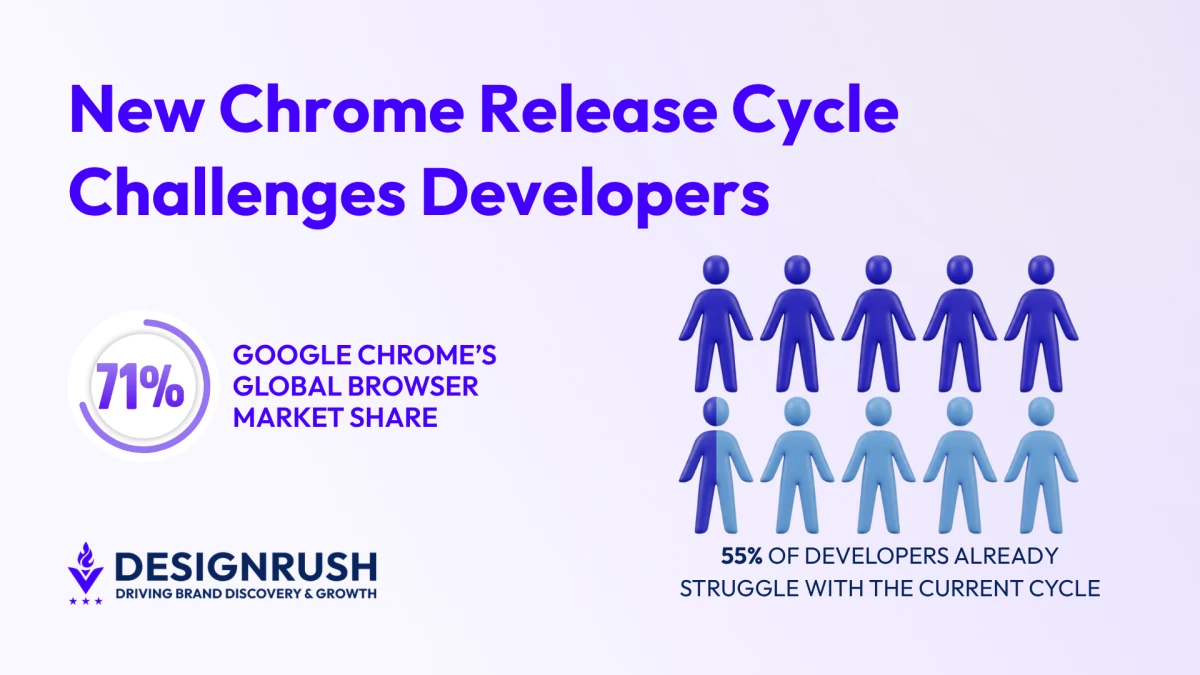
- But 55% of development teams already struggle with flaky testing, meaning faster Chrome releases could raise deployment pressure.
- Quixta says faster Chrome releases will reward teams built for continuous iteration, creating an edge for prepared developers.
The world’s most-used browser is speeding up again, and development teams may need to rethink how they think about web development.
In a March 3 Chrome for Developers blog post, Google announced that Chrome will transition from its four-week release cycle to a two-week cycle.
This change effectively doubles the rate Chrome receives new features, security updates, and platform fixes.
With this change, Google aims to provide developers and users immediate access to the latest performance improvements, fixes, and new capabilities.
Likewise, the search giant says the smaller scope of each release minimizes disruption and simplifies post-release debugging.
The accelerated release cycle will begin on September 8, 2026, with Chrome 153.
This change will affect a significant number of people, given that Chrome’s global browser market share sits at 71.37%, per estimates from SQ Magazine.
Strategic Implications and Challenges
The shortened cycle is expected to benefit users but pose a challenge for developers.
The compressed cycle means developers have less time to test, adapt, and validate between Chrome versions.
Similarly, they’ll need to account for how faster releases affect existing code and user-facing behavior.
Both magnify a common problem among developers.
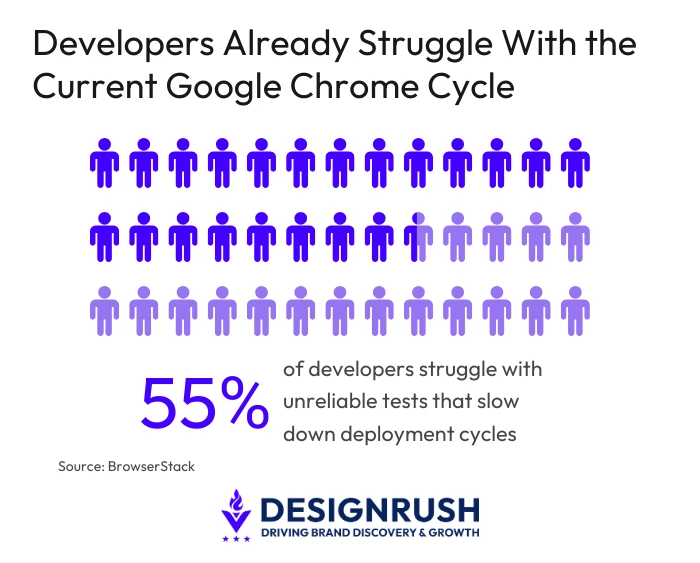
According to a BrowserStack report, 55% of development teams already struggle with flaky, unreliable tests that slow down deployment cycles.
 Overall, the implications of this change will come in the following ways:
1. Faster evolving production code
Modern websites depend on frameworks, libraries, plugins, analytics scripts, and APIs layered together over time.
When browsers evolve faster, production code must keep pace. Small compatibility issues that once waited for quarterly maintenance can become recurring operational problems.
2. Smaller but more frequent changes
Google argues that smaller release scopes reduce disruption and simplify debugging. In many cases, that may be true.
But reduced disruption per release can still add up to a higher cumulative workload when changes arrive twice as often.
3. More expensive technical debt
Legacy codebases and brittle dependencies become harder to sustain in fast-moving environments.
What once seemed manageable under slower release cycles can become a constant source of friction when the platform underneath keeps changing.
Despite these looming issues, leading web development experts, like Quixta, see this less as a threat and more as a market separator.
“Faster browser velocity rewards organizations built for continuous iteration,” said Quixta Founder Anand Ashok.
“Teams with automated testing, flexible front-end systems, and clear deployment processes will adapt smoothly, allowing them to rise above the competition."
"This benefits both the developers and the brands that rely on them.”
In other words, Chrome’s faster release cycle may expose a widening divide.
Teams built for resilience will move with the browser. Teams built around reactive fixes may spend the next year or so trying to catch up.
Build Websites That Stay Stable as the Web Speeds Up
Future-proofing websites doesn’t mean web development teams must predict the content of every browser update. That’s a losing battle.
Instead, Ashok recommends replacing reactive maintenance with continuous readiness.
“Teams that treat web delivery as an operating capability instead of a maintenance task are the ones best positioned to adapt,” he said.
“When release velocity increases, the gap between disciplined teams and reactive teams becomes visible very quickly.”
More specifically, Ashok recommends teams to do the following:
Adopt Continuous Pre-Release Monitoring
Development teams should actively track the Chrome Status Roadmap, Chromium Dashboard, and upcoming release notes rather than waiting for Stable releases to land.
Additionally, the Chrome Beta channel gives developers a 4-6 week preview of features coming to the Stable version, while the Dev channel provides a 9-12 week preview.
That extra lead time both monitoring options can provide can turn a production incident into a routine fix handled during normal sprint cycles.
Move Compatibility Testing Earlier and Make It Continuous
A two-week release model makes end-stage compatibility testing increasingly unreliable.
Tests may pass early in the week, Chrome may update days later, and user-facing issues can surface immediately after deployment.
The stronger model is continuous cross-browser testing during development, pull requests, staging validation, and post-release monitoring.
When testing happens throughout the lifecycle, teams can catch problems before customers do.
Use Progressive Enhancement Architecture
Core website experiences should remain functional even when newer browser features behave differently or fail unexpectedly. This is where progressive enhancement comes in.
Instead of making modern APIs a requirement for basic usability, progressive enhancement builds the essential experience first. Then, it layers advanced features on top when the browser supports them.
This approach limits the damage when browser updates introduce temporary bugs, inconsistent behavior, or partial support for newer capabilities.
Adapt Before Chrome Becomes The Bottleneck
For years, development teams found comfort in the slow and steady pace of browser updates, which allowed them to take their time to get things right.
The new updated cycle for Chrome has flipped that script.
Now, slow QA cycles, manual testing, fragile dependencies, and delayed approvals have become direct and serious obstacles to speed, stability, and customer experience.
And if internal processes still move at yesterday’s pace, Google Chrome will start exposing that gap every two weeks.