
Google AI Overview Citation Shift: Key Findings
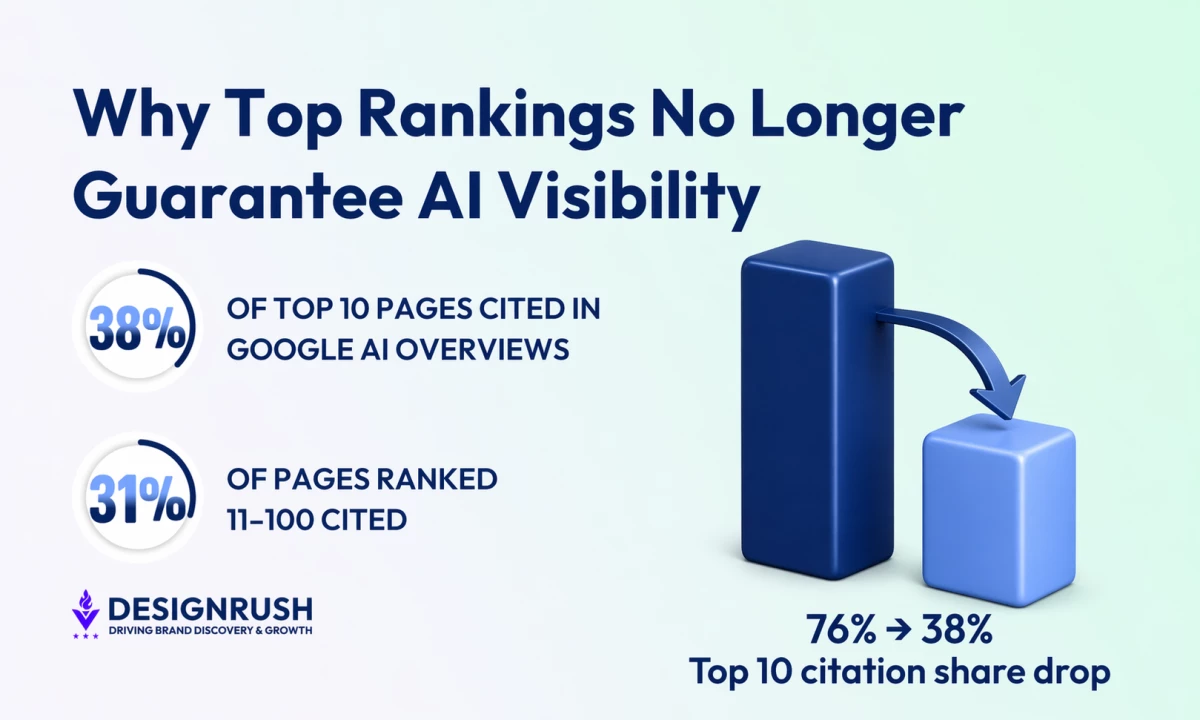
- Only 38% of pages cited in Google AI Overviews also rank in the top 10 for the same query, down sharply from 76% in Ahrefs’ July 2025 study.
- The rest of the citations are now split almost evenly between pages ranking 11 to 100 (over 31%) and those beyond the top 100 (31%), suggesting visibility in AI answers is no longer tied closely to page-one rankings.
- YouTube is showing up heavily in citations that do not rank organically for the same query, reinforcing the need for brands to build authority across formats, not just traditional webpages.
Only 38% of pages cited in Google AI Overviews now rank in Google’s top 10 results for the same query.
That’s according to a new Ahrefs analysisof 863,000 keywords and 4 million AI Overview URLs.
In Ahrefs’ previous July 2025 study, that number was 76%. That is a sharp drop.
It also changes the SEO conversation around AI visibility.
The remaining citations are split almost evenly, with just over 30% coming from pages ranking 11 to 100 and a similar share from pages beyond the top 100.
That suggests ranking on page one is becoming a less reliable signal for whether a page will be cited in an AI Overview.
Leading digital marketing agency eSEOspace says the shift should push brands to think beyond single-keyword rankings and focus more on authority, topical coverage, and citation-friendly content structures.
“This data confirms what brands are starting to feel in practice: ranking well is no longer the full picture.
“If your content is not authoritative enough to be pulled into AI-generated answers, page-one visibility alone won’t protect you,” says Irina Shvaya, founder of eSEOspace.
Visibility now depends on being a source AI can cite.
AI Overviews Are Pulling From Far Deeper in the Index
Editor's Note: This is a sponsored article created in partnership with eSEOspace.
Ahrefs ran two versions of the analysis.
The first counted all result types on the page, including ads, featured snippets, People Also Ask boxes, video packs, and organic listings.
The second filtered results down to standard organic listings only. Both produced similar findings.
In the organic-only version, over 37% of cited pages ranked in the top 10, while nearly 37% did not rank in the top 100 at all.
Ahrefs says that suggests some AI Overview citations come from pages that surface in SERP features or sub-query results rather than in traditional organic rankings for the exact query.
Ahrefs points to two likely reasons for the gap.
First, it says its citation detection has improved since the earlier 2025 study, which means the two datasets are not directly comparable.
Second, it points to Google’s fan-out query process, where Google breaks an initial query into multiple related sub-queries, then cites pages that perform well across that wider cluster.
Google has not confirmed any specific change to fan-out behavior, but it did roll out Gemini 3 as the default model for AI Overviews globally in late January 2026, giving the timing more weight.
That matters because it suggests brands may now be judged less on whether they hold one ranking position and more on whether their content covers a topic deeply enough to support related queries.
“The old model rewarded the page that ranked highest for one term.
“AI Overviews appear to reward the source that helps Google answer a cluster of related questions with enough clarity and trust,” Shvaya explains.
BrightEdge’s Data Points in the Same Direction
Ahrefs is not the only firm seeing this shift.
A separate BrightEdge analysis published in February found that only about 17% of AI Overview citations overlapped with pages ranking in the organic top 10.
BrightEdge also reported that roughly five out of six AI Overview citations come from content that is not on page one of traditional results.
The methodologies differ, so the studies are not directly comparable.
Still, both point in the same direction: AI Overviews are citing far more content from outside page one than many marketers expected.
That has serious implications for GEO and AEO strategies.
If AI answers are increasingly assembled from multiple related signals, then publishing one strong page around one target keyword is not enough.
Brands need broader topical depth, stronger internal relationships between pages, and content that AI systems can parse, trust, and reuse.
YouTube Keeps Showing Up Even When It Does Not Rank
Another notable signal in the Ahrefs study is YouTube.
Among AI Overview citations that did not rank in the top 100 organic results for the same keyword, over 18% were YouTube URLs. Overall, YouTube made up nearly 6% of all AI Overview citations in the Ahrefs dataset.
Ahrefs also says YouTube has become the most-cited domain in AI Overviews in its broader tracking and has grown 34% over the past six months.
That lines up with other recent studies. Search Engine Journal noted that SE Ranking’s Jan 2026 study of German health queries also found YouTube outranking official medical sources in AI Overview citations.
This is a reminder that AI visibility is becoming format-agnostic.
If Google sees a video, forum page, or supporting asset as useful for part of the answer, it may cite that source even when it does not surface in traditional results for the exact query.
“Brands still treating AI search like a text-only SEO problem are already behind. If YouTube is being cited this often outside organic rankings, authority now has to travel across formats,” adds Shvaya.
Why GEO and AEO Need to Change Now
The bigger takeaway here is not that rankings no longer matter.
They still do. But they no longer tell the whole story.
The AI layer is forcing brands to optimize for something wider: topical authority, clean structure, entity clarity, and enough supporting coverage to answer follow-up questions Google may generate through fan-out.
That changes how GEO and AEO should be approached.
Pages need to be built for citation, not just clicks. That means direct answers, strong sectioning, factual support, consistent terminology, and enough breadth to support adjacent intents.
It also means brands need to stop measuring success only by whether a page ranks in position three or seven.
If AI Overviews are pulling from across the index, then content strategy needs to focus on becoming the best source on the topic, not just the best-ranking page for the exact phrase.
“The next phase of optimization is less about chasing one ranking and more about building a body of content AI can trust across an entire topic.
“That is where GEO and AEO start to overlap in a meaningful way,” Shvaya explains.
What Brands and Agencies Should Do Nex
The practical move now is to audit content for AI usefulness, not just keyword targeting.
Brands should look at whether they cover related subtopics, whether their pages answer questions directly, and whether they have authority signals beyond the page itself.
To compete, brands need to focus on:
- deeper topical coverage
- stronger internal linking across related themes
- citation-worthy structure
- broader authority signals from video, PR, reviews, and third-party mentions
Because if the gap between rankings and citations keeps widening, the winners in AI search will not be the pages that rank best for one phrase.
They will be the sources that help Google answer the full question.
“The brands that will win in AI search are the ones that think beyond rankings and focus on becoming a trusted source across an entire topic.
“If your content can’t support how AI connects questions together, it won’t be surfaced when it matters most,” says Shvaya.
Want to improve your visibility in AI search and stay competitive in 2026? Check out our selection of the Best SEO Agencies to help you build authority, structure your content, and optimize for GEO and AEO.