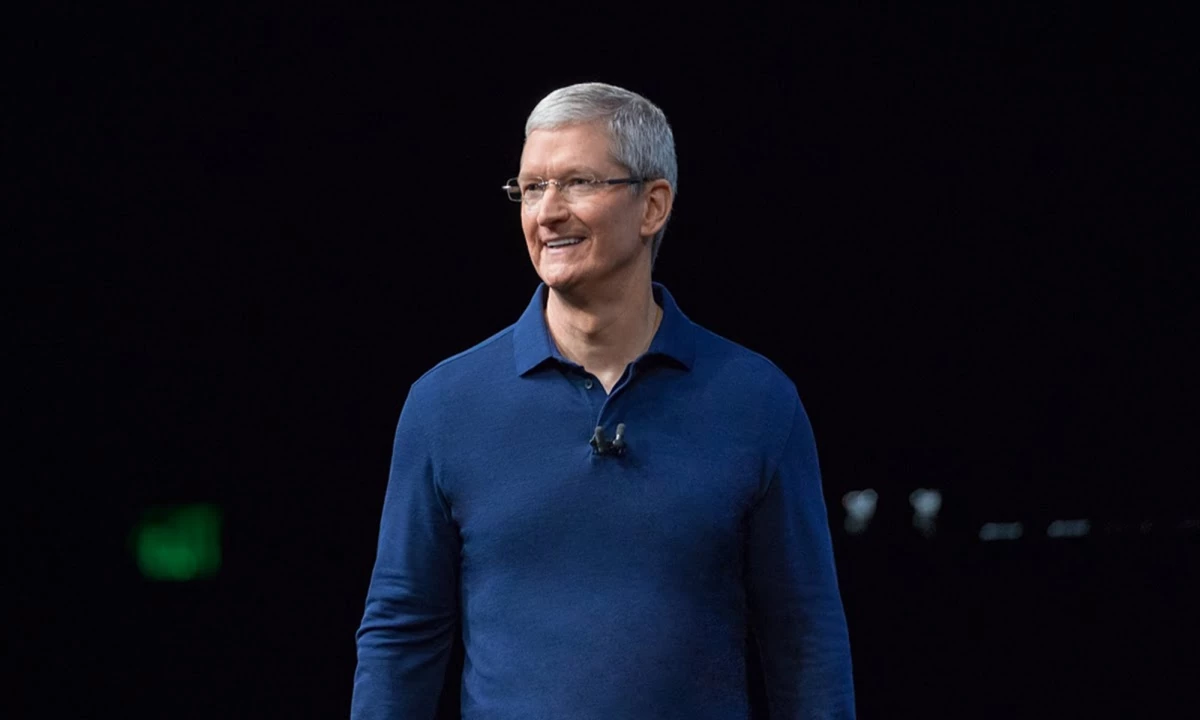

Tim Cook worked his last day as Apple's CEO on August 31, 2026.
John Ternus, who ran hardware engineering for five years, took over the next morning.
Cook isn't leaving the company; he's staying on as executive chairman of the board.
Bank of America put a number on what his 15 years produced as Apple CEO.
Analyst Wamsi Mohan calculated in an August 20 report that Apple's market cap grew by roughly $32 million an hour, every hour, for nearly 15 years.
This is the figure that Ternus now has to live up to.
Apple's stock traded at a split-adjusted $13.35 on the day Cook became CEO in August 2011.
It closed above $316 the week he handed off the role to Ternus, a gain of 2,272% in 15 years.
Market cap grew from roughly $350 billion to $4.5 trillion over the same stretch.
Run the number yourself, and it comes out to roughly $768 million a day, every day, for 15 years.
Apple Services alone now generates more revenue in a year than the entire company did in 2011.
The brand builder's job is to know what to protect and what to rebuild, usually while something is going wrong.
Here's a look at how Cook got here, starting with the job nobody thought he could fill.
The 2011 Succession Problem
Cook became Apple's CEO on August 24, 2011, six weeks before the company's legendary chairman and co-founder, Steve Jobs, died on October 5.
Jobs spent his second run at Apple proving that the product itself had to be the innovation.
He then wrapped this idea in one of the most recognizable brand identities in modern business.
Jobs was the identity as much as the products were, and many people assumed that Apple's pull would leave with him.
Analysts and the business press spent most of 2011 asking whether Cook could hold the brand together without its founder.
Cook's answer was to change almost nothing about how Apple marketed itself.
He then changed almost everything about how the company operated behind its marketing.
The Agency Made for One Client
Apple's creative work has run through the TBWA network since 1997, when Steve Jobs brought back Chiat\Day for the Think Different campaign.
TBWA spun out a dedicated shop, TBWA\Media Arts Lab, in 2006 to work on Apple and nothing else.
Media Arts Lab has held the account for 20 years with the iPhone maker as its only client.
Cook inherited this arrangement and kept it intact for all 15 years.
Apple's advertising stayed minimal and product-forward through every launch he oversaw.
Cook changed a great deal about what Apple's marketing actually sold.
Shot on iPhone built a global campaign out of customer photos in 2015.
Privacy became its own advertising territory with the "Privacy. That's iPhone." campaign in 2019.
The keynote is Apple's biggest owned marketing channel, and Cook rebuilt it, too.
The company moved its keynote presentations to pre-recorded films at WWDC 2020 during the pandemic and never went back.
Executives still appear at Apple Park, but the announcements themselves have been on tape for six years.
Through all of it, Media Arts Lab kept the account, and Apple's ads kept leading with the product rather than the spec sheet.
Cook revived Jobs's "one more thing" line at the September 2014 keynote that introduced the Apple Watch.
He then used it again in later announcements.
Apple valued the phrase enough to fight Swatch for it in Australia, Switzerland, and the U.K.
The company lost all three, including a March 2021 London ruling that let Swatch register the line.
Losing the trademark cost Apple nothing, because the association was already fixed in customers' heads.
Twenty years with a single agency builds brand consistency that no internal style guide can enforce on its own.
Apple's Highest-Margin Business
Cook grew Apple Services into the company's most profitable line.
It accounted for 26% of company revenue in fiscal year 2025, but its 75.4% gross margin makes it worth far more than a quarter of the business.
Apple's products run at 36.8%, so every Services dollar does roughly twice the work of a hardware dollar.
Hardware is what creates the customers that Services then sells to, and the iPhone held the center throughout at 50.4% of revenue in 2025.
Cook moved the Mac to Apple silicon in 2020, replacing Intel processors with chips that the company designs itself.
The switch reset the product line without changing how Apple sold it.
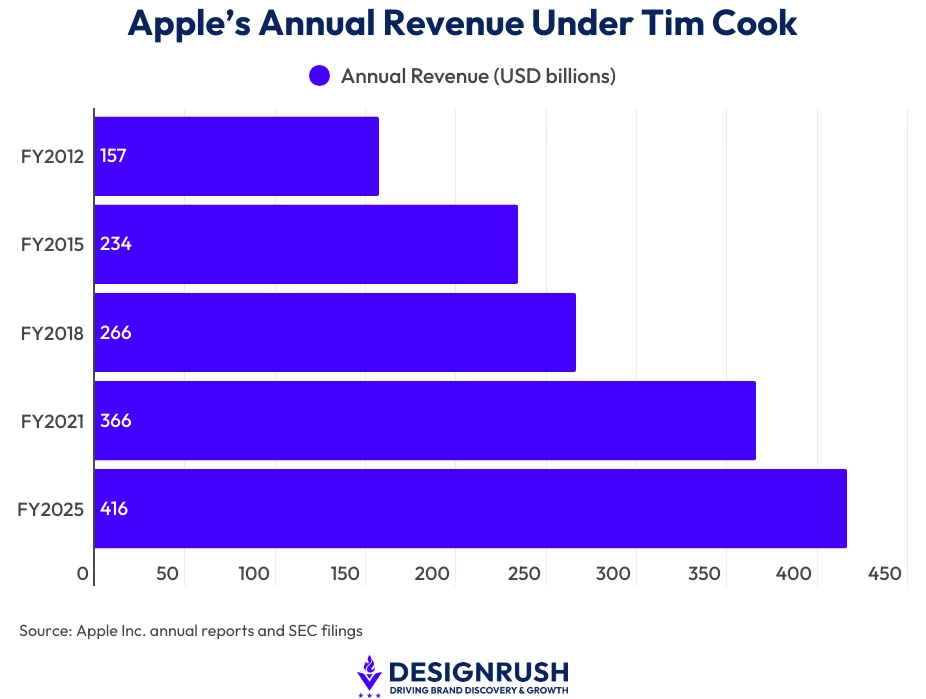
Annual revenue grew from $108 billion in fiscal 2011 to $416 billion in fiscal 2025.
Cook's growth came from selling more to people who already owned an Apple product.
An installed base of over 2.5 billion active devices gives the tech brand a distribution channel that no competitor can buy into.
13 Straight Years at No. 1
Interbrand has ranked Apple as the world's most valuable brand for 13 consecutive years.
It covers more than a decade during which Apple's biggest launches were accessories for the iPhone.
Apple Watch, AirPods, and Vision Pro each widened the product line, though the iPhone remains the only product that changed how people behave.
Apple's value grew anyway, because the brand identity was settled enough to hold without a yearly reveal.
Mohan credited Cook with ending Apple's dependence on the product cycle.
He wrote that Cook left behind "an institution capable of producing growth, cash flow, customer loyalty, and innovation."
But this 13-year streak came with a warning in Cook's final year as CEO.
Apple's Interbrand value fell 4% in 2025, while Nvidia's climbed 116% to reach 15th place.
Ternus takes over a brand that is holding its rank while a competitor closes the distance.
Here are three key things that brand leaders can take from how Cook approached the job:
- Audit what's actually working before changing it: A new leader's first year should confirm which brand assets are producing returns before any of them get touched.
- Treat identity and business model separately: A brand can hold its voice for a decade while the revenue underneath it gets rebuilt twice.
- Hand a successor a stable foundation: A departing leader's last job is leaving behind an identity the next person can argue from.
Brand power compounds across leadership changes, but only if the one in the chair knows what's worth protecting.
Our Take: Was Discipline Cook's Real Innovation?
Discipline is the least glamorous thing that a CEO can be praised for, and it usually only gets praised in hindsight.
We'd argue that it was Cook's real innovation, though discipline asked more of him than it sounds.
Jobs handed him a brand so specific that changing it would have destroyed value.
He gracefully endured 15 years of pressure to prove that he was not just the operations guy, and he never once reached for a rebrand to answer it.
Cook's Apple achieved growth through services, new product categories, and a customer base that got more valuable every year.
The problem is that protecting a brand works until the ground under it moves.
AI is rewriting what people expect a phone to do, and brand consistency has no answer for that.
Ternus, the first engineer to run Apple since Jobs, takes over a brand built to reassure users at a point where it needs to surprise them.
Can he also be called a brand builder when it's time for him to retire? All we can do is wait and see.
Brand leaders inheriting an established identity need agencies that understand when to protect what already works.
Explore these top branding agencies in our directory.