

John Ternus takes over as Apple CEO today, ending Tim Cook's 15-year run at the top of the company.
Cook hands Ternus a business worth about $4.67 trillion, up from roughly $350 billion when he replaced Steve Jobs in August 2011.
Apple stock is up an estimated 2,300% since Cook took over, and more than 2,700% once dividends are counted.
Annual revenue quadrupled over the same stretch, from $108 billion in fiscal 2011 to $416 billion in fiscal 2025.
Ternus also inherits the best-selling phone in the world.
Counterpoint Research ranked the iPhone 17 the top-selling smartphone globally in both Q1 and Q2 2026, with the Pro Max and Pro right behind it.
Apple's unit sales grew 5% in the June quarter while the overall smartphone market contracted 11%.
But there's one awkward item that landed six days before Cook's last day.
Apple switched on ads in Maps for users in the U.S. and Canada on August 25, with no setting to turn them off.
Under Cook, Apple scaled the iPhone, grew services into a large recurring revenue business, hardened its supply chain, and held its premium pricing.
Cook gave Ternus his advice in April, during Apple's second-quarter earnings call.
He told Ternus to spend his time where it does the most good for users and to keep the company's north star in view.
Making products that enrich people's lives, Cook said, is what produces a great business.
But Cook isn't leaving the building.
He becomes executive chairman today and will manage Apple's relationships with policymakers around the world.
Sending lots of love to the Apple community on my last day as CEO. My title changes tomorrow, but the love I have for the Apple community never will. Thank you for being a constant source of inspiration. My gratitude is endless, and I’m excited for the next chapter!
— Tim Cook (@tim_cook) August 31, 2026
Ternus rose through hardware engineering, and he now leads a company that depends on services and advertising for its next stretch of growth.
His first real test is whether he expands the Maps ad model or reins it in before users decide that Apple's privacy pitch was always conditional.
Record Services Revenue Feeds the Ad Business
Cook's last quarter as CEO was Apple's strongest June quarter on record.
Revenue hit $109.4 billion in fiscal Q3 2026, up 16% year-over-year.
iPhone revenue grew 22%, Mac grew 29%, and Services set a June quarter record at $30.7 billion, up 12%.
Apple CFO Kevan Parekh also credited an installed base that keeps setting new highs.
"Our installed base of active devices also reached a new all-time high across all major product categories and geographic segments," Parekh said in a press release.
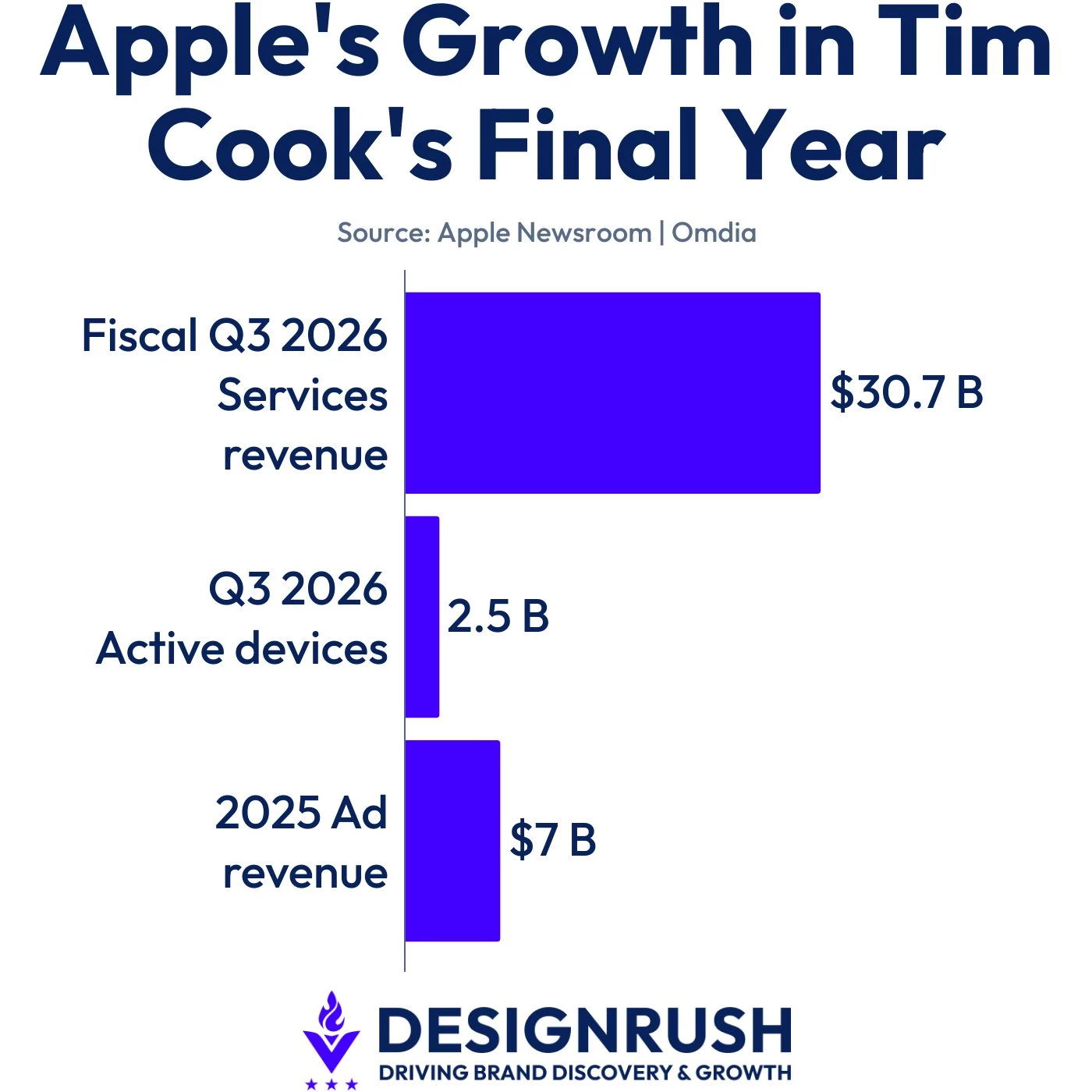
Apple last put a figure on that base in January, when it passed 2.5 billion active devices.
This gives Ternus an enormous audience for services and advertising from his first day.
Apple's ad business has grown quietly alongside these services.
Omdia estimated that Apple generated about $7 billion in ad revenue in 2025, up 15%, with the App Store accounting for roughly 95% of it.
Maps adds a surface with a direct line to purchase intent.
Someone searching for a restaurant or a hardware store is already close to spending money, which makes the inventory valuable.
Apple says more than a billion business searches happen on Maps each month, and about half end with the user taking an action.
Cook proved that the company could pull huge value from its installed base.
And advertising gives Ternus room to grow customer lifetime value from the same audience.
Maps Ads Test Apple's Privacy Promise
The iPhone maker announced Ads on Maps on March 24 as part of its new Apple Business platform.
Buying opened on August 14, and the first ads already reached users in the U.S. and Canada.
They show up in Suggested Places and at the top of relevant search results, one per result set, tagged with a blue "Ad" label.
Targeting runs on search terms, approximate location, and the section of the map on screen.
Apple keeps precise location, Maps history, and Apple Account data out of the system, and personal data stays on the device.
The data handling holds up under scrutiny, but the missing off switch is the part users will notice.
Apple offers ad controls elsewhere in its products, and its own privacy documentation confirms personalized ad settings do not apply in Maps.
iOS 27 was locked at WWDC26 and ships days into Ternus's tenure, so a point release this fall is his first real window to add a Maps ad toggle.
Skipping it would then read as a deliberate call, and not an oversight.
He starts with privacy as a core brand promise and an ad product sitting where commercial intent and physical location overlap.
How he handles this overlap will say a lot about Apple's brand trust over the next few years.
Apple's numbers show why advertising keeps growing as a share of the business.
- Services create revenue that outlasts product cycles. Companies should build income streams that keep earning between hardware launches.
- Scale makes owned media valuable. Marketers should weigh closed-platform inventory where audience intent is easier to read.
- Contextual ads connect media to live demand. Advertisers should match the creative to what someone is actively searching for.
Ternus now has to grow advertising while protecting the privacy positioning that Cook spent years establishing.
Our Take: Did Cook Leave Ternus a Winning Hand?
Cook spent 15 years proving that a hardware company could sell trust as a product feature.
We definitely think that Ternus inherits a strong hand, but ads on Maps is the one card he should watch.
Apple's privacy engineering here is real, but customers still judge privacy by whether they can say no.
Google Maps has run ads for years, and nobody expected an off switch, which is exactly the comparison that Apple spent a decade avoiding.
Ternus takes over with the top-selling phone, record services revenue, and an ad business still small enough to steer.
We'd argue that his first real test is deciding how much of the Maps surface to sell before the privacy story costs more than the ads earn.
Cook handed over a stronger, larger, and more diversified business than the one he took on in 2011.
Apple's $1.4 trillion App Store economy in 2025 is a useful case study for brands working to turn an installed customer base into recurring revenue.
Brands looking to build long-term value across products, services, and media can connect with these top branding agencies for strategic support.