
Enterprise app development is moving faster in 2026, but quicker engineering does not automatically mean a project will stay on budget or on schedule.
Gartner's April forecast puts worldwide IT spending at $6.31 trillion this year, including $1.44 trillion on software.
Chop Dawg says AI-assisted engineering with senior review has roughly halved the cost and time of a typical build compared with the pre-AI era.
Even with that saving, requirements, approvals, integrations, and other dependencies can still push a project beyond its original estimate.
Chop Dawg, an app development company that has launched 500+ apps since 2009, works across new products, rescues and revamps of products built elsewhere, and ongoing support for products already live.
Its delivery data shows where enterprise application development services encounter the most pressure and, more importantly, which problems can be identified before they become budget or schedule overruns.
How Far Enterprise App Projects Typically Overrun
The best-known software project benchmarks are not new, which is part of the problem.
A McKinsey and University of Oxford study of more than 5,400 IT projects found that large projects ran an average of 45% over budget and 7% over time, while delivering 56% less value than predicted. Seventeen percent performed so poorly that they threatened the survival of the business running them.
Requirements are another persistent warning sign. Project Management Institute research found that 47% of unsuccessful projects failed to meet their goals because of inaccurate requirements management.
Those figures show the scale of the problem, but not where the extra cost or time enters the project. They also make no distinction between an approved change in scope and avoidable rework.
Adding three new features midway through development changes the baseline; rebuilding work because the original requirement was unclear does not.
Chop Dawg's 2025 project records make that distinction explicit.
According to the company, no project ran over budget or schedule because of its delivery that year. Projects that exceeded their original estimate did so through scope expansions approved by both sides.
For buyers evaluating enterprise application development services, the more useful question is which decisions create that variance and at what stage they appear.
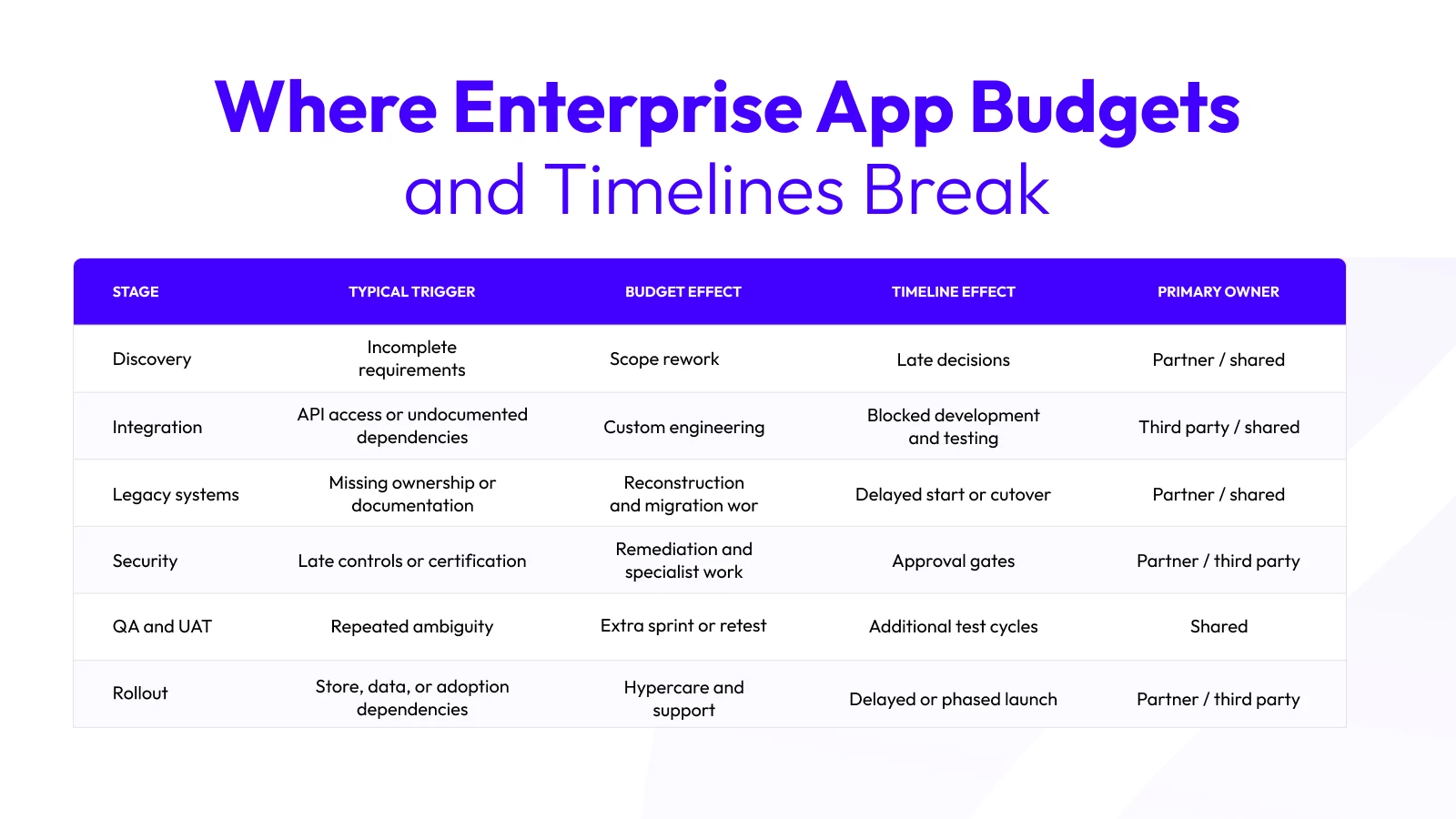
6 Stages Where Budgets and Timelines Break
A reliable estimate for enterprise app development services should separate the project into stages and make the assumptions, dependencies, and approval requirements behind each one clear.
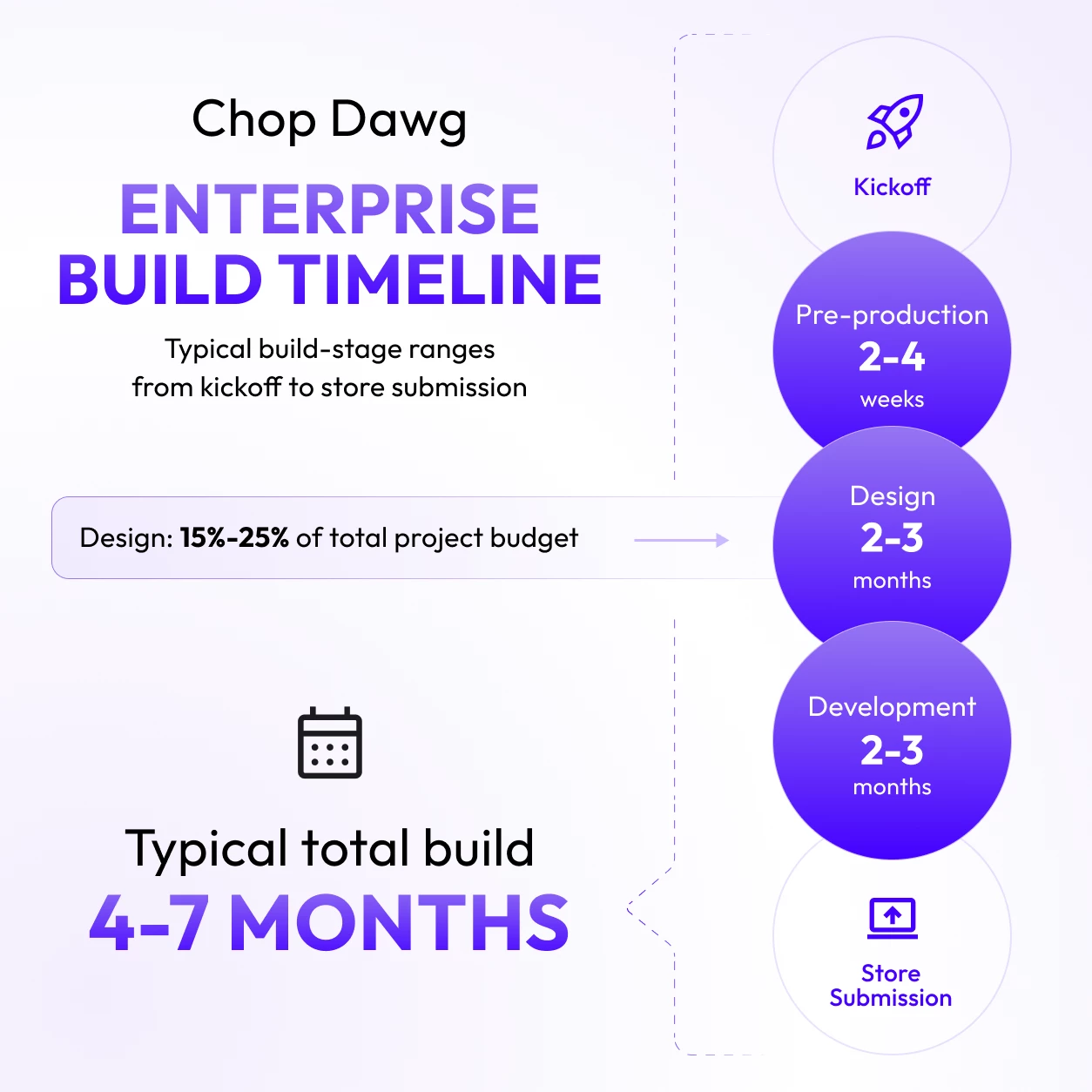
Chop Dawg's build-stage benchmarks put pre-production scoping at two to four weeks, design at two to three months, and development at two to three months for lean scopes, with larger enterprise projects extending beyond those ranges.
Typical builds run roughly four to seven months from kickoff to store submission, before store review.
Chop Dawg also puts design at 15% to 25% of the total project budget, which gives teams a cheaper place to settle expensive decisions before development begins.
1. Discovery and Requirements
Chop Dawg uses its two-to-four-week pre-production stage to pin down the product before development begins.
This means agreeing on the features, the users, and the main journeys early, while changes are still easier and cheaper to make.
Three categories repeatedly appear in scopes the company inherits from elsewhere:
- Administrative backends
- Moderation and user-safety tooling for products with user-generated content
- Onboarding logistics, including account creation, login mirroring, password resets, and launch-day communication
The other issue is how quickly decisions get made once the project is underway.
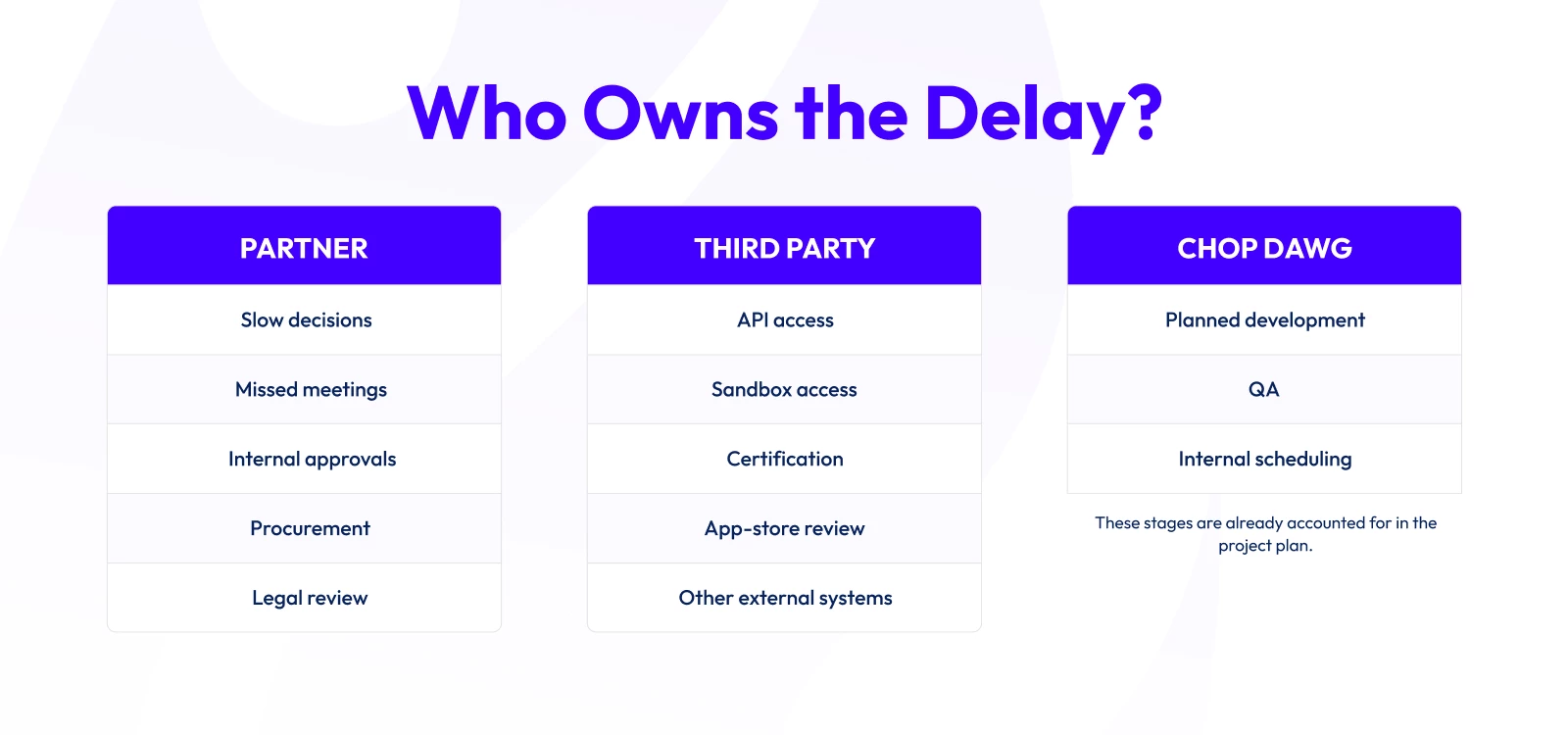
Chop Dawg identifies missed meetings and slow decisions as its two most common partner-owned timeline movers, so pre-production also needs clear ownership for approvals.
Together, the documented scope and approval process create the baseline against which later changes can be measured.
New work can then be recorded as an approved expansion rather than disappearing into an unexplained overrun.
2. Architecture and System Integration
Integrations can be harder to estimate when another provider controls the system being connected. Access can be delayed and the documentation may not tell the full story.
MuleSoft’s 2026 Connectivity Benchmark found that IT teams spend an average of 36% of their time designing, building and testing custom integrations between systems and data.
Chop Dawg identifies third-party dependencies as the most common source of unplanned engineering in its enterprise work.
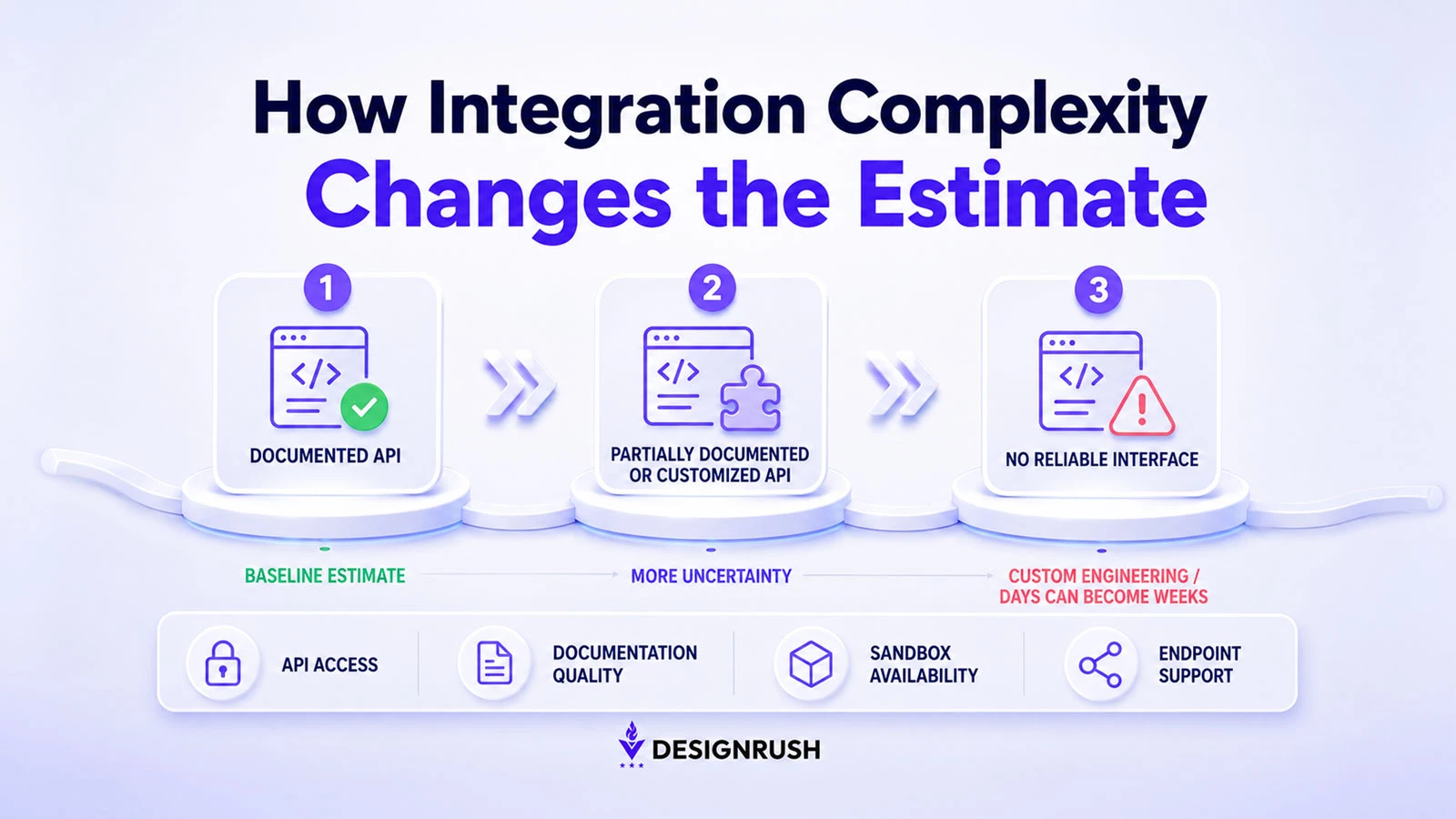
A documented API forms the baseline estimate, while partially documented or customized APIs introduce more uncertainty. When no reliable interface exists, the company scopes the integration as custom engineering, because work that might otherwise take days can extend into weeks.
Before pricing an integration, Chop Dawg reviews the third party's API documentation and uses AI tooling to verify that the required endpoints exist and remain supported. That moves a potential integration surprise into pre-contract due diligence.
It also schedules system access as a dependency rather than assuming credentials will arrive on time.
The company has seen a mainstream reservation platform take more than two months to grant an enterprise partner sandbox access. Smaller test environments can also limit how accurately production performance is validated.
Integration does not always mean replacing an incumbent system, either.
For restaurant group Zuma, Chop Dawg connected the VIP experience with SevenRooms rather than rebuilding the reservation infrastructure, and reports a 95% increase in VIP reservation efficiency, with the platform supporting operations across more than 20 cities.
The practical safeguard is straightforward: verify the dependency before pricing the work that depends on it.
3. Legacy Systems and Data Migration
In a takeover, the first constraint may be ownership rather than technology. Chop Dawg begins by establishing whether the partner owns and can access the source code, database, and design files.
Missing access is Chop Dawg's number one takeover red flag, because the existing system cannot be inspected properly until those assets are available.
Undocumented systems create a similar delay by forcing the incoming team to reconstruct decisions that exist only in the code.
Chop Dawg says AI-generated and vibe-coded products are also emerging as a new legacy category in 2026. Some of these products work on the surface, but the structure behind them is poorly documented.
Security decisions may be unclear too, which can make the code difficult to pick up and extend. In some cases, starting again is more practical than continuing to patch it.
At enterprise scale, the problem can span decades of systems. Chop Dawg is currently helping a construction company with roughly 25,000 employees consolidate fragmented third-party platforms into a single company-owned ecosystem.
That work involves more than moving files. Data has to be cleansed, mapped, validated, and prepared for cutover before the new system can be trusted in production.
4. Security, Compliance, and Procurement
Security and compliance have to be settled before development gets too far. If they come in late, teams may have to revisit work that is already finished.
NIST’s Secure Software Development Framework recommends building secure-development practices into the full software lifecycle.
The European Commission's guidance on data protection by design takes the same approach to privacy safeguards.
Chop Dawg therefore builds GDPR requirements in from day one for products handling EU personal data. Retrofitting those controls later can force changes to storage, permissions, user flows, and documentation that had already been completed.
Some delays sit outside engineering altogether. HIPAA attestations, federal certifications, procurement reviews, and security approvals can set the critical path even when the code is ready.
The financial stakes explain why these controls cannot be treated as optional polish.
IBM's 2026 Cost of a Data Breach Report puts the global average breach cost at $4.99 million. That number is a risk benchmark, not an app-development estimate, but it shows what sits behind the compliance conversation.
5. Development, QA, and User Acceptance Testing
Finding a bug during QA does not mean the project has overrun. Chop Dawg threads testing through development and then runs a dedicated QA phase before submission. That phase combines automated unit tests with human QA and structured user acceptance testing against criteria documented during design.
Planned QA is therefore part of the baseline budget. The overrun is the same issue surfacing again because an upstream decision stayed ambiguous, not a defect being found at the stage designed to find it.
The CISQ 2022 report estimated poor software quality cost the U.S. economy at least $2.41 trillion that year. The figure covers a much wider problem than one app project, but repeated defects, technical debt, and avoidable rework all contribute to that burden.
Testing can also be blocked by systems outside the team's control. Chop Dawg identifies limited, stale, or missing third-party sandboxes as a recurring cause of delayed integration testing.
Buyers should therefore look at whether defects are caught at the planned stage and whether each requirement can be traced back to written acceptance criteria, rather than treating the existence of bugs as evidence of a failed process.
6. Deployment and Rollout
A technically finished product can still be weeks away from launch because production cutover depends on data validation, staff training, device management, store accounts, third-party approvals, and launch communications.
DORA's current delivery metrics distinguish change failures from deployment rework, including unplanned deployments needed to correct production incidents.
Chop Dawg plans for those external dependencies before development begins rather than adding them once the product is ready to ship. Its planning model reserves 30 to 45 days around Apple and Google submission for account setup, review, revisions, and resubmission.
Those figures are planning buffers, not promises about how long Apple or Google will take on an individual review.
Every Chop Dawg launch also includes a complimentary 30-day bug and maintenance window. The company advises partners to reserve roughly 20% of the original build cost per year for upkeep after launch.
Methodology: Chop Dawg build-stage benchmarks are drawn from the company's delivery experience across 500+ launches since 2009, including enterprise work for organizations such as NASA, Siemens, Hilton, Jefferson Health, the U.S. Navy, and the State of Georgia.
 How to Vet a Partner for Overrun Risk
A credible proposal for enterprise application development services should make uncertainty visible before the contract is signed.
It should state what is included, which assumptions the price depends on, which external systems have been checked, who owns each approval, and how a change to any of those inputs affects the budget or schedule.
That visibility should continue through delivery, and an enterprise app development company should be able to show who owns each decision, system, and approval along the way.
Chop Dawg's enterprise partners often have their own CTOs, product managers, engineers, and governance requirements, so its teams give them direct access to GitHub repositories, Jira and Confluence boards, and design work in Figma.
Internal IT retains ownership of accounts, environments, and credentials, while the documentation is written so the enterprise's own engineers can audit, extend, or eventually take over the work.
Teams comparing enterprise app development partners should therefore compare the assumptions, ownership rules, and change-control process behind each estimate before comparing the totals.
Do's and Don'ts for Your Enterprise App Budget
A complete budget for enterprise app development services should account for discovery, architecture, UX and interface design, development, integrations, security and compliance, QA and UAT, data migration, training, deployment, hypercare, ongoing support, and contingency.
Those costs should not all be treated the same. Fixed work belongs in the baseline, variable dependencies need a range, partner-owned approvals belong on the schedule, and third-party expenses should be identified separately.
Contingency should cover genuine uncertainty rather than known work.
An enterprise mobile app development company should also account for device testing, mobile security, store or MDM deployment, account approvals, and operating-system maintenance.
Planned QA, known compliance work, expected infrastructure, routine maintenance, and features deliberately added after signoff should not be hidden inside contingency.
A defensible budget makes each of those categories visible before development begins.
Enterprise App Overrun FAQs
Why do enterprise app projects go over budget?
Enterprise app projects go over budget when requirements, ownership, integrations, approvals, or other dependencies differ from the assumptions used to create the original estimate.
Chop Dawg's 2025 records show no budget or schedule overruns caused by the company that year; projects that cost more did so through scope expansions approved by both sides.
How long does enterprise app development take?
Timelines vary with scope, integrations, migration, compliance, and approval requirements.
Chop Dawg's build-stage benchmarks put pre-production at two to four weeks, design at two to three months, and development at two to three months on lean scopes. Typical builds run around four to seven months from kickoff to store submission, while larger enterprise projects take longer.
How much contingency should an enterprise app budget include?
There is no useful universal contingency percentage because the risk depends on the project's integrations, migration, compliance, and approval requirements.
Chop Dawg treats planned QA, deployment, maintenance, and approved scope changes separately, while advising partners to reserve roughly 20% of the original build cost per year for post-launch upkeep.
What should you ask an enterprise app development company before signing?
Before signing, ask who will work on the product, what the proposal includes, how scope changes are approved, who owns the code and accounts, how integrations were assessed, what QA acceptance criteria will be used, and which dependencies could move the launch date.
DesignRush's 9 Questions to Ask Before Hiring an App Development Company covers the wider questions buyers should ask about proposals, team structure, ownership, communication, and change control.
How One Undocumented Decision Compounds Across the Build
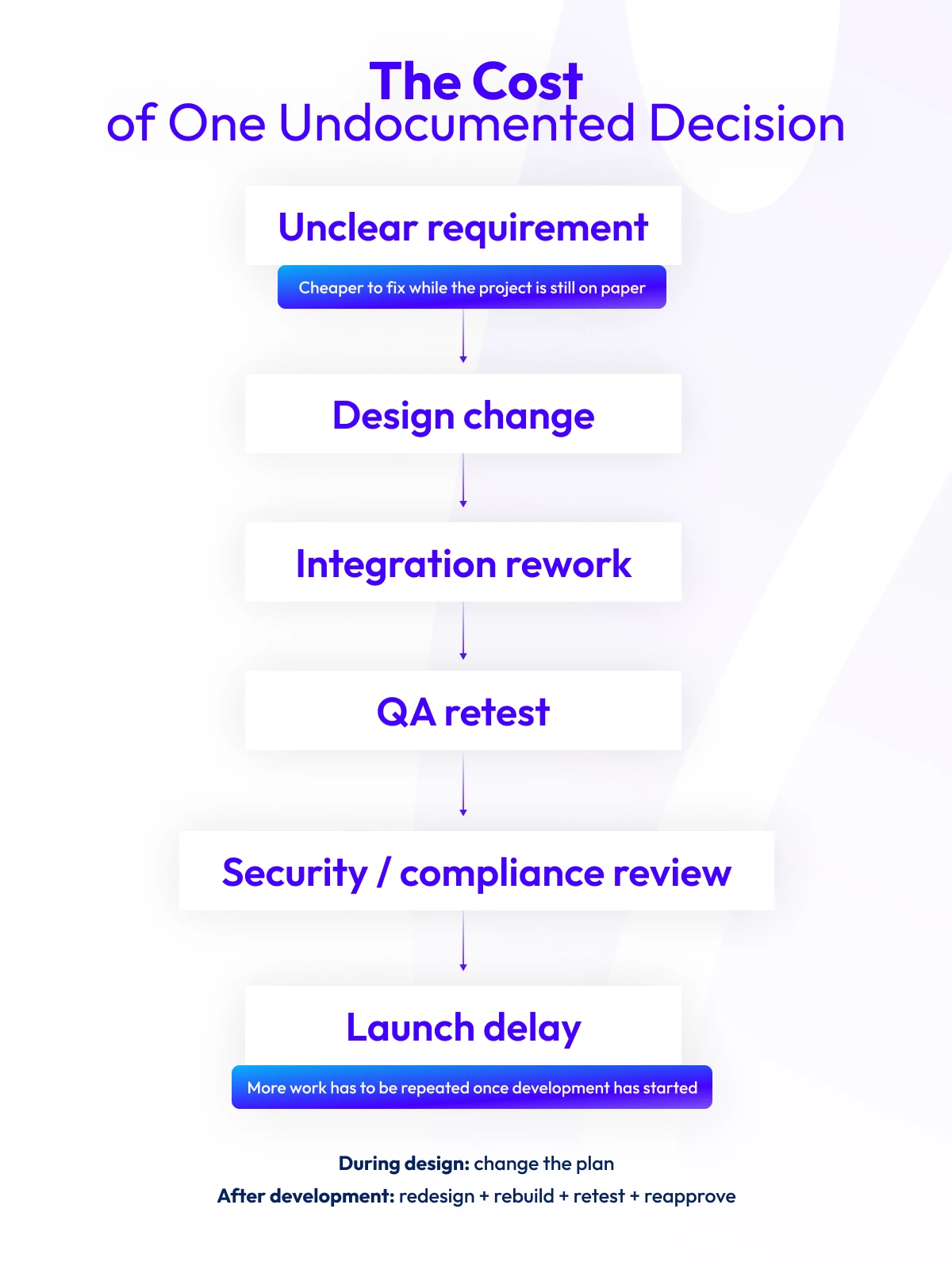
Changing a wall on a blueprint costs a pencil mark. Changing it after the drywall goes up means paying to build it, demolish it, and build it again. Enterprise software follows the same basic economics.
Consider an account-access requirement that remains vague during discovery. It determines which screens and states are needed in design, affects identity and permissions in architecture, and may require integration with the enterprise's existing login system.
If development begins before that decision is settled, the team has to make an assumption.
When UAT later proves that assumption wrong, the cost spreads beyond one correction. The authentication flow changes, integration needs another pass, security has to review the revised approach, testing repeats, training materials change, and deployment moves.
One unresolved decision has created work across several stages, all from a question that could have been settled while the product still existed on paper.
 Settling those decisions early matters more when AI-assisted engineering is involved, because execution can move faster once development starts.
Chop Dawg pairs Claude and Cursor with senior engineers who establish the architecture first, review generated code, and gate changes through pull requests.
The tools can accelerate implementation, but they cannot resolve an ownership question, secure API access, interpret an undocumented compliance requirement, or recover a stakeholder decision that was never recorded.
Faster code does not remove the cost of ambiguity. In 2026, the expensive mistake is still allowing an unresolved decision to reach development and paying to solve it more than once.