
Brand Refresh Strategy: Key Findings
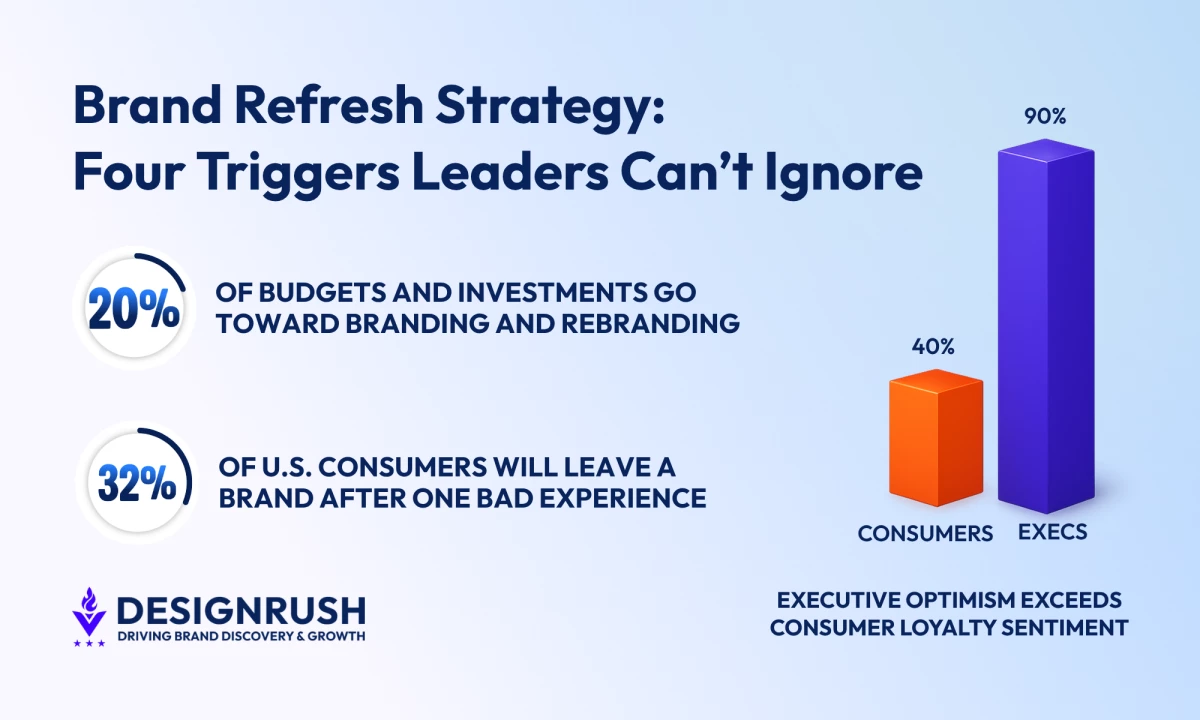
- Up to 20% of budgets are now devoted to branding, so leaders need a structured approach to ensure every dollar strengthens market position.
- Willoughby Design emphasizes a disciplined approach to brand strategy, helping executives decide when it’s best to continue supporting the brand with existing assets versus when it’s best to consider evolving or rebuilding the brand to protect value and support growth.
- Customers lose patience quickly, with 32% abandoning a brand after one bad experience, showing why your brand refresh strategy must keep promise and delivery fully aligned.
Up to 20% of annual budgets and capital investments now go toward branding and rebranding, according to WiserReview.
When investment reaches this scale, the margin for misjudgment narrows.
Leadership teams can’t afford guesswork.
Senior B2B marketing leaders put work that increases brand awareness and visibility at the top of their agenda.
At the same time, PwC’s 2025 Customer Experience Survey reports 32% of U.S. consumers will stop doing business with a brand they love after a single bad experience.
Investment is climbing while patience for misalignment is dropping.
The ongoing brand management question is, continue to refine what exists or rebuild from the ground up?
Editor's Note: This is a sponsored article created in partnership with Willoughby Design.
Brand Spend Demands Strategic Discipline
Global branding agency Willoughby Design treats this decision as a business inflection point rather than a creative exercise.
A brand evolution or “refresh” is an update to visual and verbal identity while preserving the foundation.
Reinvention rebuilds it entirely, and each carries distinct cost, operational impact, and internal demands.
Confusing them can waste capital and time.
Willoughby structures the evaluation around four triggers.
1. Market conditions.
As challenger brands appear with precise narratives and focused positioning, established brands need to assess if their story still communicates with relevance and authority.
Maintaining a leadership position requires an ongoing commitment to evolution and innovation.
2. Business model shifts.
Moving from product to service, expanding geographically, or broadening offerings changes how value is delivered and, upon occasion, renders brand names and identity systems irrelevant.
To understand if this is happening, the brand architecture must be evaluated to ensure it matches the brand strategy across every touchpoint.
3. Mergers and acquisitions.
Integration introduces complexity. Sometimes, as companies grow through acquisition, they end up with multiple legacy brands competing for clarity.
A clear approach to the brand’s system design simplifies communication internally and externally.
4. Customer expectation.
PwC’s 2025 survey shows how quickly customers disengage when experiences fall short. Therefore, brand promise and delivery must remain in step.
These factors demand evidence-based assessment.
Evolution works when the brand’s core positioning remains relevant, and equity still carries weight.
Signals include steady recognition, consistent perception, and a business strategy that remains aligned.
“A strong brand balances investment and evolution with discipline and consistency to focus on driving alignment, clarity, and measurable impact across the business,” said Megan Stephens, co-CEO of Willoughby Design.
When the underlying purpose holds, the brand may slowly evolve over time to stay relevant without disrupting the existing equity.
Updates can include modernizing visual systems supporting the core identity, clarifying messaging, refining tone, and improving digital touchpoints.
Willoughby guides this work through structured audits and leadership alignment sessions.
Market research, customer insight, and workshops, much like those Willoughby provides, define which elements stay and which require adjustment.
That clarity keeps teams aligned and investment focused.
Reinvention is necessary when the existing brand no longer reflects the organization’s direction or category realities.
Triggers include strategic pivots, expansion into new categories, post-acquisition consolidation, or entering markets where legacy positioning no longer resonates.
- Incremental changes create confusion.
- Architecture can limit growth.
- Messaging may misrepresent capability.
- Identity systems may not support expansion.
Reinvention addresses purpose, positioning, audience definition, and growth ambition before the identity is rebuilt.
It starts with research and alignment before creative execution.
Willoughby’s brand invention practice integrates strategy, naming exploration, and identity development into a single process.
The objective is coherence between leadership vision, market opportunity, and customer perception.
A Practical Decision Framework
Executive teams benefit from a structured approach.
Begin with a competitive and category audit. Identify gaps, positioning overlaps, and opportunities in the market.
Layer in customer insight. Check if perception matches intended positioning. Identify any disconnect between promise and experience.
Assess the business trajectory. Confirm that the brand architecture supports future offerings, partnerships, and expansion.
Align leadership around a clear ambition. Internal clarity precedes external execution. Ensure that everyone is working towards a shared goal.
This process anchors decisions in evidence.
With branding accounting for a large portion of spend, missteps cost real money.
What Leaders Should Consider
Brand equity influences valuation, talent attraction, and customer acquisition efficiency.
A clear brand system reduces friction across sales, marketing, and product, while a fragmented one increases it.
Industry trends show continued investment in brand positioning into 2026.
Organizations understand that perception affects long-term performance.
The evolve-or-reinvent decision must connect to data, finances, and strategy.
Willoughby positions the brand as infrastructure for growth.
Its methodology combines research, architecture, and identity development into a repeatable evaluation model.
With up to 20% of annual budgets at stake, uncertainty is expensive.
Leaders who assess rigorously preserve equity and rebuild where the foundation no longer supports the enterprise.
Brand investment now affects enterprise value.
Treating it with discipline safeguards growth and protects market position.