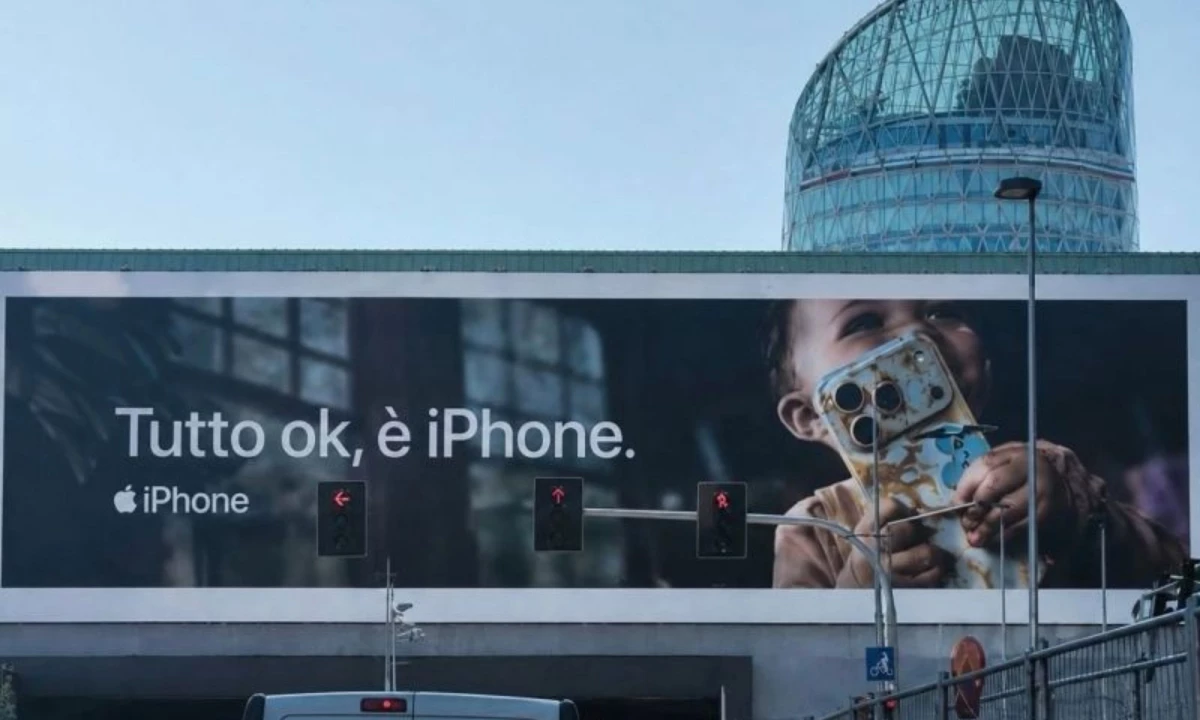

Apple's durability message hit an unexpected roadblock in Italy.
A billboard for the company's "Relax, It's iPhone" campaign showed a toddler holding a food-covered iPhone on Via Melchiorre Gioia in Milan.
The imagery prompted a complaint to Italy's Authority for Children and Adolescents (AGIA).
The authority's president, Marina Terragni, said the ad risked "normalizing" electronic babysitting as countries debate minimum ages for digital access.
"The image is disturbing to me," a Milanese citizen told AGIA, "because it brings together two worlds that should remain distant.
"On the one hand, childhood, with its freedom, its innocence, its right to get dirty, get bored, invent, and explore the world;
"On the other, a tool designed to constantly capture attention, create need, and make it difficult to detach.
"Those little hands covered in baby food represent an age when everything should still be discovered."
Apple subsequently replaced the billboard, after initially adding a QR code directing viewers to parental-control resources.
The controversial billboard offers up a critical marketing lesson about aligning and maintaining core brand messaging with creative.
Durability Collides with Screen-Time Anxiety
The billboard extended the logic of "Relax, It's iPhone" into an everyday parenting scenario.
While the campaign intended to make the device look capable of surviving the kind of treatment associated with a messy toddler, the execution landed wrong.
The interpretation sits awkwardly beside the campaign's established creative language.
Apple has previously featured children putting iPhones through physical abuse.
Particularly, in the "Run Baby Run" spot, a toddler drops, bangs, and splashes an iPhone 13 while the phone survives intact.
The campaign also used family situations to demonstrate features such as Check In, through spots like "New Driver."
In essence, the Milan billboard did not stray far from the campaign's creative formula.
But its static image left less room for viewers to understand the product demonstration behind it.
Screen-Time Concerns Go Global
Concerns around children's screen use are on the rise around the world.
Health authorities, parents, and child-rights organizations are examining how digital access affects development, behavior, and well-being.
The World Health Organization recommends no sedentary screen time for 1-year-olds and no more than one hour a day for 2-year-olds.
Its guidance for children ages 5-17 calls for recreational screen time to be limited.
According to Pew Research Center's 2025 survey, 42% of U.S. parents with children 12 and younger say they could handle their children's screen time better.
Pew also found 86% of parents call reasonable screen time a day-to-day priority, including 42% who rank it among their biggest.
UNICEF identifies digital technology as both an opportunity and a risk for children.
It cites the potential benefits alongside concerns around harmful content, privacy, exploitation, and mental health.
Italy provides the latest brand-specific case study around the rising concerns that ad campaigns could normalize "electronic babysitting."
The growing scrutiny around children and devices gives marketers another layer to consider when depicting technology in family settings.
- Age can change the meaning of product imagery. Teams should consider potential views around device use to avoid making a product demonstration look like behavioral endorsement.
- Global campaigns need local checks. Brands should test creative against regional cultural and regulatory concerns to catch associations that may not be obvious from a central-market perspective.
- Brand safety now includes implied behavior. Marketers should assess what audiences might believe a product encourages to protect broader brand positioning.
For tech brands, the harder job is making sure the behavior in the ad matches what the brand claims to stand for.
Our Take: Did Apple Need to Remove the Billboard?
The billboard communicated durability instantly, but it also created an association Apple had little reason to defend.
Interestingly, Apple's initial QR code response directed people toward parental controls and attempted to add context without abandoning the original image.
This suggests the company recognized the interpretation problem while initially treating it as a messaging gap.
We think the stronger lesson is about static advertising.
A 30-second film can establish that a child is accidentally abusing a phone.
A billboard freezes the relationship between child and device, leaving viewers to supply the narrative themselves.
The approach works only if the visual cues support the intended product claim.
It makes local cultural review particularly important when creative involves children, health, safety or behavior.
A concept can remain strategically consistent while its most prominent image becomes incompatible with the expectations of a specific market.
Apple's broader child-safety work makes that distinction especially important.
In June 2026, the company announced additional parental tools, including Time Allowances and a redesigned Screen Time experience.
That wider positioning makes the Milan billboard a useful case study in a larger advertising problem: creative consistency needs to exist across the brand.
Need creative that works across markets without creating unnecessary brand risk?
Explore these top advertising agencies with creative, strategy, and campaign expertise.