
Marketing Alignment and Revenue Growth: Key Findings
- Marketing misalignment undermines revenue growth, as disconnected strategy and executive priorities lead to strong surface metrics but weak pipeline performance.
- Rising global ad spend is increasing accountability, with trillion-dollar investment levels pushing leadership teams to demand measurable business impact from marketing.
- Alignment becomes a revenue driver when grounded in business math and shared goals, enabling teams to move from reactive reporting to proactive growth leadership.
As 2026 gets underway, marketing leaders are feeling the pressure to demonstrate the value of marketing spend.
In response to this challenge, 72% of CMOs plan to increase their marketing budget relative to sales in 2026, according to a report by McKinsey.
But is increasing the budget to run more ads and adopt more tools the most efficient way to prove the business value of marketing?
Jacob Baadsgaard, founder and CEO of one of the top digital marketing agencies, Disruptive Advertising, has seen many marketing teams fall into this trap.
He said that marketing is no longer being judged on how bold or creative it looks anymore. Instead, leadership now wants to know if and how it’s moving the business forward.
“That shift has sparked deeper internal questioning inside organizations. Are marketing efforts truly aligned with the business goals leadership is accountable for delivering, or are teams optimizing activity while executives measure revenue?”
For many companies, the tension is no longer subtle. It shows up in pipeline conversations, quarterly reviews, and uncomfortable boardroom discussions.
Editor's Note: This is a sponsored article created in partnership with Disruptive Advertising.
Why Alignment Is Now a Revenue Conversation
The urgency around alignment is rising alongside the scale of global investment.
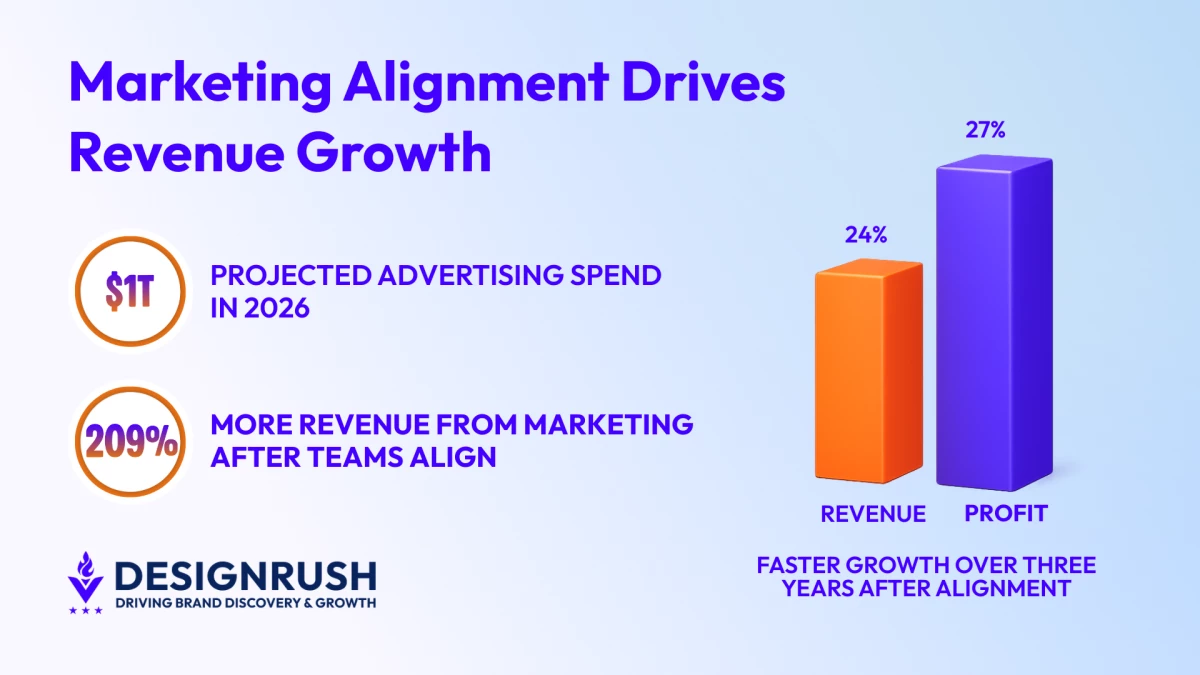
According to Dentsu, global advertising spend is projected to surpass $1 trillion in 2026, making this the first time that the industry has crossed this threshold.
But when spending reaches that level, expectations change.
Marketing budgets are treated less like experimental spend and more like capital investments expected to generate measurable returns.
Long-term performance data reinforces why internal cohesion matters.
ZoomInfo adds that B2B organizations with strong sales and marketing alignment achieve roughly 24% faster three-year revenue growth and 27% faster three-year profit growth than those operating in silos.
Moreover, the research shows aligned teams generate up to 209% more revenue from marketing efforts compared to fragmented organizations.
This confirms that when alignment is strong, growth compounds. And when it is weak, inefficiencies compound just as quickly.
Against that backdrop, Disruptive Advertising approaches alignment as infrastructure, not just inspiration.
Signs of Marketing Misalignment
Disruptive Advertising describes the earliest red flag in direct terms.
“The clearest sign is when marketing leaders are constantly guessing,” Baadsgaard said.
“Nobody's written down what success actually looks like, so they're reverse-engineering the CEO's mood after every all-hands meeting.”
When success is undefined, marketing becomes reactive. Strategy shifts based on perception rather than plan.
Another signal appears when marketing is treated as a simple output machine.
“Marketing has become a vending machine,” Baadsgaard said.
“Leadership puts budget in, expects leads out, and when the results disappoint, they don't ask better questions, they just kick the machine harder.”
Dashboards may show clicks rising and impressions climbing, yet the pipeline remains thin. And as Baadsgaard put it, that's not a media problem, that's an alignment problem.
Often, beneath those symptoms sits unrealistic math, where the growth targets were never grounded in reality to begin with.
When that happens, marketing leaders start to feel the pressure, where one rough month can suddenly feel career-defining.
From Vision to Measurable Goals
While most leaders have a vision, the issue is that it is rarely articulated in a way that survives quarterly scrutiny.
That’s where Disruptive Advertising always starts any partnership. Before starting any partnership, the agency clarifies what the business is actually trying to achieve.
“We stop the guessing game by putting the founder's intent on paper,” Baadsgaard said.
Then, the team works to anchor every strategic decision to these goals, so that it does not shift with every competitor campaign or new business book.
From there, the strategy is shaped by four foundational questions:
- What does the math actually require?
- Who is the real customer?
- How do they buy?
- And what does the scoreboard look like?
Those questions turn aspiration into execution.
If the numbers do not support the goal given the available resources, that reality surfaces immediately.
“While that conversation is uncomfortable for about an hour, discovering it six months later is far worse,” Baadsgaard said.
The difference is stark. A vague growth goal invites confusion, while a math-backed strategy invites accountability.
Baadsgaard explains why clarity is critically important in this video:
Aligning Marketing and Sales Teams
During onboarding, alignment starts with data transparency.
“You can't align a team that's arguing about whose numbers are right. And within the first 72 hours, we get everyone looking at the same dashboard,” Baadsgaard said.
Without a shared source of truth, cross-functional strategy collapses into metric disputes.
The next shift focuses on roles. Many job descriptions emphasize activity rather than results.
As such, Disruptive Advertising reframes responsibilities around outcomes.
Instead of outlining what someone does all day, expectations center on what they are responsible for delivering. That shift creates ownership rather than motion.
Alignment must also work across three forces at once, including revenue targets, customer needs, and individual strengths.
“When those three things are misaligned, you get burnout and turnover,” Baadsgaard said. “But when they're aligned, you gain traction.”
Measuring Impact Against Business Goals
At Disruptive Advertising, performance measurement begins with fundamentals.
“We don't start with ROAS. We start with business math, such as what does this company need to grow, and is marketing actually contributing to that?” Baadsgaard said.
The team tracks controllable activities alongside the outcomes that those activities are meant to compound over time.
Here, leading indicators signal direction while lagging metrics confirm impact.
Additionally, Baadsgaard points to a less obvious metric.
“If the CEO is in the weeds, second-guessing every decision, and asking for weekly recaps of things they should already see in the dashboard, the strategy isn't working yet,” he said.
When leadership steps back and allows the team to drive, that signals the system is functioning.
Alignment in Practice
Disruptive Advertising’s work with PhotoShelter offers a tangible example of what happens when structure replaces guesswork.
When the partnership began, the issue was not a poor-performing agency.
“They weren't dealing with a bad agency but dealing with a bad system,” Baadsgaard said.
Strategy shifted constantly, performance fluctuated without explanation, and the marketing leader was stuck reacting rather than leading.
The first move was rebuilding tracking so that paid media reporting aligned with CRM data. That alone reshaped internal conversations. Paid search was then connected directly to quarterly revenue goals rather than traffic metrics.
The first quarter already delivered measurable results:
- 50% revenue increase over any prior paid search quarter
- 15% improvement in MQL-to-SQL conversion
- 26% improvement in SQL-to-opportunity conversion
Paid search shifted from a debated budget line to one of the most trusted pipeline sources in the organization.
Yet the most significant outcome was cultural.
“The client went from defending her existence to driving strategy. That's what the whole system is designed to produce,” Baadsgaard said.
In the video below, another Disruptive Advertising client explains just what the agency has done for their marketing endeavors:
What Alignment Means for 2026
As global advertising investment surpasses the trillion-dollar mark, marketing teams are operating in a more accountable environment.
Larger budgets bring greater visibility, and greater visibility brings higher expectations around performance and contribution.
Fortunately, the organizations that perform well in 2026 will not rely solely on channel optimization.
They will ensure that executive priorities, financial targets, customer behavior, and team execution are aligned from the outset.
“In that environment, alignment is not a messaging exercise. It becomes a structural advantage that directly influences how consistently a company can grow,” Baadsgaard said.
And the organizations that master it will find that marketing no longer needs to justify its presence. It becomes the engine that leadership trusts to move the entire business forward.