
Dyson wants consumers to see brushing as a technology problem.
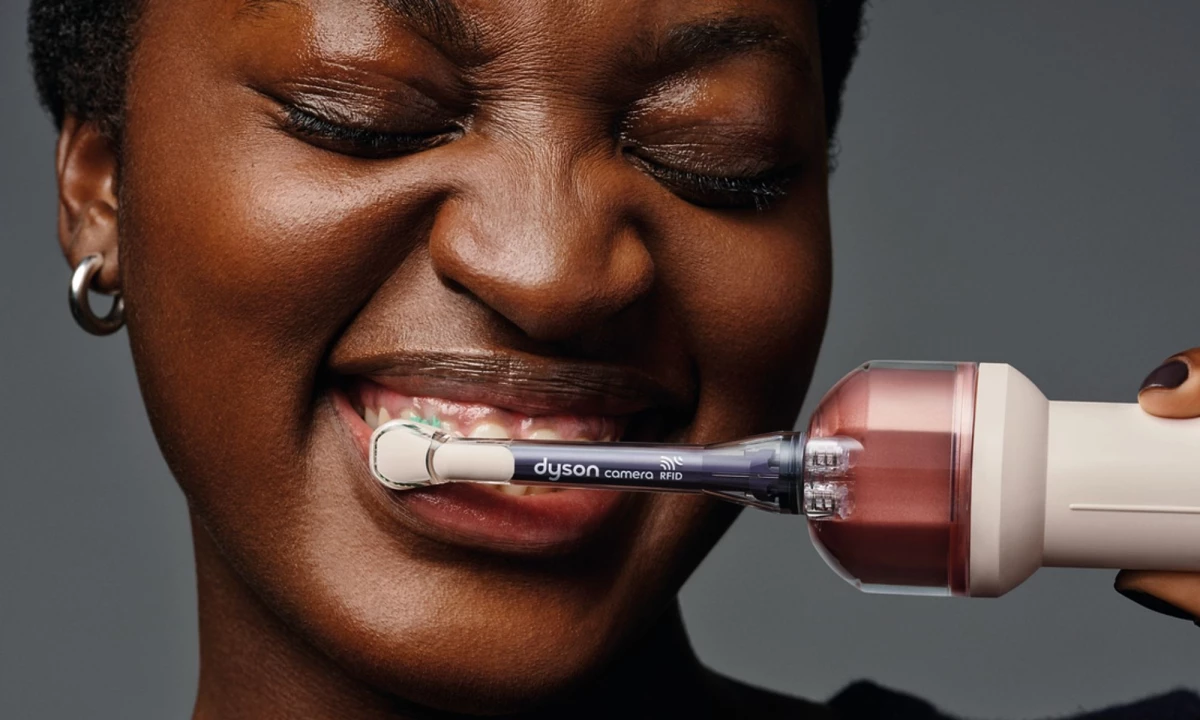
Its new CameraJet toothbrush puts a 100,000-pixel camera, AI tech, precision fluid dynamics, and app connectivity into a simple daily habit.
The company unveiled CameraJet in Paris on September 1 as its first oral care product.
It scans 28 images per second to identify gaps between teeth, then fires a targeted mouthrinse jet within 100 milliseconds.
Six years of development involved 661 Dyson engineers, 38 patents, and more than 470,000 dental images.
This magnitude reinforces Dyson’s familiar engineering-first positioning.
"Dyson CameraJet introduces an entirely new way to keep your mouth healthy," James Dyson, founder and chief engineer, said in press release.
The strategy asks consumers to give Dyson permission in a category where its brand has little history.
CameraJet gives the company a way to make this expansion through a familiar brand formula.
It identifies a problem, engineers a solution, and makes the technology visible.
Dyson now has to prove consumers will see oral care as a problem worth solving with $499 technology.
Dyson Toothbrush Comes with Anti-Gravity Rinse Tank
CameraJet gives Dyson plenty of physical evidence for its engineering-first brand identity.
The AI toothbrush features:
- A contoured dual-bristle head
- Variable sonic oscillation
- An anti-gravity 12.5-milliliter mouthrinse tank
- A docking station that refills the device in three seconds
The MyDyson app streams live footage from inside the mouth.
Users can review coverage maps, get technique guidance, and track brushing performance.
To put privacy concerns at ease, the brand says the images are not stored on the device or in the cloud.
Dyson also developed low-foaming toothpaste and mouthrinse for CameraJet.
The formulas limit foam because excess foam could obstruct the camera’s view between teeth.
Each component of the product design supports the same promise of seeing, targeting, and cleaning areas conventional brushing can miss.
Dyson’s $540M R&D Investment Targets 3.7B People
Dyson reported £6.13 billion in revenue for 2025, down from £6.6 billion the year before.
The company invested more than £400 million in research and development that year across all of its categories.
The launch also arrives as oral care remains a large behavior gap.
Dyson cites its own Oral Care Usage and Attitudes Study from 2017, which found nine in 10 people do not floss as often as recommended.
The same study puts average brushing time at 45 seconds.
"Flossing is an awkward and time-consuming chore. Few of us do it even though we know we should.
"Our research has shown that people consistently miss the areas where plaque forms: the gaps between teeth," added Dyson.
These habits give the brand specific problems to address through automation.
Nearly 3.7 billion people globally are estimated to live with oral diseases, according to the World Health Organization.
The figure shows how oral care remains a huge health category even as consumers struggle with basic routines.
Dyson’s development numbers show how much engineering it is putting behind its entry into the category.
- Engineering can create category permission. Brands should transfer a proven capability into adjacent categories to create immediate product credibility.
- Automation can address end-user gaps. Product teams should automate the parts of a routine people consistently avoid to improve adherence.
- Premium pricing needs visible validation. Premium brands should connect expensive features to specific consumer problems to justify the price.
Dyson’s opportunity is to prove its credentials can generate demand in a category where the brand has no legacy advantage.
Our Take: Do Consumers Actually Want CameraJet?
Dyson priced CameraJet at $499 without publishing the comparison that actually matters to buyers.
Hands-on reviews are encouraging. TechRadar tested the CameraJet for a week and praised its cleaning, premium design, and smart features.
But consumer reactions are less settled.
Reddit discussions praise the integrated flossing and report a noticeably clean feeling, but many comments call $500 excessive.
Others question the camera, the mess from the water spray, and whether a cheaper electric toothbrush plus flossing can deliver enough value.
We think the flossing problem is real, though the proof that Dyson has released so far doesn't reach the price mark.
The launch generated the curiosity Dyson wanted, but purchase intent is the hurdle now.
Dyson now needs real-world results to show that the convenience can justify a price that's several times higher than established alternatives.
Developing complex physical products?
Explore these top product design companies for partners spanning strategy, engineering, prototyping, and product development.