
Growing businesses adopt SaaS tools to move faster.
But by the time cost realization settles in, they are already dealing with dozens of fragmented apps, if not more.
To make matters worse, they continue to pay for overlapping capabilities or run an architecture that fails to support the growth pace it was designed for.
And the situation can quickly spiral out of control.
According to Zylo’s 2024 SaaS Management Index, a medium-scale enterprise manages about 275 SaaS apps, up from 269 recorded in 2023.
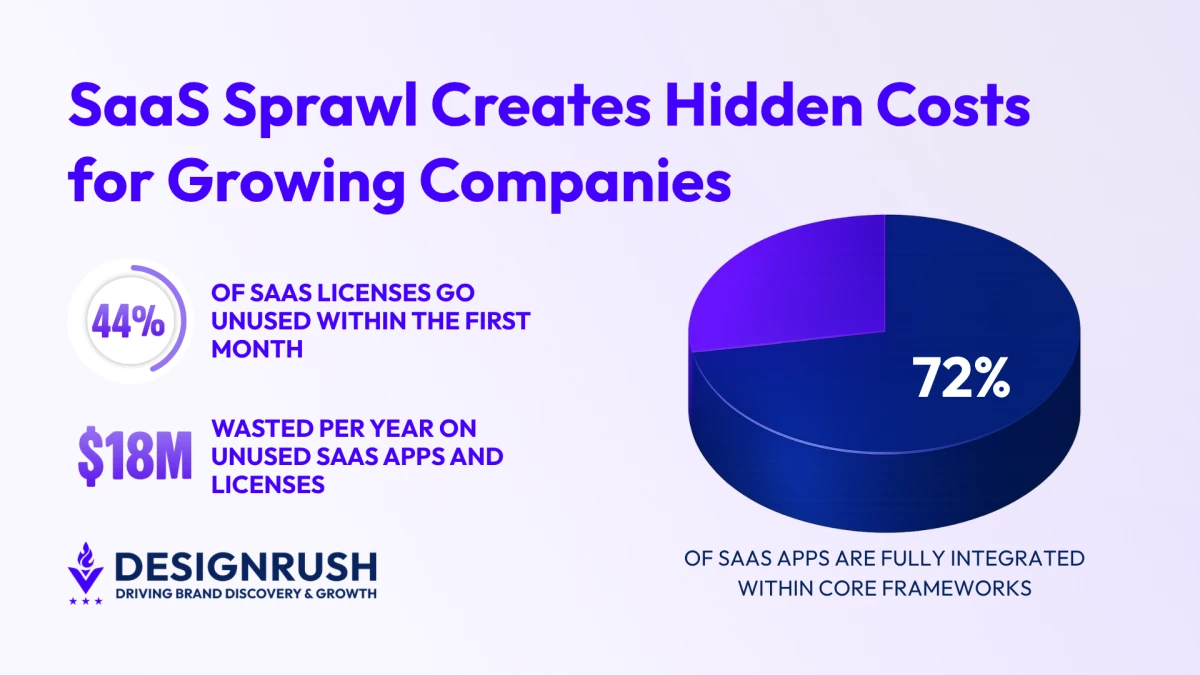
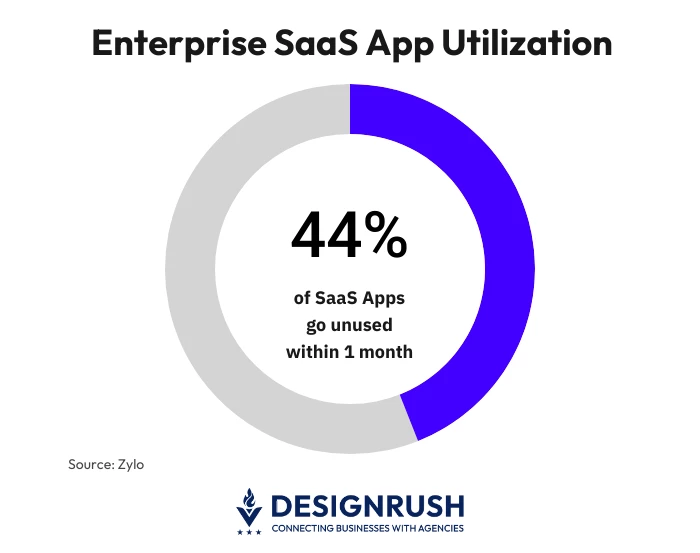
In addition, it was revealed that about 44% of SaaS licenses often go unused in the span of a month.
The most common error driving this problem is adopting SaaS tools reactively.
At Quixta, we see this constantly when we inherit a client's existing stack before a rebuild.
There'll be a CRM that doesn't talk to their billing system, a project tool nobody's touched in eight months, and three different tools doing the same thing because several departments made independent decisions.
Each decision appears rational in isolation. In aggregate, they produce an uncoordinated stack with no defined architecture.
With no centralized procurement or governance framework in play, many of these tools are never properly integrated into the core framework.
Therefore, data silos continue to exist, restricting visibility and decelerating operational decisions.
Utilization Data Points to a Spend Problem
Companies are only using 49% of their provisioned licenses, according to the same Zylo report, which analyzed data from 30 million SaaS licenses and $34 billion in SaaS spend.
On average, companies leave $18 million in wasted spend on the table, a figure that increased 7% from 2022.
The waste extends beyond inactive licenses.
The average company operates 15 duplicate online training apps, 11 project management tools, and 10 team collaboration apps, according to the same report.
That redundancy represents parallel spending on tools performing the same function across different departments.
Integration Debt Accumulates Quietly
Reactive SaaS adoption produces a secondary consequence, integration debt, which is more difficult to reverse.
The moment you select additional tools meant to function independently, you need to establish custom integrations with your existing infrastructure.
It can be done through APIs, middleware, or manual data handling pipelines. Once your stack starts growing, the number of potential failures automatically multiplies.
In a report, MuleSoft found that organizations use about 976 applications. However, only 28% of them are fully integrated with the core framework.
This highlights how fragmented modern digital ecosystems are.
For organizations depending on a custom digital infrastructure or web apps, it can lead to structural debt, rather than incidental.
This integration debt is usually worse than the license waste, because at least unused licenses just means an underutilization of budget.
However, broken integrations affect your operations every single day.
What Structured SaaS Management Looks Like
Companies that manage sprawl effectively share identifiable practices:
- They centralize software procurement through IT or operations leadership instead of individual teams.
- They audit utilization on a defined cadence, typically quarterly, against established benchmarks.
- They evaluate integration compatibility before adopting a new tool, not after.
These practices matter especially since these practices help optimize expenditure and savings can be redistributed to other high-priority projects.
In fact, organizations that do not achieve centralized visibility and coordinate SaaS life cycles will overspend by at least 25% through 2027 due to unused entitlements and overlapping tools.
That figure is according to estimates from the 2024 Gartner Magic Quadrant for SaaS Management Platforms.
The reduction potential comes from removing duplication and low-utilization licenses that have accumulated without oversight.
For organizations building or maintaining custom digital products, this intersects directly with architecture.
The decision of when to use an off-the-shelf SaaS solution versus when to build a custom component is not purely technical.
It carries cost implications that reactive, uncoordinated procurement makes difficult to calculate until they become expensive to unwind.
What’s the Smartest Approach for SaaS-based Infrastructure?
Overall, growing companies must emphasize effective, intelligent management, and end-to-end transparency when it comes to their SaaS tools.
If you want to reduce the risks of cloud app sprawl and make things work the way they are meant to, here’s what you have to:
- Establish centralized oversight to track all SaaS tools, their usage, and the expenses
- Standardize approval processes so that new tools can be evaluated before adoption
- Run regular audits to minimize the number of unused or redundant platforms
- Adopt an integration-first approach to avoid too many inter-dependencies at scale
There’s no doubt that SaaS tools are quintessential for modern business operations.
However, they need to be developed, launched, and used responsibly and with a clear governance matrix.