
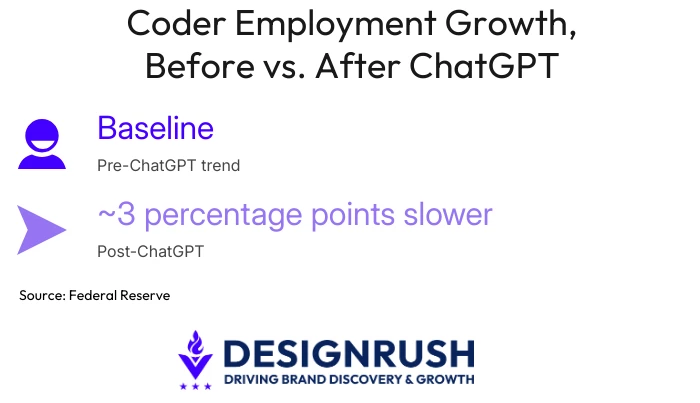
Coder employment growth slowed by roughly 3% annually after ChatGPT's release, according to a 2026 Federal Reserve analysis of occupation-level labor data.
A separate Harvard study of 65 million résumés at more than 280,000 firms narrows down where that slowdown is concentrated. Junior hiring drops sharply at firms adopting generative AI. Senior hiring barely moves.
That gap between what junior-level execution AI absorbs and what senior-level judgment still requires is exactly what shows up in a single web agency's day-to-day work.
Clients used to show up at a web agency with a wishlist. Now they show up with a working prototype they built themselves over a weekend.
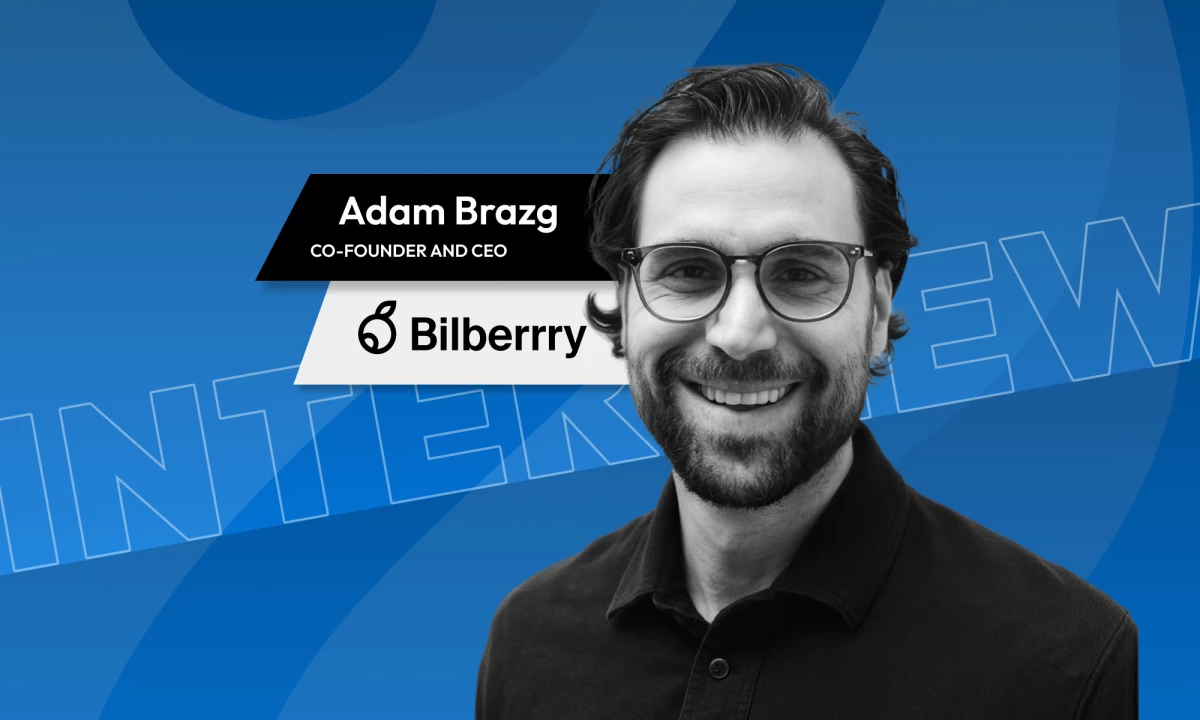
That shift sounds like good news for agencies. It also creates a specific kind of misunderstanding, according to Adam Brazg, co-founder and CEO of Bilberrry.
In this DesignRush interview, he explains what actually got easier and what stayed just as hard. Managing that gap, he says, is now most of the job.

Who Is Adam Brazg?
Adam Brazg's decade of work spans digital strategy, design, marketing, and product management. He has led digital innovation projects for companies including Deloitte, Business Wire, David’s Bridal and Lockheed Martin.
Bilberrry grew out of that background. Custom applications, enterprise eCommerce, and long-term digital transformation work with CTOs and CIOs make up most of what the agency does today.
Why the Easy 80% Created a New Kind of Misunderstanding
Clients who show up to the first meeting with something already built have a healthier starting point. The prototype forces clarity about what they want.
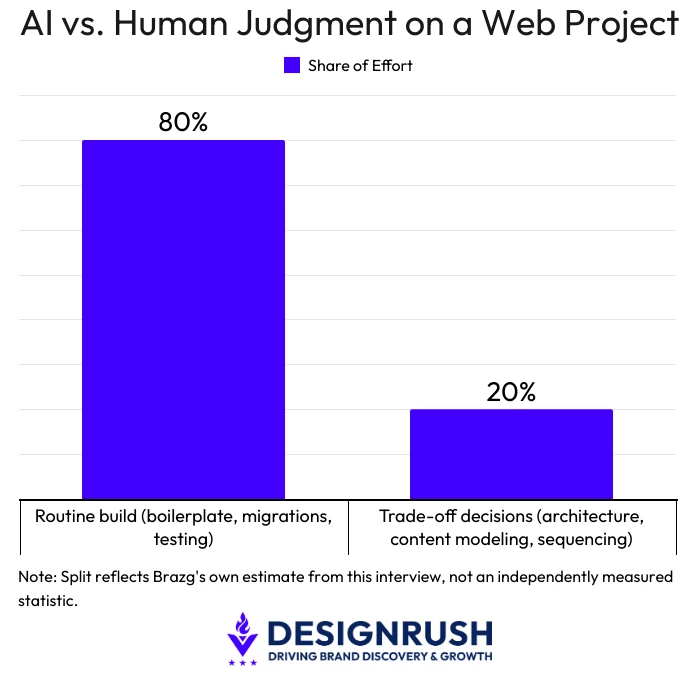
"But it also creates a specific kind of misunderstanding. Because the first 80% got easy, clients assume the whole thing got easy," Brazg says.
A prototype like that runs in a clean environment. One test user, a handful of records, nothing that has to reconcile with the systems already running the business day-to-day.
The remaining 20% is where all the cost was, and it hasn't gotten cheaper.
"So expectations have split. Clients expect us to move much faster on the parts AI genuinely accelerates, which is fair," Brazg adds.
"And they expect the hard parts to have gotten proportionally easier, which they haven't. Managing that gap honestly is a real part of the job now."
The Test for Which Decisions AI Can Make
Ask an AI to pick a CMS, and you get a competent summary of the market. Ask whether an organization should move to headless architecture, and the answer changes.
Brazg says the answer depends on several things.
- Who owns the platform in three years.
- Whether the marketing team will use a structured content model or fight it. What the procurement cycle allows.
- Whether there's internal capacity to maintain what gets built.
And none of that is in the training data.
"The pattern I see is that AI is strong on questions with a knowable best answer and weak on questions where the answer is a trade-off," he says.
Content modeling is the clearest example. There is no universal template, only a structure that fits how one specific organization creates and reuses information.
Getting it wrong is expensive to undo two years later, once thousands of entries already exist.
"AI will happily generate a content model. It won't tell you the one it generated assumes an editorial workflow your client doesn't have," Brazg adds.
The same test applies to sequencing. Knowing which stakeholder pulls funding without visible progress by a set quarter decides what gets built first, and no model has access to that.
Where AI Earns Its Place in the Workflow
AI's clearest value shows up in the work developers were never excited about doing in the first place.
That includes test coverage, migration scripts, data transformation, boilerplate, documentation, and reading unfamiliar code.
"On a large migration, the mapping logic between an old content structure and a new one is tedious and mechanical, and AI is very good at it," Brazg says.
Where it goes wrong is when developers use it to skip understanding entirely. Code that runs is not code a team can maintain.
Six months later something breaks. And nobody remembers why it was written that way.
"We treat AI output the way we'd treat any hand-written pull request. It gets reviewed," Brazg says.
A quieter shift matters just as much. AI has made it much cheaper to explore an approach before committing to it.
"We can prototype three architectural directions in the time it used to take to do one, which means more decisions get made with evidence instead of instinct," Brazg explains.
"That's probably a bigger quality improvement than the speed gain."
A Product Catalog Redesign Shows the Difference in Practice
Bilberrry is currently redesigning a site for a global manufacturer with multiple business units and thousands of SKUs, a project Brazg cites as a clear example of the split.
Historically on a project like this, the design phase runs on a small sample.
"You mock up a handful of product marketing page concepts, populate them with placeholder text, and hope you've covered the range of use cases," he says.
Gaps that get missed at the design stage tend to surface at build time instead.
A product with forty technical specifications and no imagery breaks a template built for one with three specs and a hero shot. That discovery used to happen late and late is expensive.
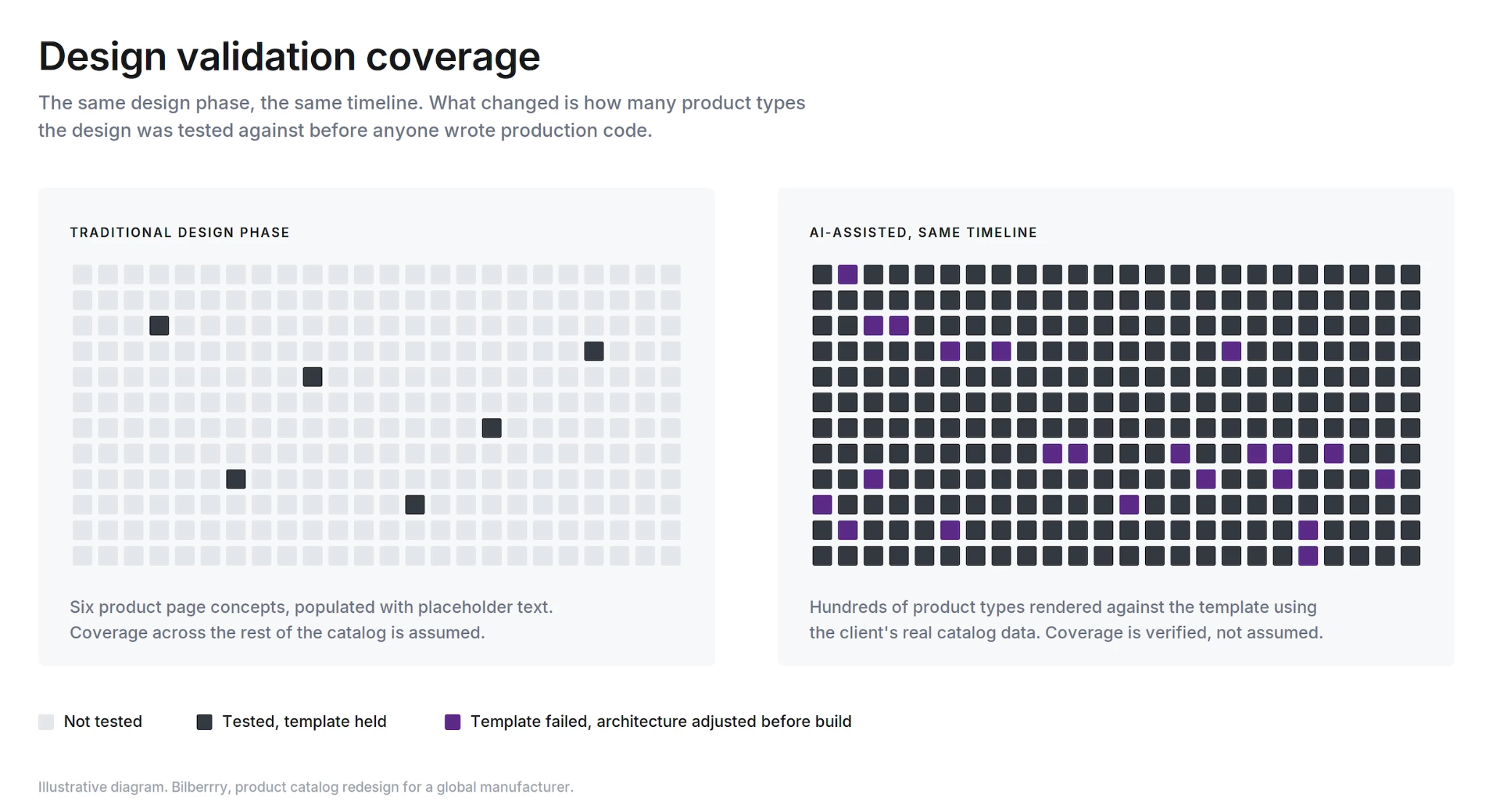
"On this engagement, we've been able to stress test our designs across hundreds of product types using the client's real product data," Brazg adds.
"We're not hoping the template holds up across the catalog, we've watched it hold up, and where it didn't we adjusted the architecture before anyone wrote production code."
The timeline didn't shrink. The validation got more thorough inside roughly the same window. Brazg considers that the more valuable outcome.
What AI Still Couldn't Decide on Its Own
The project didn't move faster. It moved more thoroughly, inside roughly the same window. Brazg emphasizes that point specifically, since it runs against the usual AI narrative.
"We're validating more thoroughly in roughly the same amount of time, which is a different and more valuable outcome," he says.
"The decisions still take as long to make. We just now know whether they were right before we commit to them."
A second benefit came as a surprise.
"It's much easier for the client to participate when they can see their own products on the page instead of imagining their content in someone else's layout," Brazg adds.
Placeholder text forces every stakeholder to go through a private translation exercise, and people translate it differently, which is often where design feedback conflicts begin.
The underlying decisions, how to model the catalog, how the business units relate, which product attributes matter to a buyer versus internally, none of that came from a tool.
"AI let us test those decisions at a scale we couldn't reach before. It didn't make them," Brazg says.
What Clients Should Ask Web Agencies Now
The Harvard data on junior hiring and Brazg's own examples point to the same practical test.
A prospective client should worry less about which tools a team uses.
Instead, they should ask who has actually made the trade-off call between two content models. Or who decided which stakeholder's deadline drives the build order?
Agencies face the same test from the inside. Junior hires used to earn their keep writing code.
That work compresses fast. Still, recognizing which questions a client hasn't thought to ask takes years to learn. That's exactly why training that judgment early matters more than ever.
Years of shipped code used to prove that skill on its own. Now it proves itself in the room, in a client meeting, when someone catches the assumption everyone else missed.