
AI-Generated Code Web Development: Key Findings
- 41% of global code is now AI-generated, marking a fundamental shift in how websites and digital platforms are built.
- AI tools deliver early-build productivity gains of up to 40%, with 92% of U.S. developers using them daily, accelerating launch timelines across teams.
- 45% of AI-generated code fails basic security testing without review, underscoring the need for structured oversight and reliable hosting as adoption scales.
About 41% of global code is now generated by AI, according to SecondTalent.
That same report shows 256 billion lines of code were written using AI tools in 2024 alone.
AI-generated code now plays a central role in the work of product teams, agencies, and small businesses (SMBs) around the world.
Often described as vibe coding, this intent-driven approach allows users to describe a function or page in plain language while AI systems generate working code.
As a result, teams spend less time writing syntax and more time steering prompts, refining outputs, and validating results.
“AI is dramatically accelerating how websites are built,” says Daniel Kanchev, Director of Product Development at SiteGround, an all-in-one platform for online success.
“But speed only creates value when it’s matched with the right infrastructure, performance, and oversight once those sites go live.”
As more teams adopt AI, building fast is not the only goal.
What matters just as much is whether those AI-built websites hold up in the long-run.
Editor's Note: This is a sponsored article created in partnership with SiteGround.
How Vibe Coding Speeds Web Development
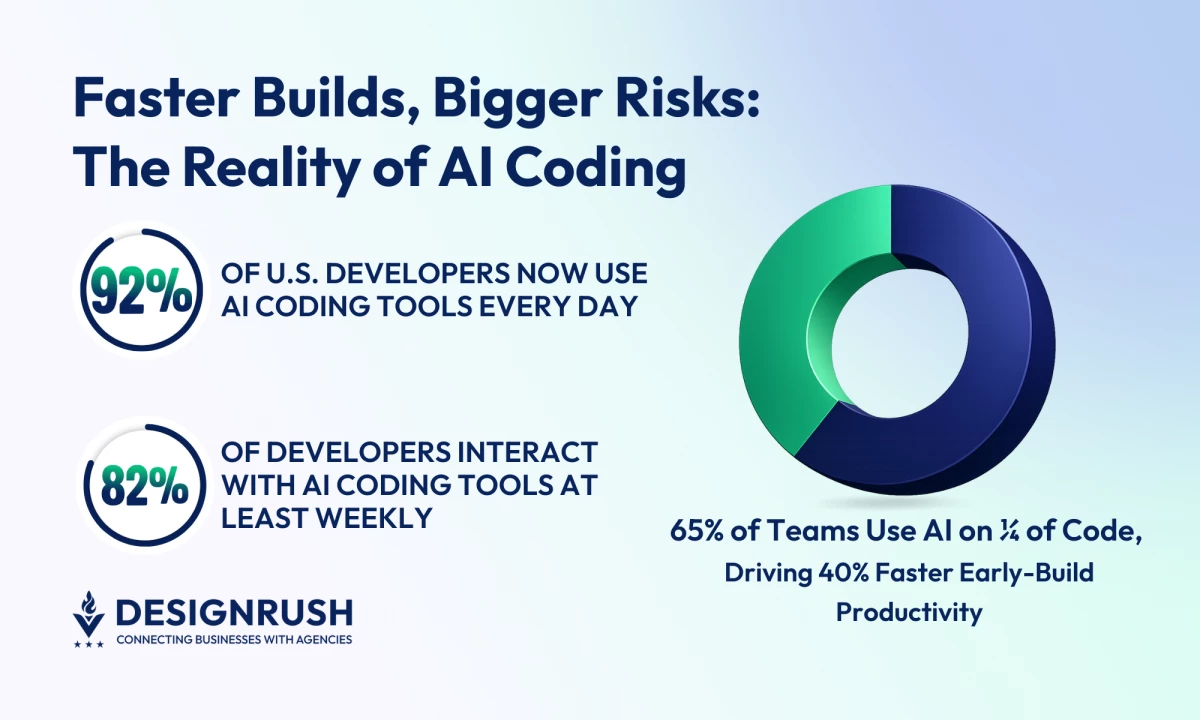
It's become so widespread that 92% of U.S. developers now use AI coding tools on a daily basis.
Web hosting service SiteGround recently demonstrated how AI tools can support coding workflows:
Globally, that number isn’t far off, with 82% of developers using them at least weekly.
This is because the barrier to entry is low, as we’ve seen with the increased adoption of GitHub Copilot and ChatGPT across teams.
And this is not only for small tasks.
SecondTalent’s data indicates that AI coding now reaches at least one-fourth of the codebase for 65% of development teams, reporting faster delivery on routine tasks such as layout generation, configuration, and documentation.
As a result, productivity gains often exceed 40% on early-build work.
The problem, however, comes when AI-generated code still hallucinates, introducing logic gaps and security risks.
Independent research shows a significant portion of AI‑generated code fails basic security checks unless reviewed and corrected.
AllAboutAI’s research found 45% of AI-generated code fails security testing, and enterprises now face 10,000+ monthly security incidents tied to AI-authored code.
This means SMBs without dedicated engineering oversight have to catch these errors before customers encounter them.
“Automation doesn’t remove accountability,” Kanchev adds.
“Teams still need clear checkpoints for testing and deployment, especially when customer data is involved.”
Those risks make it clear that vibe coding needs structure and oversight to be used safely.
Guardrails Teams Must Put in Place
To turn AI-driven speed into sustainable results, teams need clear processes and accountability.
Here are three ways to use vibe coding responsibly:
- One, use AI to speed up work, not to make final calls. Human review is still required for logic, security, and maintainability over time.
- Two, make reviews non-negotiable. Clear testing and approval checkpoints matter, even for lean teams.
- Three, prioritize reliable infrastructure. Speed is irrelevant if systems fail under real traffic, security pressure, or uptime demands.
That operational guidance only matters if teams understand where the real costs and risks now sit.
Vibe coding changes the cost structure of website development in practical ways.
Build speed is no longer dependent on deep technical expertise, allowing teams with limited coding experience to launch functional sites and features.
Iteration also happens faster, with pages, forms, and integrations tested and revised in quick cycles that suit campaign-led teams and early-stage companies.
The tradeoff is that technical debt can build unnoticed, as code that functions in the short term may weaken over time without proper checks for structure, performance, and security.
“For smaller teams, AI‑assisted coding lowers the cost of experimentation. The risk is assuming the output is production‑ready without applying the same review standards teams used before automation,” says Kanchev.
All of this brings the conversation back to what happens after the site goes live.
Hosting Still Determines Site Success
AI-built sites still rely on hosting speed, uptime, and security.
Slow loads or unstable servers wipe out any gains made during development.
Search rankings and user trust drop fast when performance slips.
That puts basic hosting requirements back in focus, including reliable servers, solid security controls, and the ability to handle real traffic as sites grow.
With AI accelerating site builds, are review steps and infrastructure keeping pace?
Vibe coding cuts build time and lowers technical barriers, but it cannot replace human oversight or stable infrastructure.
Without proper validation and reliable servers, early productivity gains quickly disappear.
As teams release sites faster, the real test begins after launch.
“To turn faster builds into dependable, user-ready sites, teams need hosting that consistently delivers on performance, security, and uptime,” says Kanchev.
“If the infrastructure cannot handle real traffic, the time saved during development disappears quickly.”
And while AI may reduce build time, long-term site performance still depends on reliable infrastructure once real users arrive.