
Scaling Enterprise Web Apps: Key Findings
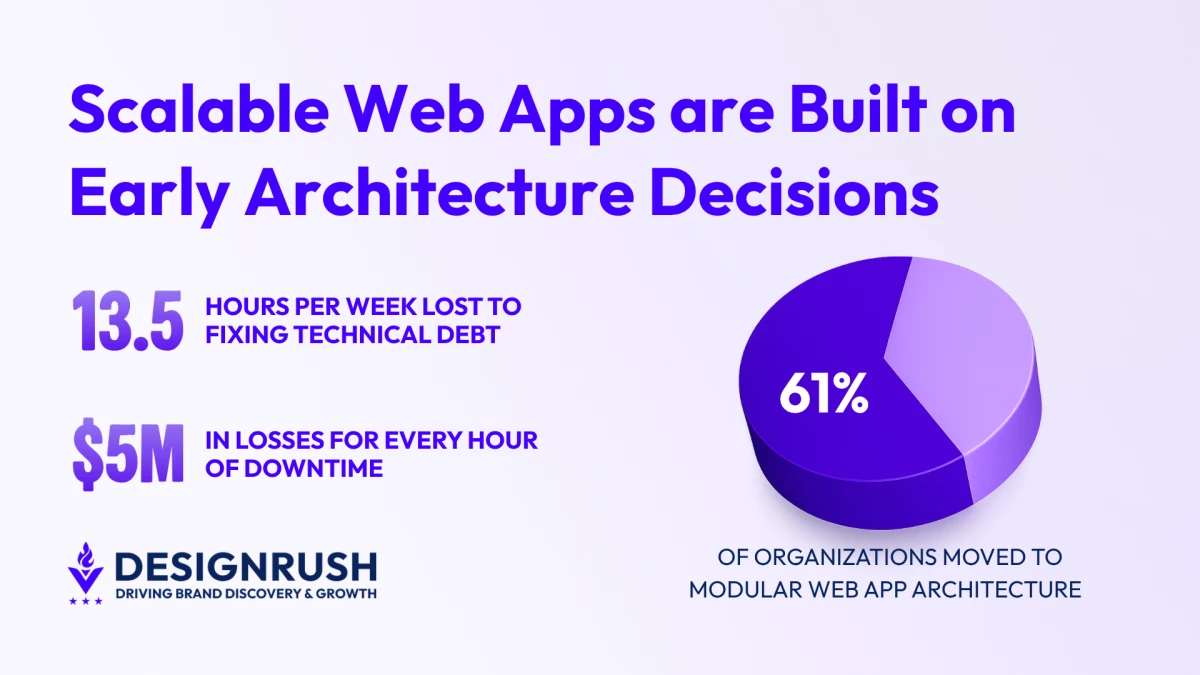
- Developers lose 13.5 hours dealing with technical debt, showing how poor early architecture decisions quietly drain productivity over time.
- A single hour of downtime can cost enterprises over $5 million, making scalability a direct financial priority.
- Quixta warns that most scalability failures stem from teams prioritizing speedto market instead of flexibility, resilience, and long-term growth.
Most web applications perform reliably during the initial stages. However, they face outages and downtime as usage begins to compound.
This happens because scalable web applications require architecture-level planning in the early stages of development.
Many website development companies ignore optimizing the web application for scalability in the beginning, leading to technical difficulties and growth issues later.
This is known as technical debt.
According to Stripe’s Developer Coefficient Report, developers spent 13.5 hours of their time dealing with technical debt.
Web applications that are not optimized to scale and handle high volumes can also lead to increased downtimes.
These downtimes can be costly in high-impact industries like finance and healthcare.
According to the ITIC 2023 Global Server OS Reliability Report, a single hour of downtime can cost mid-sized enterprises $300,000 or more, and more than $5 million for large enterprises.
Why Does Scaling Web Applications Fail Early?
Demand for custom web applications has increased.
The custom web application development service market is projected to grow at a CAGR of 9.4%, according to Technavio’s market report.
In response, many teams have reduced their timelines to accelerate launch, often at the expense of optimizing the system architecture for long-term operational load.
This is a general trend in the industry. Early-stage systems are designed to launch faster, sacrificing architecture-level planning of future growth patterns.
As traffic grows and data volume increases, these early-level missteps surface in the form of latency issues, outages, and operational costs.
A web application that is designed to serve hundreds can rarely support thousands of users.
Architecture Decisions That Matter
Developers who can adopt architecture-level decisions regarding scalability can avoid downtimes or outages during the expansion phase.
In particular, the most successful developers consistently make the following choices:
1. Choosing Modular Architecture Over Monoliths
Most early-stage web applications are built as monoliths because it’s faster and cheaper. But problems appear when the system needs to scale independently.
Modular architecture solves this problem by breaking complex systems into smaller, independent, and self-contained modules, each with specific functionality.
This makes it easier for the system to scale, as the developer needs to only change the configuration of one particular module without disrupting the entire system.
This is in stark contrast to monolithic architecture, where the entire system is built, deployed, and managed as a single unified unit.
This often made scalability difficult and resource-intensive because updating a single unit required scaling the entire application.
Because of this, 61% of organizations moved away from tightly coupled monolithic architectures to modular architectures, as reported by O’Reilly.
Choosing modular architecture over monolithic architecture for website application development in the early stages allows room to scale and upgrade without disrupting the broader system.
2. Making the Right Database Design Decision
Database schema decisions made in the initial phases of the development determine how the web application can scale.
Decisions like how the data will be stored, organized, and retrieved can impact whether a web application can handle a growing number of data volumes in the future.
For instance, a database schema designed for today’s data volume rarely accommodates future growth complexity.
Similarly, teams that delay indexing decisions until performance degrades face costly and complicated situations under live traffic.
A common failure pattern emerges when teams use an experimental platform to store the data in the early stages of development, only to face schema incompatibilities and data corruption issues during migration to a production server.
Fixing this requires significant rework across the system, making it costly and time-consuming.
3. Optimizing for Performance at Early Stages
Optimizing the website application for performance is often treated as a post-launch concern, but as the system grows, performance bottlenecks become the biggest cause for scalability limitations.
Common performance-related decision issues include choosing sequential API calls where parallel calls would work, or adding an unoptimized image or asset delivery into the page structure.
Retrofitting a caching layer or restructuring data-fetching logic after launch is a significant re-architecture effort that can be avoided by early-stage performance optimization.
A Google and Deloitte study, Milliseconds Make Millions, found that a 0.1-second improvement in mobile site speed improved retail conversion rates by 8.4%.
As such, optimizing for performance is a design choice that can be taken at the architectural level of the development process to support scalability.
4. Avoiding The Third-Party Dependency Trap
Third-party applications are commonly used to extend functionality and accelerate development in the early stages of a web application.
However, as the user count increases, third-party dependencies introduce constraints like API rate limits, pricing changes, and performance variability that are beyond the control of internal teams.
According to a Gartner survey, 45% of organizations experienced third-party-related business disruptions.
These dependencies create scalability bottlenecks, where replacing or restructuring integrations can disrupt system performance and cost efficiency, while requiring significant rework across the system architecture.
In my experience leading Quixta, I’ve found that scalability issues are mostly the result of early assumptions that go unchallenged.
Most teams optimize for speed of launch, not for flexibility and growth.
But the real shift happens when teams start treating architecture as a long-term product decision, not just a development phase.
If your system can’t adapt without significant rework, it’s not built to scale.
Implications and Next Steps
Scalability is not a conversation to have after launch. It’s a decision made during the earliest stages of development, especially when founders and digital leaders are most involved.
Before starting the development process, three questions are worth asking the team:
- How will this system perform at 10 times its current capacity?
- Which components would require an upgrade or rebuild if the product needs a new feature addition in the future?
- What happens to the application if a critical third-party service changes its pricing model or shuts down?
The answers will determine what architecture-level changes are required in the initial stages of the development. Scalability is a priority decision that, if overlooked, can become costly after launch.