
Google Core Update & UX: Key Findings
- Google’s March 2026 core update shows ranking drops aren’t penalties, but the result of pages being beaten by more useful alternatives, forcing brands to rethink how they compete in search.
- Search visibility now hinges on relative usefulness, with UX performance, content clarity, and navigation shaping how pages are judged.
- Design In DC outlines how structured user journeys and practical UX improvements can help brands regain visibility and stay competitive.
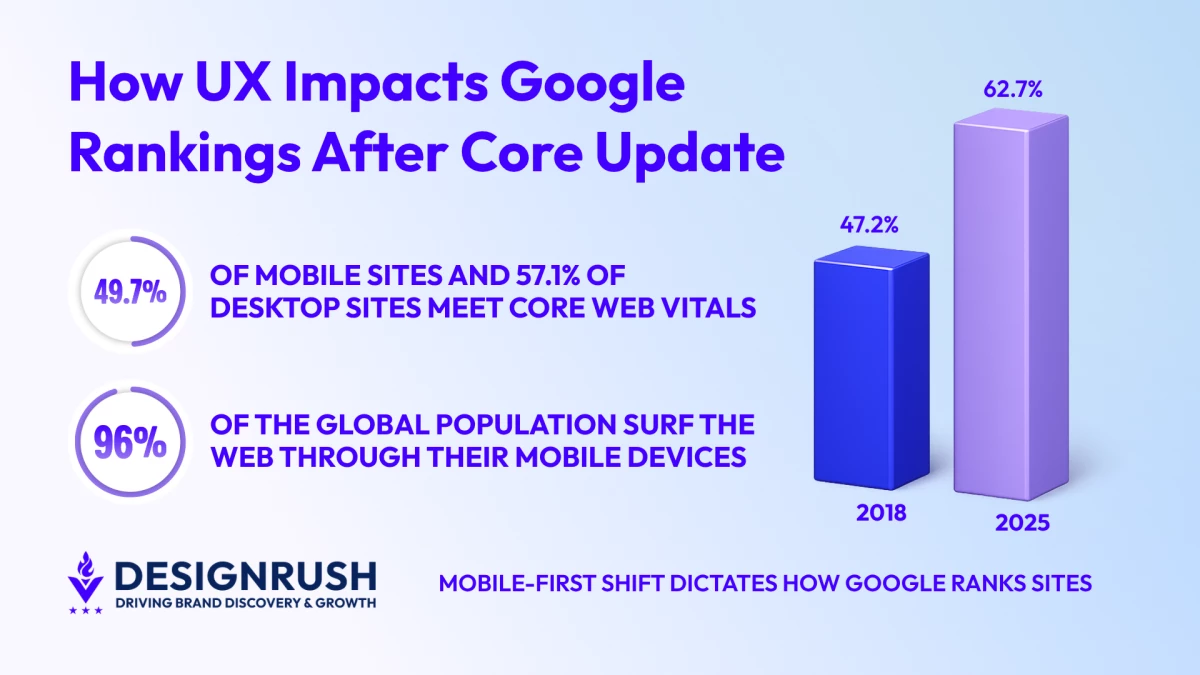
Only 49.7% of mobile websites and 57.1% of desktop sites currently meet Core Web Vitals benchmarks, according to DebugBear. This comes as Google’s March 2026 Core Update reshapes how rankings are evaluated.
These changes reflect a broader reassessment of content usefulness.
Ziad Foty, CEO and founder of Washington-based agency, Design In DC, believes that the implications run deeper than just focusing on SEO mechanics.
“When rankings drop, it’s less about something being broken and more about how a site compares to what users are finding elsewhere,” he says.
While a drop in rankings used to trigger a technical audit, it now raises a different question. Who’s delivering the better experience and how?
The video below shares what to take into consideration when making tweaks to your website following the March 2026 Core Update:
Editor's Note: This is a sponsored article created in partnership with Design In DC.
Core Web Vitals Data Explains Ranking Changes
Performance data reflects a growing divide in how websites perform under real user conditions.
Even small delays can have measurable consequences. Cloudflare reports that a two-second delay in page rendering can lead to around a 4% drop in revenue per visitor.
To put that into a real-world scenario, an eCommerce site generating $10 million in annual revenue could see an additional $400,000 simply by improving load times enough to lift conversions by 4%. For high-traffic brands, those gains can compound exponentially.
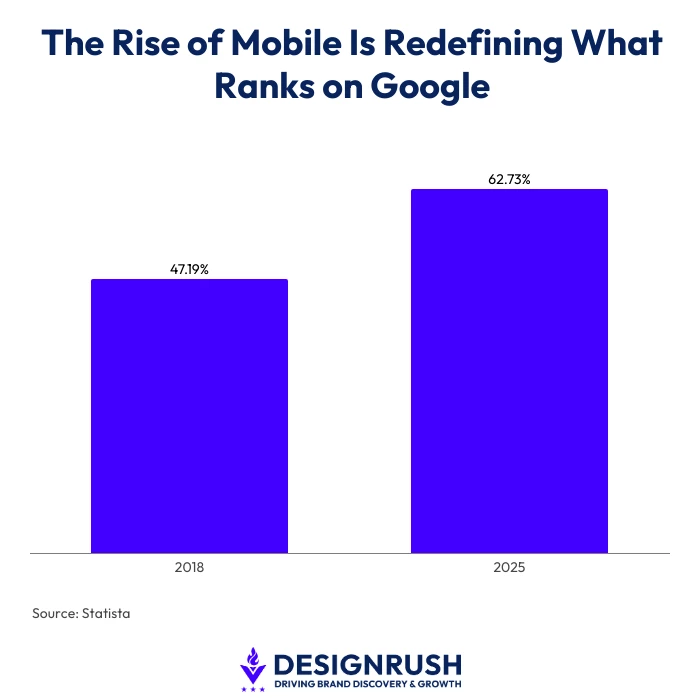
Mobile experience also carries increasing weight. Statista suggests that more than 62.73% of global web traffic now comes from mobile devices, up from as low as 47.19% at the end of 2018.
With DataReportal adding that 96% of the global population uses a mobile phone to go online, usability on smaller screens often determines how content is perceived.
“Pages aren’t just competing on what they say anymore, but on how reliably and efficiently they deliver it,” Foty says.
Google Now Ranks Pages by Comparison
Rankings are now adjusted based on how pages perform against competing results.
Pages aren’t judged in isolation anymore. They’re weighed against competing results, and ranking algorithms adjust based on which one performs better for the user.
A page can lose traffic without doing anything wrong. It just wasn’t the strongest option at that moment.
“Google’s guidance reflects this,” Foty says.
“There isn’t a quick fix for ranking drops after a core update. The focus is broader. Improve content so it’s more useful, easier to navigate, and aligned with what users need.”
YouTuber, Edward Sturm, breaks down Google’s March 2026 Core Update and how early data shows volatility across search results and rankings:
Why UX Now Impacts Google Rankings
User experience now carries real weight in how content performs.
Design, structure, and usability shape how information is consumed. A well-written page can lose ground if it’s difficult to navigate or slow to load. A simpler page can outperform it by being clearer and easier to move through.
Foty points to this growing connection between UX and SEO.
“The way users move through a page, how quickly they find answers, and whether they stay all contribute to how useful that page appears,” he says.
“It’s not just about what’s on the page anymore. It’s about how it works.”
Design In DC’s comprehensive web development process meets these challenges and more:
View this post on Instagram
Content Alone Isn’t Enough for Rankings
While content still matters, expectations have changed.
Answering a question isn’t enough, and the answer needs to be as easy to find as it is to follow.
“Pages that guide users naturally from one step to the next tend to hold their ground,” Foty says. “Others fall behind, even when the information is accurate.”
This means that content discovery, clarity and usability now carry as much weight as the content itself.
View this post on Instagram
Where Search Is Headed Next
This update marks a turning point. Google isn’t just refining rankings, but redefining what earns them.
Experience signals are only going to become more important. As user interaction metrics become more precise, the gap between high-performing and underperforming sites will continue to widen.
There’s a longer-term effect taking shape here. Pages built to rank rather than to work are becoming easier to spot and replace. As that trend continues, surface-level optimization will keep losing ground.
“For agencies, this raises the bar,” Foty says. “The conversation is moving beyond visibility and into performance. Not just how a page ranks, but how it behaves once someone lands on it.”
Want to know how to build a high-converting website? Design In DC’s guide below shows why it's no longer about just looking good, but working smarter:
View this post on Instagram
What the Core Update Means for Brands
For marketers and agencies, this changes how SEO work gets done. It can’t operate on its own anymore. It has to connect with design, content, and the overall experience.
When rankings drop, the instinct shouldn’t be to look for errors. It should be to look at the experience and ask the questions that some don't always consider.
Where do users hesitate? What feels unclear? And who’s making it easier?
“Google isn’t handing out penalties here, but changing how performance is judged,” Foty says.
“Visibility now comes down to who delivers the better experience, not just who checks the right boxes. Brands that understand that won’t just recover lost ground, but build something that’s much harder to outrank.”
In practical terms, that changes what “good SEO” really looks like.
So ask yourself the question. What matters more now, how your site ranks or how it works?
Want to know more about UX and web development?
Take a look at our list of the Top UI/UX Design Agencies for 2026.