
Web Accessibility and WCAG Failures: Key Findings
- Accessibility failures remain widespread, meaning that nearly all websites still contain WCAG issues that disrupt user experience and limit access to information
- The business impact is often invisible, as B2B brands lose trust, engagement, and potential deals before users ever convert
- Accessibility must be built into the foundation, requiring teams to embed inclusive design, continuous testing, and real user feedback to turn compliance into a competitive advantage
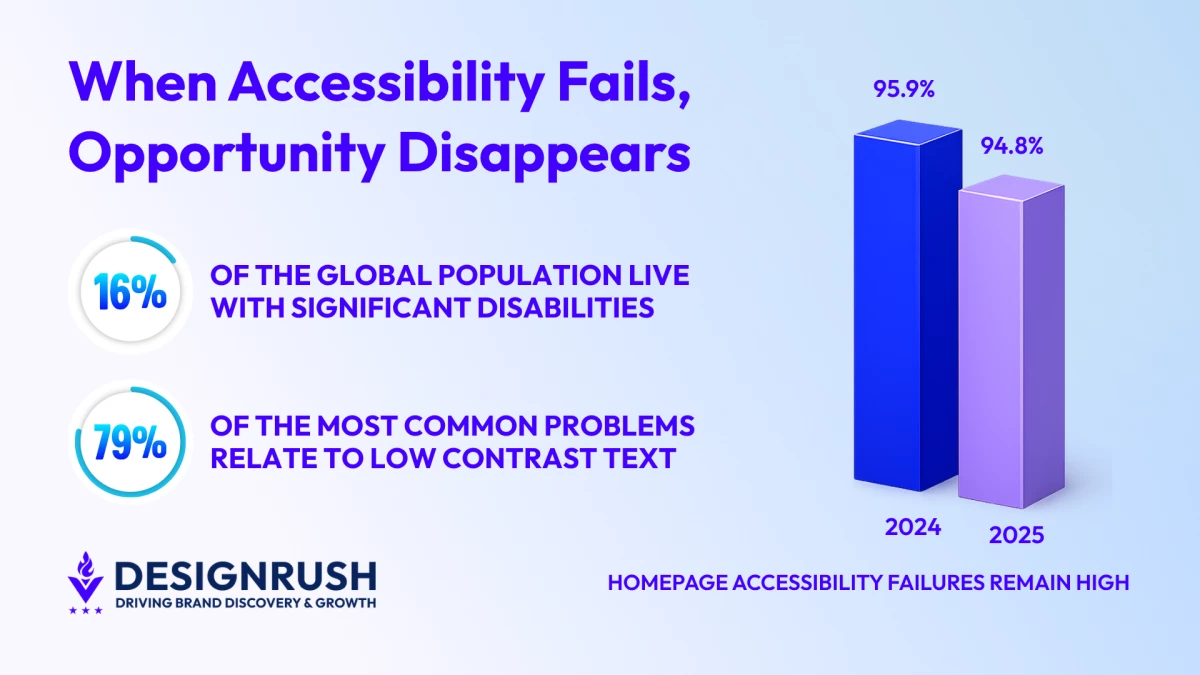
Data shows 94.8% of homepages still show detectable accessibility failures, a marginal improvement from 95.9% in 2024.
This is according to a report by WebAIM, a non-profit accessibility organization. Its data suggests most digital companies (and B2B brands) are likely losing business as a result.
Accessibility issues, such as unreadable buttons, low-contrast text, or non-intuitive navigation, can cause users to leave, eliminating chances of conversion.
Paul J. Scott is the Founder and Chief B2B Website Strategist of GoingClear, a leading B2B digital agency based out of Boston, Massachusetts. His team sees these accessibility failures all the time, reinforcing WebAIM’s findings that most websites don’t get accessibility right.
“For an industry that likes to think of itself as innovative, it really makes you question yourself. Are we improving, or just talking about it more?” Scott says.
So far, progress has been limited.
What does a B2B website actually need to succeed? Scott outlines 22 must-haves, including accessibility considerations:
Editor's Note: This is a sponsored article created in partnership with GoingClear.
Why Web Accessibility Isn’t Where It Should Be
It’s no secret that web accessibility matters. But what’s causing teams to miss the mark?
Accessibility is frequently talked about. It comes up in strategy conversations, brand guidelines, and product discussions.
But somewhere between intention and execution, things go sideways. This, according to Scott, isn’t acceptable.
“What’s striking is how simple many of the issues are,” Scott says.
“We aren’t talking about highly technical edge cases. We’re talking about low-contrast text that is hard to read, missing descriptions that leave images meaningless, and forms that confuse users at critical moments.”
And yet, they continue to shape experiences in ways that quietly exclude people.
Business Insider’s report on GoingClear’s G3 framework is a clear example of how accessibility is built into the foundation of website development:
Accessibility Fails by the Numbers
With as many as 1.3 billion people worldwide living with significant disabilities (16% of the global population), having easy-to-use accessibility features isn’t optional.
It becomes a question of who your website is actually built for and who you are limiting from accessing information.
According to the same WebAIM report:
- Homepages contain an average of 51 accessibility errors, creating friction from the very beginning
- 79.1% of homepages have low-contrast text, making content harder to read
- 55.5% of pages lack alternative text for images, leaving key content inaccessible
For users relying on screen readers, that means entire sections of content are effectively invisible.
Then, there are form labeling and usability issues, which affect 48.2% of homepages.
These are the exact points where users are expected to take action. And when those moments break, opportunities disappear without warning.
“When barriers exist at this scale, they stop being exceptions. They become part of the experience itself, shaping who gets access to information and who gets left out,” Scott says.
Why Accessibility Hits B2B Harder
For B2B companies, a website is not just a digital presence. It’s part of the sales journey and the platform where potential clients evaluate your credibility, your clarity, and your attention to detail.
But when accessibility fails, the impact is not always obvious.
Users may struggle and leave, decision-makers may abandon broken forms, and potential partners may never fully engage with your content.
There is also a growing layer of compliance to consider, particularly those related to WCAG guidelines.
Many enterprises and public sector organizations now build accessibility into their procurement requirements. If your website does not meet those standards, you may not even make it past the first filter.
“At the same time, accessibility reflects something deeper,” Scott says.
“It signals how seriously a brand takes its audience. This includes whether it’s thoughtful and inclusive, or simply checking boxes.”
The video below outlines the 2026 ADA (Americans with Disabilities Act) and why your website needs to be compliant:
Turning Accessibility Into Advantage
The brands that are making real progress aren’t treating accessibility as a task to complete. They are treating it as a design principle.
When accessibility is done well, it improves the experience for everyone. Interfaces become clearer. Navigation becomes more intuitive. Content becomes easier to understand.
It also forces teams to be more intentional, to simplify, and to prioritize what truly matters.
And there is a clear business upside.
“By removing barriers, brands expand their reach and create more opportunities for engagement,” Scott says.
“And in the competitive B2B markets of today, that can be the difference between being considered or being overlooked.”
Highcharts’ video below explains why web accessibility is a competitive advantage:
How B2B Teams Can Fix Accessibility
Improving accessibility is not about a one-time fix and requires a shift in how teams approach design and development from the start.
This begins with embedding accessibility into design systems so it becomes part of the foundation. This includes providing developers with the knowledge and design tools to implement standards correctly.
Regular testing also plays a critical role, particularly as websites evolve and new issues emerge. Here, ongoing audits will help ensure that progress is not undone over time.
“And perhaps most importantly, real user feedback brings clarity,” Scott says. “It reveals the moments where experiences break in ways that tools alone cannot fully capture.”
Take a look at what digital accessibility really means for B2B experiences:
Accessibility Is a Reflection of Your Brand
Accessibility is easy to overlook when everything seems to be working for those without disabilities. However, the reality is that for many users, it’s not working at all.
“And when that happens, the loss doesn’t come with an alert or notification. Just a missed connection, a lost opportunity, and a conversation that never begins,” Scott says.
In the B2B sector, where trust is built through every interaction, accessibility is no longer a secondary concern. It’s a reflection of how a brand shows up.
And in many cases, it’s the difference between being accessible in theory and being truly open for business.
Want to know more about website accessibility and WCAG failures and guidelines?
Take a look at our Top Web Design Companies of 2026.