
Interactive Brand Moments: Key Findings
- 69% of consumers expect brands to capture their attention immediately, making interactive brand moments that prompt quick action more effective than static pages.
- Short interactions can stack multiple touchpoints in seconds, which means interactive brand moments should use simple actions like tap, choose, and reveal to keep users engaged.
- Users trust what they can test, not what they’re told, so interactive brand moments need to show clear outcomes in real time and give users a sense of control.
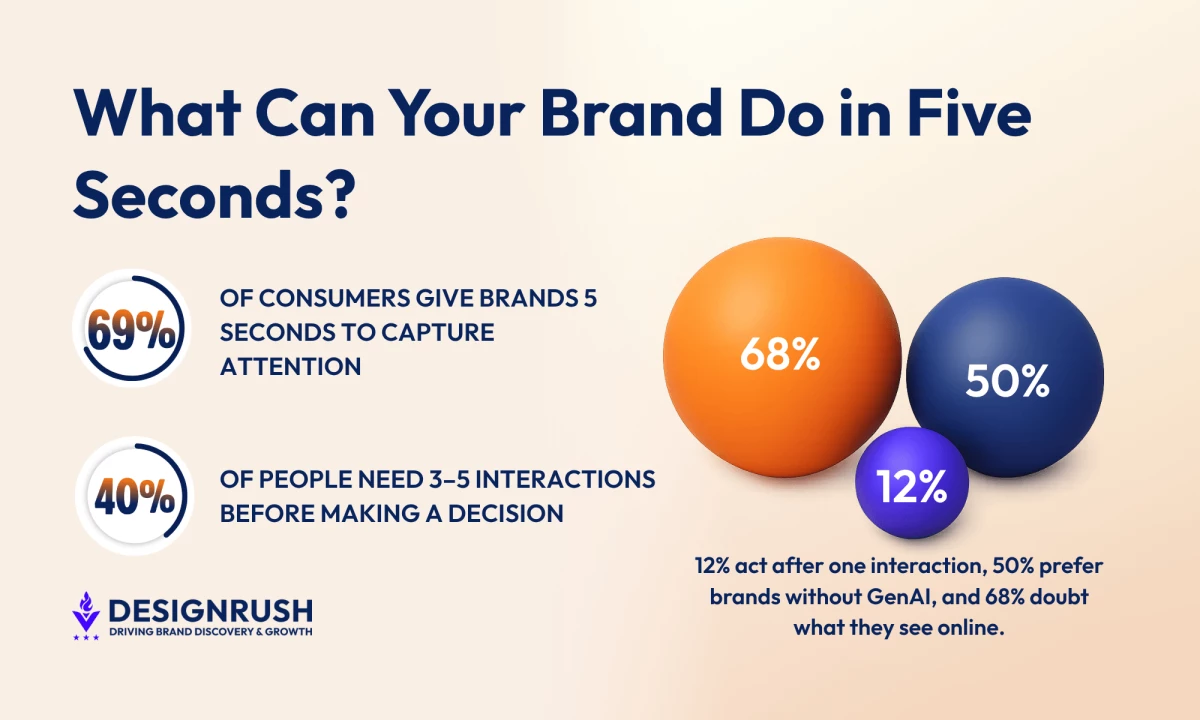
Sixty-nine percent of consumers say brands have five seconds or less to capture attention in ads, emails, and social media, according to the Adobe 2026 AI and Digital Trends Consumer Report.
Five seconds is not a lot of time. It’s barely enough time to scroll, let alone care.
And yet, it’s the reality brands have to design for.
Digital-first creative agency Isadora Agency built a small, interactive “stress release” game on its website.
The project recently earned a bronze at the DesignRush Design Awards, an early nod to how much impact a small idea can carry.
There’s no grand product pitch or funnel gymnastics, though.
Editor's Note: This is a sponsored article created in partnership with Isadora Agency.
Instead, it serves as just a quick, tactile moment where visitors can click, squish, and reset before getting back to work.
On paper, it might sound like a side project, but in practice, it lands right in the middle of a much larger issue.
The agency’s president, Isadora Marlow‑Morgan, says the idea was never to build something big for the sake of it.
“We wanted to create a moment that people could step into without thinking. Something immediate, tactile, and satisfying,” Marlow-Morgan says.
“If it feels effortless to the user, that’s when the work is doing its job.”
CX Is Declining, Micro-Experiences Fill the Attention Gap
Customer experience (CX) in the United States is slipping, and brands are running out of ways to fix it.
About 25% of U.S. brands saw their CX ranking decline in 2025, while only 7% improved, Forrester found.
The drop wasn’t limited to usability; it cut across effectiveness, ease, and emotion.
And that last one, emotion, matters more than most teams admit.
If there’s no emotion, everything feels the same. And when everything feels the same, customers stop caring.
That’s where small, digital experiences start to earn their place.
It’s exactly the kind of thinking the agency brought to Upli, where emotion and engagement guided every step of designing a financial wellness app.
Now, a microsite like Isadora Agency’s game doesn’t try to solve everything, but it does give the user a brief sense of control and relief.
It asks nothing upfront, doesn’t interrupt, and doesn’t overexplain. It just works.
That’s because it mirrors how people now engage with digital content.
As noted earlier, Adobe reports that 69% of consumers say brands have five seconds or less to capture attention.
It’s a hard limit, especially given that only 12% feel ready to act after a single interaction, while three to five interactions influence decisions for 40% of people.
This is why the idea of a short interactive loop looks much less like a novelty and more like a practical format.
A static page gets one shot to impress, while a micro-experience can stack interactions in seconds.
Tap. Choose. React. Repeat.
It aligns with how attention actually works now: people engage first and decide along the way.
Marlow-Morgan points out that the structure mirrors how people already behave online: “you don’t have time to explain an experience anymore, you have to let people get into it instantly and figure it out through interaction.
“That’s why short loops work. They give users something to do right away instead of something to read.”
And a well-designed interactive moment compresses that process into something immediate.
This just proves that small, self-contained experiences can carry real weight if they respect the user’s time and deliver something tangible in return.
Users Don’t Trust What They See, So They Test It
Trust underpins it as well.
Gartner’s 2026 Marketing Survey found that 50% of U.S. consumers prefer brands that don’t use GenAI in customer-facing content.
Conversely, 61% say they frequently question whether the information they rely on is reliable, and 68% wonder whether what they see online is real.
It also changes how people engage.
With static content, users are asked to believe what they’re told. Interactive experiences don’t ask for that.
Small interactive experiences offer something different. They:
- Show instead of tell
- Respond instantly to user input
- Create a clear cause and effect
- Remove abstract claims to interpret
- Provide proof in real time
Isadora Agency’s stress-release game leans into that idea without overcomplicating it, giving the user a self-contained and intentional moment.
According to Marlow-Morgan, trust now comes from clarity in the interaction itself.
“People are skeptical, so the experience has to be direct. You click something, it responds. You make a choice, you see the result,” she says.
“There’s no gap between action and outcome, and that’s what makes it feel real.”
The business argument isn’t subtle.
When customer experience declines, brands look for ways to fix the big things: platforms, journeys, and personalization engines.
They’re necessary, but they’re also expensive and can take ages to roll out.
But smaller interventions get overlooked, even though they can influence how a brand is perceived. And that perception can compound quickly.
What This Means for Brands and Agencies
A quick, positive interaction can reset how a user feels about a brand.
It can also:
- Increase time spent on a website
- Create a memory that lasts longer than a headline or banner
- Be shared and entertain others
This is where the “five-second experience” starts to punch above its weight.
There is also a strategic angle that often gets missed: interactive experiences keep attention within brand-controlled environments.
Marlow-Morgan adds:
“These small experiences do more than entertain. They give brands a way to hold attention on their own terms,” she says.
“You’re not relying on another platform to keep someone engaged. You’re creating a moment that belongs entirely to your brand, and that has long-term value.”
Distribution channels are increasingly mediated. It gives brands the space to control the rules, the pacing, and the outcome.
But this doesn’t mean that every brand should build a game; most probably shouldn’t.
Rather, the point is to focus on small, purposeful interactions to rebuild emotional connections with visitors, demonstrate intent without overexplaining, and give users a reason to stay, albeit briefly.
Isadora Agency’s project makes that case without saying a word. It invites the user in, gives them something to do, and lets the experience speak for itself.
There’s no pitch or pressure. It’s just a moment that feels different from the rest of the web.
Turns out, that might be exactly what people are looking for.