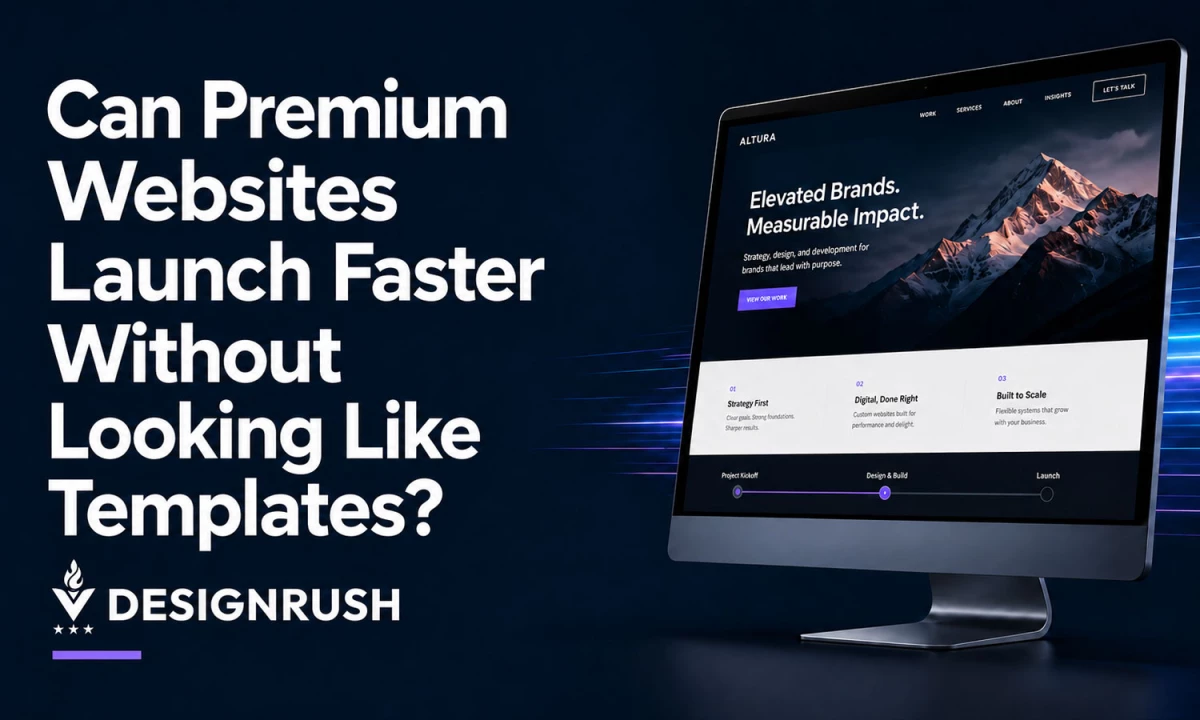

Businesses increasingly need websites that can launch within realistic budgets and timelines while still looking premium, communicating clearly, guiding visitors toward action and remaining understandable to both traditional search engines and AI-powered discovery platforms.
That puts pressure on the old assumptions behind both fully bespoke websites and standard templates.
A fully custom project can require significant time and investment, while a traditional template often solves the visual starting point without solving the strategic decisions underneath it.
Visuable's response is a different website methodology:
- Professionally planned frameworks that embed strategic thinking into the foundation
- Customizing the finished experience around each brand
Why the Website Market Needs a New Model
Seventy percent of executives believe customer expectations are changing faster than their companies can adapt, according to PwC’s 2025 Customer Experience Survey.
Now add customer experience to the need for speed, with 29% of consumers saying they’ve stopped using or buying from a brand because of a poor experience online or in person, according to the same PwC survey.
Visuable, a Squarespace web design and SEO agency that has launched more than 2,000 websites, has spent the past three years developing and refining framework-based websites as an alternative for brands that want speed without a generic result.
So, which website decisions should be solved strategically in advance, and which should remain open to individual brand expression?
Its Framework Collection starts with a professionally designed structure covering user experience, information hierarchy, conversion pathways, customer journeys, and search-ready architecture, then adapts the visual identity, content, and messaging to the individual brand.
The Framework Collection has supported more than 100 client websites since launching in 2023.
"For years, businesses have been told that a premium website has to start from a blank page," says Lidia Drzewiecka, Founder and Creative Director at Visuable.
"The real value lies in knowing which structural decisions should already be solved, and where a brand genuinely needs room to be different."
That distinction is becoming more important as websites are asked to do more than present information to human visitors.
Their structure also needs to help search engines and AI-powered discovery platforms understand:
- What a business does
- Who it serves
- What it offers and what differentiates it from others
- How the information across the site relates
The polished surface and technical foundation now must pull in the same direction.
What Is a Website Framework?
A template gives a business a visual starting point.
A framework gives it a strategic and structural starting point.
Specifically, a Visuable Framework is a professionally planned website foundation designed around the needs of a specific type of business or industry.
Rather than simply providing a few pre-designed page layouts, the framework considers how visitors should move through the website, what information needs to appear first, where credibility should be established, how services or products should be presented and when the website should prompt action.
The agency's relaunch includes frameworks designed around different industries, audiences and business models.
Onyx, for example, is designed for fashion, lifestyle and luxury brands, while other frameworks in the collection address different customer journeys and content requirements.
The framework includes:
- Industry-specific UX
- Conversion-focused customer journeys
- Clear content hierarchy
- Search-ready website architecture
- Strategic calls to action
- Credibility and proof structures
- Page and section relationships
The visual system then becomes part of the professional customisation process, with each brand receiving its own colours, typography, photography, written content, messaging, products or services and proof points.
The relaunched frameworks also take advantage of the latest Squarespace capabilities introduced this year, creating an opportunity to modernise the collection both strategically and technologically.
The result is a website foundation in which the repeatable element is the strategic logic underneath the site, rather than the visual brand expression.
Why Website Structure Matters Now
Search engines and AI-powered discovery platforms increasingly need to interpret the same underlying signals:
- What a company does
- Who it serves
- Which services or products it offers
- What makes it credible
- Which pages provide the clearest answer to a particular search or question
That makes information architecture and content hierarchy part of the website experience itself.
For Visuable, that means SEO and GEO considerations are being incorporated into the framework foundation rather than treated as something to address after the visual design is complete.
"The goal is to reduce the work spent reinventing structural decisions while giving each brand more attention where differentiation actually happens," Drzewiecka says.
"A defined structure can remove some early-stage decisions that slow custom projects down, such as working out page relationships, content hierarchy and navigation from scratch."
That leaves more room for the elements customers notice, from photography and typography to messaging, case studies and product presentation.
A framework effectively solves those recurring strategic questions in advance.
The next question is whether the framework has enough design intelligence built in to protect the brand from looking like everyone else. The framework serves as a starting point with additional custom pages, sections or plugins available at an extra cost to tailor the site to the brand's specific needs.
Visuable is modernising its wider Framework Collection around current expectations for UX, conversion, search, AI discovery and Squarespace functionality.
Onyx is one example. Hessonite, Sapphire,Aventurine and Rose Quartz show how the same underlying methodology can be applied differently depending on the industry, audience and way a business sells.
The agency plans to relaunch all 12 website frameworks as part of its 12th anniversary year, with additional frameworks scheduled for release later in 2026.
"The strongest frameworks should make room for a clear visual identity, distinctive content, and a customer journey that fits how the business actually sells," Drzewiecka says.
Brand differentiation comes from the parts of the website that cannot be intelligently standardised across every business, including:
- Strong positioning
- Distinctive messaging
- Brand voice
- Photography direction
- Visual identity
- Typography and colour
- Product or service positioning
- Brand personality
- Case studies and testimonials
- Credentials and proof points
- Brand story
- Unique expertise
These elements give the framework a brand-specific layer, ensuring the efficiency of a standardized foundation doesn't come at the expense of differentiation.
The relaunch ultimately brings together three commercial advantages:
1. Marketing Performance
The new-generation frameworks are designed around SEO-ready architecture, GEO and AI-search considerations, industry-specific UX, conversion-focused customer journeys, clear information hierarchy, strong calls to action and credibility structures.
2. Premium Design at a More Accessible Investment
Because the strategic and structural foundation is professionally developed in advance, businesses can access high-quality website design without the investment required for a fully bespoke build.
That means the architecture is standardised where strategic consistency creates value, while the visual identity, content and messaging remain customised to the individual business.
3. Faster Launches
Because many structural decisions have already been professionally resolved, Visuable's Framework websites can typically launch within four weeks.
Speed is therefore another advantage and a consequence of the methodology, rather than the sole purpose of it.
This creates a clearer distinction between strategic architecture and brand differentiation.
The framework determines where strategic consistency creates value. The brand determines where individuality matters.
That gives premium brands a third route to market, with a strong foundation doing the heavy lifting while the brand gets the final say.