-details-webp.webp)

Website Speed Insights: Key Findings
- 50% of website visitors abandon a site that takes more than six seconds to load.
- Digital Silk drives results, delivering a 43% conversion rate and 20% sales growth for Xerox in six months.
- Site speed fuels revenue, turning performance data into measurable growth when treated as a business KPI.
Every extra second your site takes to load could be draining revenue.
Why?
Around half of visitors will abandon a website that takes more than six seconds to load, according to Adobe.
And even a 0.1-second improvement in load time can boost conversion rates by 8.4% and average order value by 9.2%, per a Deloitte-Google study.
As you can see, website speed is a revenue strategy, not just a nice-to-have.
Performance-focused firms such as Digital Silk, a leading web design agency, helps brands capture ROI by making site performance a business priority.
In 2024, the agency redesigned Xerox’s Versalink experience with three main focuses:
- Simplifying the contact form and brochure downloads
- Sharpening messaging around key buying triggers
- Building a new landing page to streamline the conversion path
Instead of just checking boxes, Digital Silk built a focused plan that delivered real, measurable ROI.
In just six months, its redesign drove a 43% conversion rate for nurtured leads and a 20% sales increase for Xerox Versalink.
What to learn more? Keep reading.
With key insights from Digital Silk, we cover the importance of Core Web Vitals, Google’s benchmarks for speed, responsiveness, and stability.
And we also discuss how to turn performance data into projects that deliver real growth.
Editor's Note: This is a sponsored article created in partnership with Digital Silk.
Core Web Vitals: Google’s Guidelines to Speed that Sells
Understanding the impact of website speed on user behavior makes it clear why Google measures real user experience so closely.
Its Core Web Vitals provide a framework for evaluating how quickly and smoothly pages load, which directly influences both search rankings and visitor engagement.
The key metrics to track are largest contentful paint (LCP) within 2.5 seconds, interaction to next paint (INP) under 200 milliseconds, and cumulative layout shift (CLS) under 0.1.
These reveal user experience and guide how Google indexes and ranks pages. Most pages still make 70 to 76 requests, depending on the device, according to the Web Almanac.
And each additional request slows the page, increasing the risk of performance issues.
According to award-winning full-service digital agency Digital Silk, that means keeping an eye on:
- Oversized images that increase payload without changing quality
- Blocking third-party scripts that delay rendering
- Unused plugins and legacy code that increase page weight and parsing time
- Poor CDN or hosting choices that create regional latency for high-value markets
Knowing what slows pages and where performance breaks down makes it possible to act.
“Speed isn’t just a technical metric. It’s a business driver. Identifying bottlenecks allows teams to prioritize fixes that directly impact conversions and revenue,” said Gabriel Shaoolian, founder and CEO of Digital Silk.
That’s why leading brands now treat performance like product strategy, assigning owners, setting KPIs, and embedding speed into go or no-go decisions.
Turn Insights into Actionable Projects
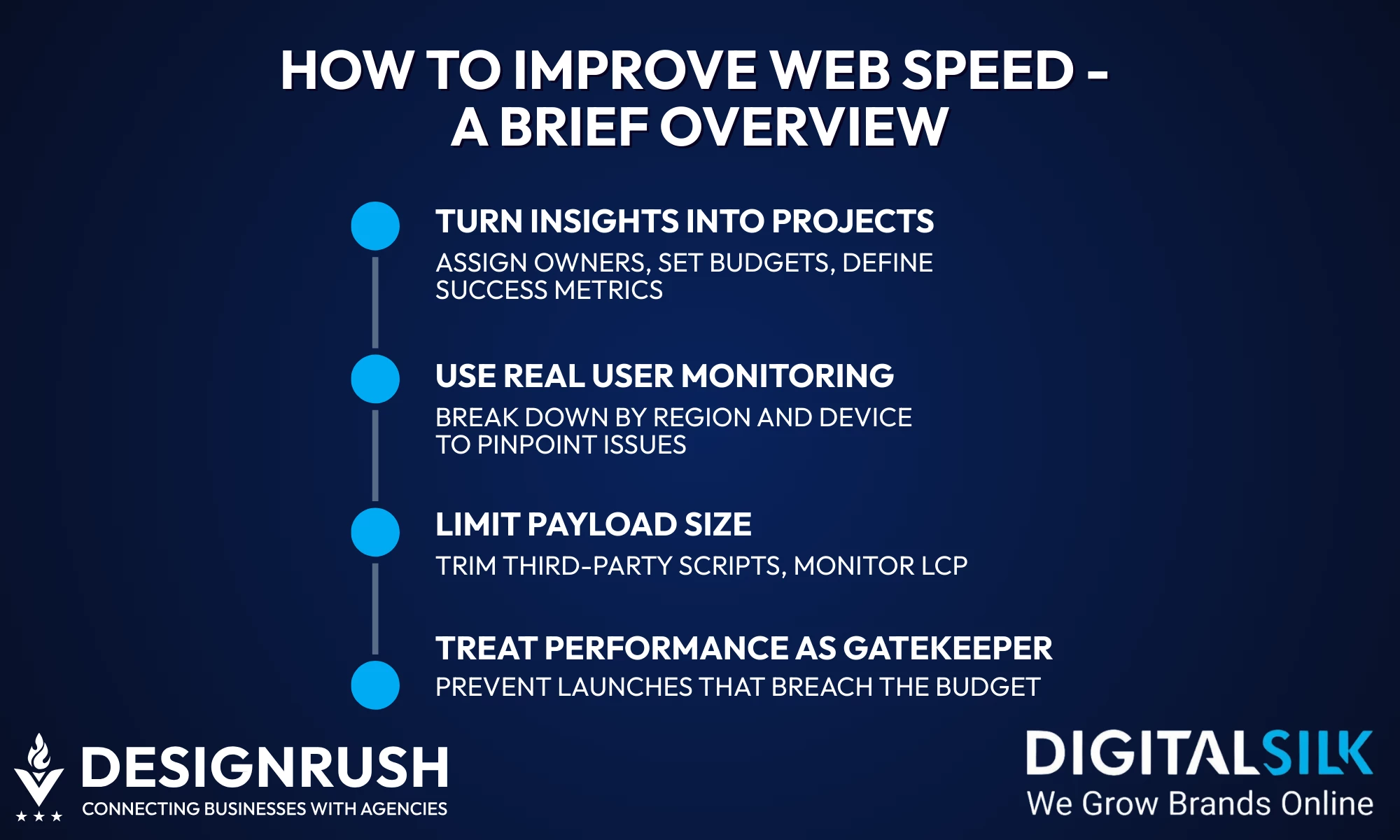
Assign owners, set budgets, and define what success looks like. Make real user monitoring your single source of truth, and break it down by region and device so you know exactly where issues appear.
Synthetic tests are useful, but they don’t replace actual user data.
Set a performance budget and stick to it. Limit payload size, trim unnecessary third-party scripts, and keep an eye on LCP.
Treat it like a gatekeeper: if a new launch breaches the budget, it doesn’t go live. Performance becomes part of how you run the business, not something optional.
Every improvement compounds. Faster pages keep visitors engaged, reduce acquisition costs, and drive measurable revenue.
Treat website speed as a business metric and make decisions based on real user data.
When teams act on insights rather than assumptions, page performance stops being a technical chore and becomes a source of competitive advantage.
Turn Performance Into Competitive Advantage
Ready to optimize your site for real returns?
Follow Digital Silk’s lead with Xerox by treating speed as a core business KPI. When performance is fixed, acquisition costs drop, engagement rises, and revenue compounds over time.
The bottom line: Brands that embed speed into their strategy today are very likely to secure lasting competitive advantage.