
AI Integration for Small Businesses: Key Findings
- 88% of organizations use AI, but adoption stalls past experiments, so small businesses should focus on structured integration, not just access.
- Only 29% of firms under $100M revenue scale AI, meaning companies need to plan governance and system connections before expanding tools.
- AI improves efficiency for most, yet only 20–30% see revenue gains, showing businesses must connect AI outputs to broader operations to drive real impact.
SiteGround has introduced two AI products aimed at small businesses:
- Coderick AI, a chat-based builder for websites and web apps, and
- AI Studio, a toolkit designed to support how those products are launched and managed.
The release lands at a time when building something online is becoming easier, while turning it into a working part of a business still takes effort.
That tension shows up in the data.
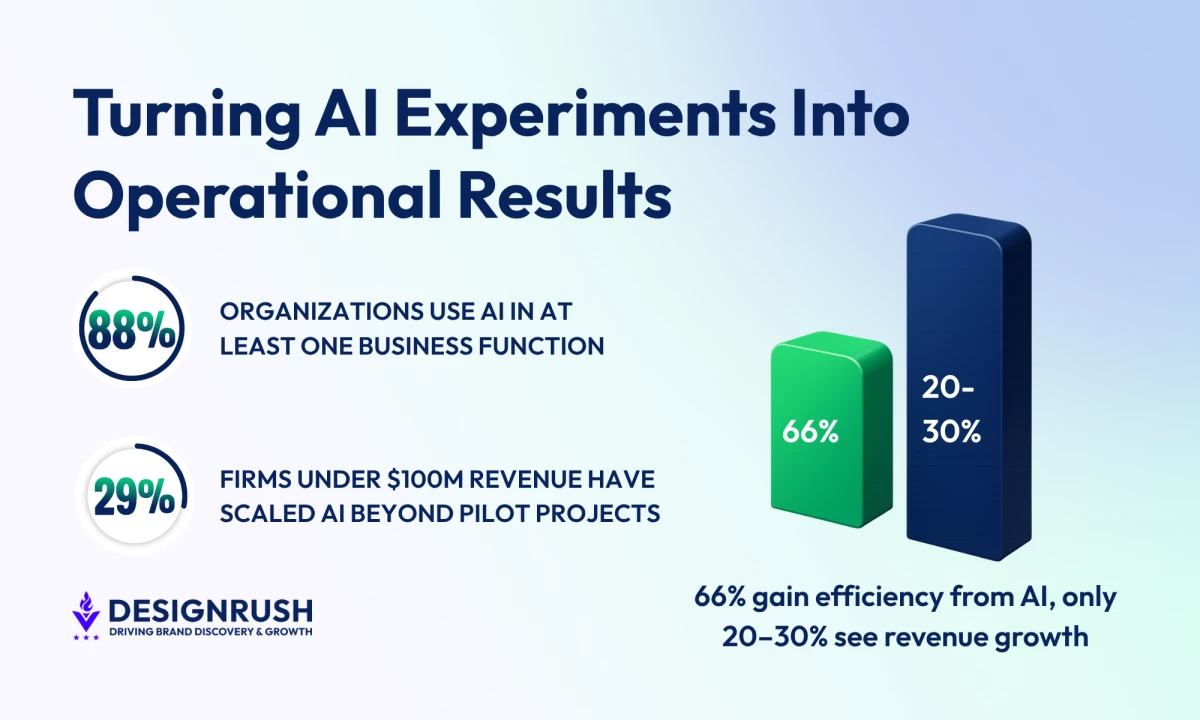
Up to 88% of organizations now use AI in at least one business function, McKinsey’s State of AI report found, up from 78% the year before.
Adoption is now widespread, but progress slows when companies try to move past experiments.
“Launching a first version is only the start. Teams need to plan how the product will run, who will manage it, and how it fits into existing workflows,” says Daniel Kanchev, Director of Product Development at SiteGround.
This is where many AI projects slow down as businesses work to integrate new tools into existing workflows, systems, and day-to-day operations.
Editor's Note: This is a sponsored article created in partnership with SiteGround.
Why Most AI Projects Stall After Launch
Only about one-third have started scaling AI across the business, and smaller firms fall behind, according to McKinsey.
Among companies under $100 million in revenue, only 29% have reached a scaling phase, while most remain in testing or pilot stages.
Deloitte’s 2026 research shows companies have expanded AI access quickly, with about 60% of workers now using approved tools, up from under 40% last year.
Even so, only 25% of organizations have put 40% or more of their AI experiments into production, though just over half expect to hit that mark in the next three to six months.
So, the issue isn’t no access, it’s how these tools are utilized on a daily basis.
“Access to AI doesn’t create results on its own. The focus should be on embedding tools into daily workflows so they actually impact decisions and operations,” Kanchev notes.
It explains why more businesses are turning to AI builders to make the first step easier.
Instead of relying on a team, a user can now describe what they need and get a working
website or app within minutes.
SiteGround's Coderick AI enables small businesses to launch a first version quickly for testing, with the real work beginning after it goes live.
Deloitte points out that timelines grow once a product has to fit into the rest of the business.
This is because integration, security, and compliance add extra steps. This may cause a project that takes three months to build to stretch to 18 months instead.
The added complexity shows that building the product is only the start; getting it to run smoothly within the business takes careful coordination.
Deloitte also found that only 25% of organizations have moved at least 40% of their AI experiments into production.
More than half expect to reach that level soon, but expectation does not guarantee execution.
Businesses often hit this hurdle because they don’t have the teams to handle infrastructure, security, and system connections while developing a product.
As a result, many projects remain in pilot mode even when the initial build is successful.
AI Improves Efficiency but Revenue Lags
AI is showing real operational gains, with 66% of organizations seeing efficiency improvements, 53% reporting better decision-making, and 40% lowering costs, Deloitte reports.
Revenue impact takes longer. Only 20% report increased revenue today.
PwC’s 2026 CEO survey aligns with that pattern.
Only 30% of CEOs report additional revenue from AI, 26% report cost reductions, and only 12% report both. More than half report neither.
The difference comes down to how widely AI is applied.
McKinsey finds that only 39% of organizations attribute any Earnings Before Interest and Taxes (EBIT) impact to AI, and most of that impact remains under 5%.
Companies that see stronger results tend to apply AI across multiple parts of the business rather than keeping it in isolated pockets.
This highlights how AI is used after the build phase.
Agentic AI adds another layer. These systems can plan and execute multi-step tasks, which makes them useful for workflows that go beyond simple content or code generation.
Kanchev says the gains from AI depend on how it’s used across the business.
“Companies need to decide where it should make decisions, who reviews the outputs, and how success is tracked.”
McKinsey further reports that 23% of organizations are already using agentic systems in at least one area, with another 39% testing them.
Deloitte’s forward view shows how quickly this could expand, with 74% of companies planning to deploy agentic AI within two years.
Only 21% report having mature governance in place, while adoption continues to outpace oversight.
What Brands and Agencies Can Learn About Managing AI Tools
More advanced AI systems require a clear structure around how they are used. Without it, risks increase, especially when tools operate across different systems.
This is where platform design comes into play.
There’s limited direct data on small business demand for all-in-one platforms, but the pressure points are clear:
- Projects slow down when systems need to be connected.
- Risks increase when tools are not managed within a single environment.
Forrester’s research highlights that organizations face security and compliance issues when AI tools are not part of an integrated, IT-approved setup.
These constraints help explain why integrated platforms are gaining attention.
They reduce the number of systems that need to be managed and simplify how products move from creation to operation.
SiteGround’s positioning reflects this direction.
Kanchev says using a single platform for AI and hosting reduces complexity and risk, “letting teams focus on launching and improving products instead of juggling multiple systems.”
Coderick AI addresses how quickly a product can be created. AI Studio and the broader platform approach focus on what happens after that.
Hosting, security, and AI tools sit within the same environment, which reduces the integration work that often slows projects down.
Businesses that succeed in this environment are likely to focus less on how fast they can build and more on how efficiently they can move from build to operation.
That includes integration, governance, and ongoing management.
The real challenge isn’t just building fast; it’s making AI work smoothly within the business, including integration, governance, and ongoing management.
The current wave of AI tools makes the first step easier than it has ever been.
The next phase will be defined by how well those tools fit into the rest of the business.