
OpenAI launched ChatGPT's self-serve Ads Manager to all U.S. advertisers earlier this month.
Adobe, Criteo, Kargo, Pacvue, and StackAdapt have all been confirmed as technology partners alongside agency relationships with Dentsu, Omnicom, Publicis, and WPP.
The platform accepts cost-per-click bids at $3 to $5, and the $200,000 minimum commitment from the February launch is gone.
This means that any U.S. advertiser can now register, set a budget, and go live.
The question now facing media buyers is whether this pulls budget from Google and Meta, or whether it warrants its own line in the media plan entirely.
Early data from Criteo and Similarweb leans toward the latter, with conversion rates and click-through rates both running ahead of established display benchmarks.
A Platform With a Specific Audience
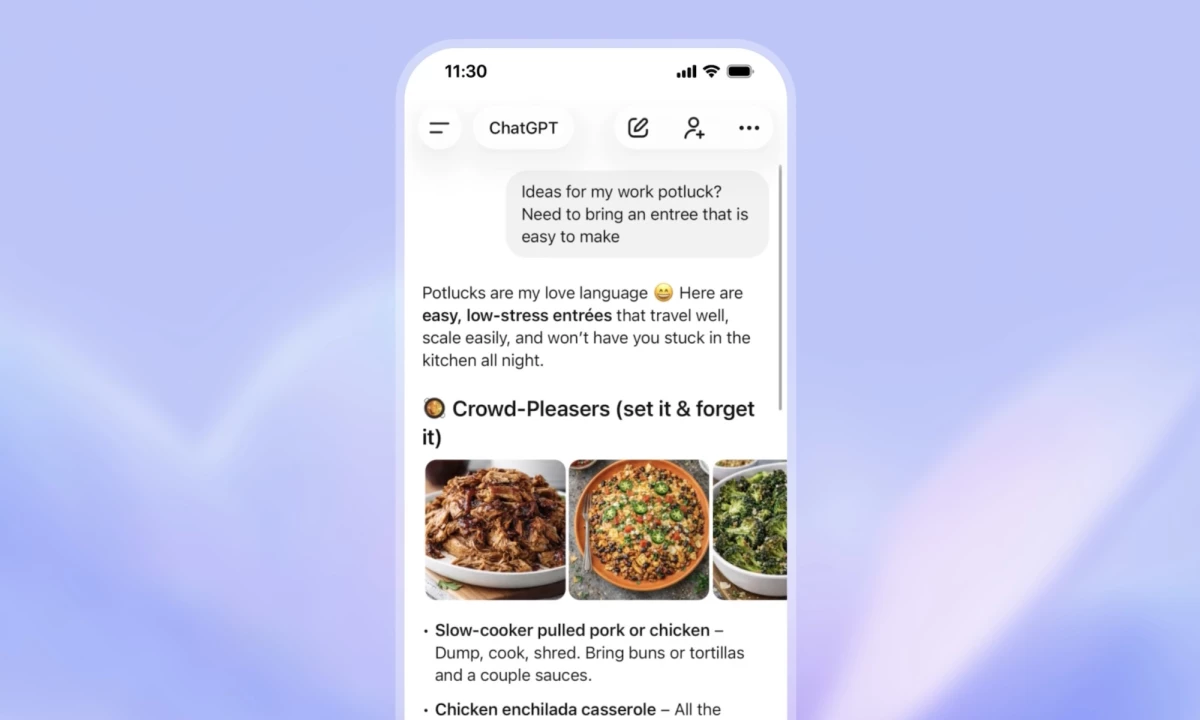
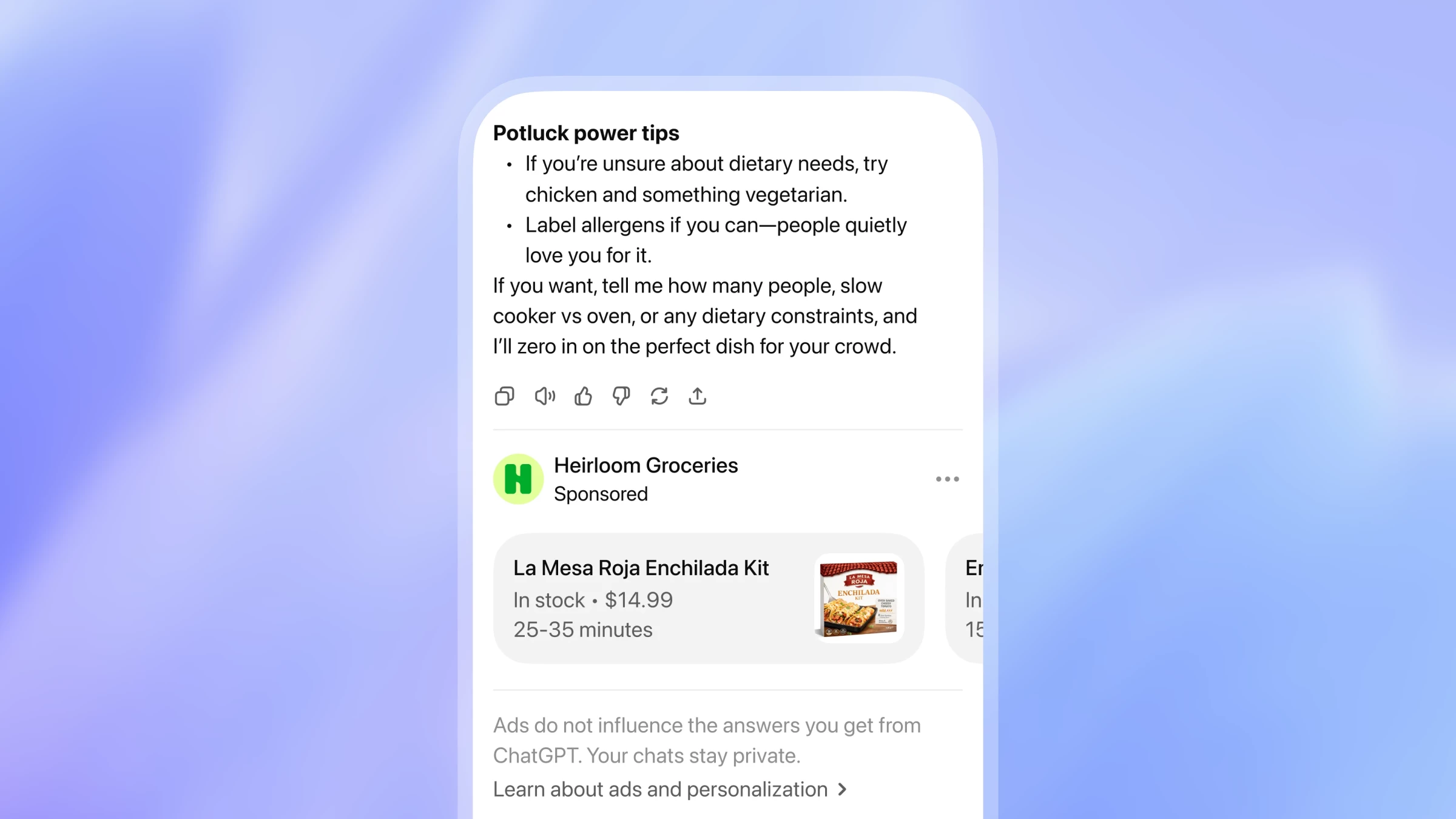
When users research products, compare services, or ask what to buy, ChatGPT now displays a clearly labeled sponsored card beneath the response.
The ads appear after the response is complete and don't interrupt the conversation.
Matching is contextual and is based on the full intent of the chat, without keyword bids, ad groups, and Quality Scores to manage.
ChatGPT reached 900 million weekly active users as of February 2026, up from 400 million a year earlier.
It now processes more than 2.5 billion messages per day.
Users asking ChatGPT to help them decide on a purchase are already deep in the decision process when the ad appears.
Google captures similar intent through search, but a ChatGPT conversation tends to be longer, more specific, and more revealing about what a user wants.
The practical read for agencies is that ChatGPT ads sit much closer to paid search.
The format favors advertisers that can respond to highly specific buyer intent instead of broad demographic targeting.
The Numbers Behind the Platform Build
Early pilot numbers are giving agencies a viable reference point to work with.
Criteo, OpenAI's first ad tech partner to sell ads within the platform, released a February 2026 study with a sample of 500 U.S. retailers.
It found that users referred through ChatGPT converted at rates 1.5 times higher than those from other traffic sources.
Similarweb's Q1 2026 CTR benchmarks also put ChatGPT's overall CTR at 0.68%, which is roughly double the display advertising average of 0.35%.
ChatGPT ads aren't a science experiment.
— Similarweb (@Similarweb) May 3, 2026
Overall CTR: 0.68%.
Top quartile: 1%.
Best brands: 1.57%.
Peak: 5.4%.
For comparison: display sits around 0.35%, podcast 0.5–1%.
>> pic.twitter.com/ixLDLDGssD
And according to a Reuters report, the pilot of 600 advertisers reached $100 million in annualized revenue within six weeks.
This result is strong, considering that the ads were only shown to less than 20% of eligible users each day.
The limited rollout suggests there's still significant inventory headroom as OpenAI expands access to more users.
At the same time, the move to CPC pricing in April pushed bid rates down to between $3 and $5.
It's also comparable to Google Search benchmarks, all while CPM has softened from $60 at launch to roughly $25 as inventory has expanded.
OpenAI's internal projections, which have been shared with investors, show $2.5 billion in ad revenue for 2026, rising to $100 billion by 2030.
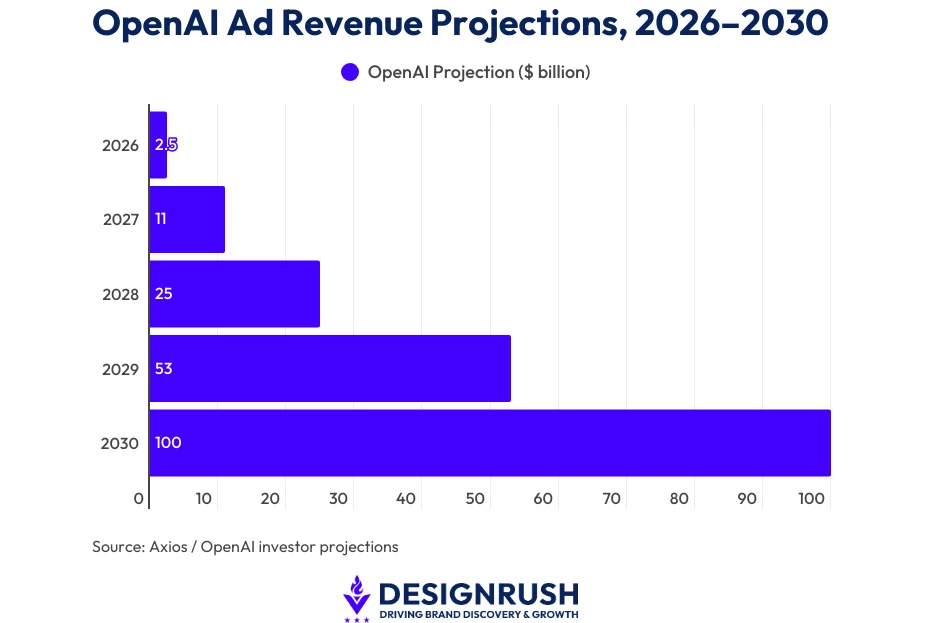
Truist analysts put the 2030 figure closer to $30 billion, which is roughly a third of OpenAI's own projection, though both estimates point toward meaningful scale.
OpenAI projects losses of approximately $14 billion in 2026, which means the company currently needs advertising to scale quickly.
It also means that the self-serve tool will keep expanding, and agencies that have already tested the platform will be better positioned to advise clients in the meantime.
Meanwhile, Meta is projected to surpass Google in global ad revenue for the first time in 2026, and Google's Dynamic Search Ads are being sunset in September.
AI referral traffic to retail sites also grew 393% year-on-year by some estimates, meaning that ChatGPT's ad launch is arriving in a channel mix that is already in motion.
Industry analysis suggests advertisers are already beginning to allocate incremental test budgets to ChatGPT, which could reduce Google's share of new digital ad spend.
Ad Format, Targeting, and What Agencies Should Know Now
For agencies used to keyword-based buying, know that ChatGPT’s targeting system works differently.
Ads are placed based on the topic and intent of a conversation, and if a user has memory enabled, it can also use relevant past interactions to improve ad relevance.
Advertisers don't bid on keywords or build traditional audience segments.
Campaign reporting is aggregated rather than user-specific, and ads currently reach only Free and Go tier users.
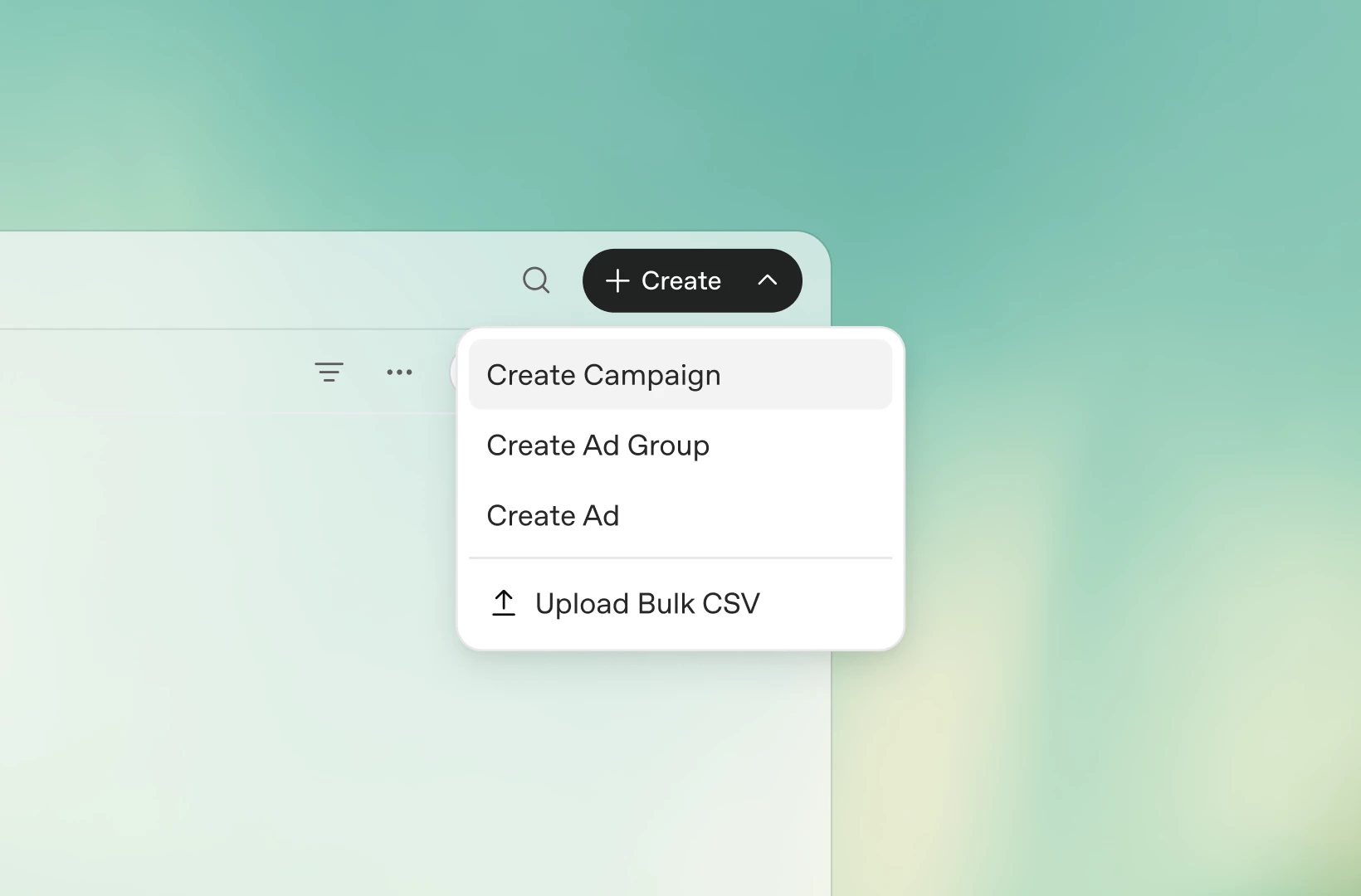
For teams already running programmatic campaigns through StackAdapt or retail media through Criteo or Pacvue, ChatGPT placements can extend from these existing workflows.
Creative specs are tight, with headlines capped at 40 characters and descriptions at 150, and the ad needs to feel like a relevant next step after a useful answer.
The ad system activates only after a response is complete, so placements can't influence what the AI says.
And this is worth highlighting in client conversations about brand awareness and safety.
Meanwhile, Anthropic ran a Super Bowl campaign the same week ChatGPT's ads launched with the explicit message that Claude is still ad-free.
OpenAI's Pentagon contract earlier this year was also met with widespread backlash, triggering a 295% spike in ChatGPT uninstalls within a single day.
Neither event stopped the platform's growth.
But both signal that trust is a live variable, and conversion quality is only as durable as user confidence in the product they're using.
The long-term challenge for OpenAI will be maintaining user trust that ads remain separate from ChatGPT's actual responses.
The Ads Manager is accessible enough to test now, and a few decisions made early will determine how useful the data turns out to be:
- Map your highest-intent conversations first: Criteo's 1.5x conversion rate is most pronounced where research leads directly to purchase.
- Adjust performance expectations for conversational search: Teams should prepare for longer consideration paths and narrower but higher-intent traffic.
- Write creative for the post-answer context: Tone and specificity do a lot of the heavy lifting here.
Remember that the cost of learning is lower now than it will be in six months.
Our Take: Does This Actually Pull Budget From Google?
We think the honest answer is that some of it will eventually.
And agencies that wait for the market to settle will have paid a premium to learn what an early test could have shown them now.
Criteo's data suggests ChatGPT-referred users arrive further down the decision process than most channels, which is the same reason paid search has commanded premium CPCs for years.
As OpenAI expands access to ads in ChatGPT via self-service, we’re continuing to build with them as their ads program evolves.
— Criteo (@criteo) May 5, 2026
More than 1,000 brands are live through our integration, as marketers explore this new space for discovery and decision-making: https://t.co/sUku5MDa1Lpic.twitter.com/CROm4Nx53t
If this kind of intent quality holds up at scale, some Google Search budget will move.
The bigger risk is whether OpenAI can sustain user trust as ad density increases and the self-serve tool opens up to a much wider advertiser pool.
Agencies that run a structured test now will know a lot more than those who wait for the platform to scale.
Teams evaluating AI advertising channels need partners who understand performance measurement, intent targeting, and how emerging platforms integrate with existing media buys.
Explore these top AI development companies in our directory.