
One brand can show up in one ChatGPT answer and disappear completely in another, even when the same question has been sent to both.
That’s the biggest problem sitting underneath the latest model split, according to a Writesonic analysis.
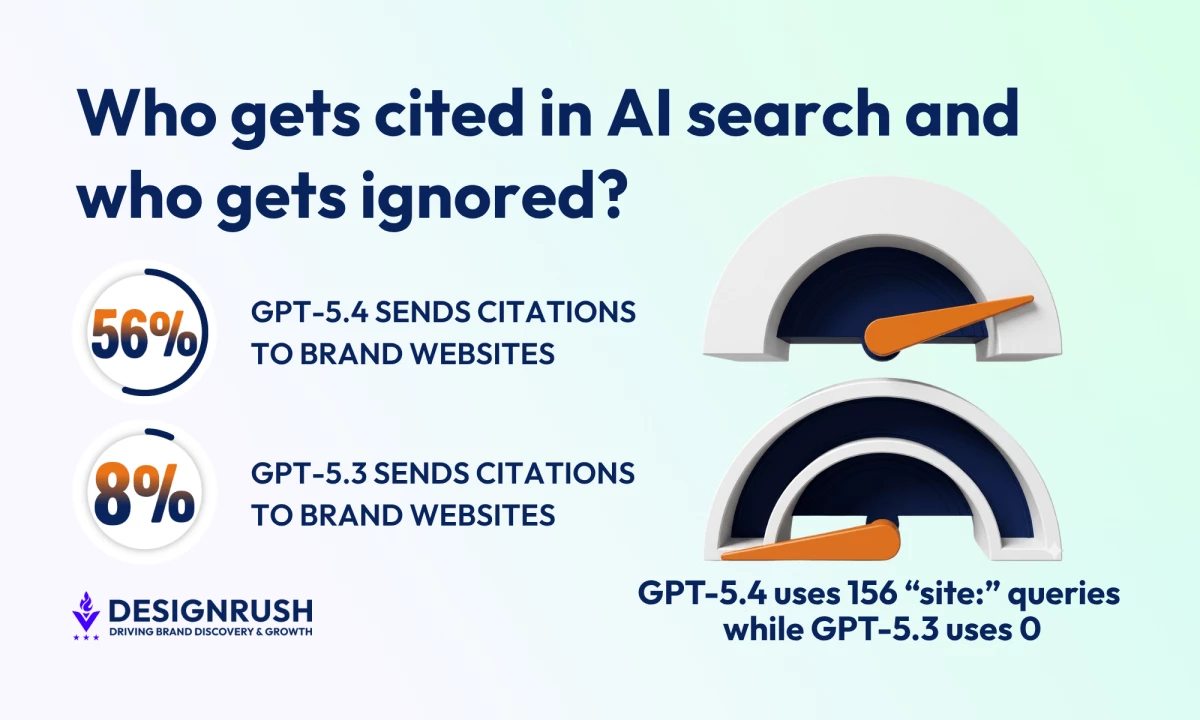
- GPT-5.4 Thinking is sending 56% of its citations to brand websites.
- GPT-5.3 Instant is sending 8%.
It gets worse.
Only 7% of cited sources overlap between the two models, which means there’s no consistent “source set” behind answers.
One model may surface a brand’s own pages, while another may lean on third-party coverage and not even touch the brand’s website at all.
So visibility in AI search isn’t stable across systems, and it changes depending on which model answers the query.
The pattern has been backed by OpenAI’s own documentation, which states that ChatGPT rewrites prompts into targeted queries and doesn’t guarantee top placement.
According to OpenAI, ChatGPT Search can send multiple targeted queries to search providers. But to be included, sites need to allow OAI-Searchbot to crawl them.
This points to a retrieval problem, a source-selection problem, and a crawl-access problem all at once.
“A brand can no longer assume one good page will perform the same way across every AI result,” said Sam Richardson, vice president of full-service digital marketing agency Intero Digital.
“The model matters, the source mix matters, and the retrieval path matters.”
And the impact is already visible in how these models look for information and decide what gets quoted in the first place.
That’s where Intero Digital’s work in generative engine optimization (GEO) becomes relevant, focusing on how brands are discovered, interpreted, and cited across AI-driven search systems.
Default and premium models do not surface the web the same way
The Writesonic analysis adds multiple wrinkles to the visibility problem between AI models:
- GPT-5.4 used an average of 8.5 sub-queries and relied on “site: operators” in 156 of 423 total queries.
- GPT-5.3 did not use “site:” at all in the tested set.
- GPT-5.4 also cited 138 pricing pages across 49 web-search conversations, while GPT-5.3 cited only four.
- GPT-5.3 never cited a brand website in head-to-head comparison prompts.
- GPT-5.4 cited brands 83% to 100% of the time on those same prompts.
This is why Richardson believes that brands that rely solely on broad visibility are missing the mechanics beneath the result.
“Premium reasoning models are reading with a different filter, so the content stack has to be built for more than one kind of answer.”
That difference shows up at scale once AI search becomes a primary discovery channel.
OpenAI reported that ChatGPT had over 700 million weekly active users around the globe.
This shows how quickly AI search has moved into everyday discovery behavior.
At that level of usage, trust and reliability start influencing how people interpret what they see on the screen.
Last year, 53% of consumers distrust or lack confidence in the reliability and impartiality of AI search and summaries, according to research by Gartner.
Meanwhile, 41% said generative AI overviews make search more frustrating than traditional search.
So the market is large, and confidence is shaky.
That’s a comfortable position for teams that know how to work with how these systems retrieve and validate information, and a less forgiving one for anyone still publishing content without clear signals, structure, or source strength.
Pew Research’s July 2025 research shows the click behavior behind that problem.
When Google users encountered an AI summary, they clicked a traditional search result 8% of the time.
When no AI summary appeared, they clicked 15% of the time.
Pew later summarized the same finding again in December 2025, saying users who landed on a page with an AI summary were about half as likely to click a result.
In other words, attention starts and ends inside the answer box more often than it used to.
That turns citation selection into less of a technical detail and more of a visibility filter.
Intero Digital’s work in GEO sits directly in that territory, focusing on how brands are represented, retrieved, and cited across AI-driven search systems.
The emphasis extends into how models assemble answers from entities, structured content, and trusted sources.
That approach combines generative AI research and analysis with entity-based content strategy, structured data, technical SEO and accessibility, and digital PR that prioritizes where and how brands are mentioned.
It also treats brand mentions and source coverage as inputs into how AI systems validate relevance, not just signals for traditional search placement.
“If a model cites brands, pricing pages, and product pages differently, then the content plan has to reflect that mix,” Richardson said.
“That means cleaner entity coverage, stronger structured data, and first-party pages that actually answer the question.”
His team evaluates how ChatGPT, Gemini, and Copilot describe a brand, tracks which sites AI engines pull from, and uses source tracking to prioritize high-trust sources.
It also calls out:
- Answer-ready formatting
- Semantic clarity
- FAQ structures
- Article markup
- Review markup
- Service schema
- Crawl and indexability fixes
- AI crawler access
Everything points to execution across content, structure, and discovery signals.
What brands and agencies should do next
It sets up a more practical question for brands and agencies working in the same environment.
Richardson said the brands that will remain visible are the ones that treat AI Search like a distribution channel.
“Publish the pages AI needs, make the structure easy to read, and earn the mentions that help confirm authority.”
Broader market data backs that up.
According to HubSpot’s 2026 marketing statistics, over 92% of marketers plan on or are already using SEO optimization for both traditional and AI-powered search engines.
At the same time, nearly 30% report decreased search traffic as consumers move toward AI tools.
On the demand side, nearly half of customers say they would use AI for personalized product recommendations.
Likewise, 44% of consumers rely on it for instant customer service, Adobe’s 2026 consumer report shows.
The behavior is already moving, so the response has to move with it.
First-party pages can’t be thin. Pricing pages, product pages, comparison pages, and FAQs need to be clear enough for both people and models to use.
Structured data sits in the middle of all of it, linking how content is written with how it gets retrieved and interpreted across AI systems.
Crawl access can’t be broken.
Brand mentions outside the site still matter because the model doesn’t just read the homepage and call it a day, which would be lovely and much easier, but no.
For brands, that means tightening what’s already there before adding anything new.
For agencies, the work goes beyond reporting on rankings and into how content is surfaced, interpreted, and reused inside AI-driven search environments.
Intero’s own GEO framework points in that direction, and the Writesonic data shows why one model leans into brand websites and pricing pages, while the other relies far less on them.
That’s the kind of split that can change who gets named, who gets ignored, and who gets the lead.
“The practical answer is to optimize for retrieval, validation, and citation together,” Richardson noted.
“Brands that do that will have a better shot at being the source AI trusts, instead of just another page in the pile.”
Visibility in AI search depends on how consistently content can be retrieved, interpreted, and cited across different models and query styles.
And consistency across pages, entities, and external mentions is what keeps a brand present when answers get assembled.