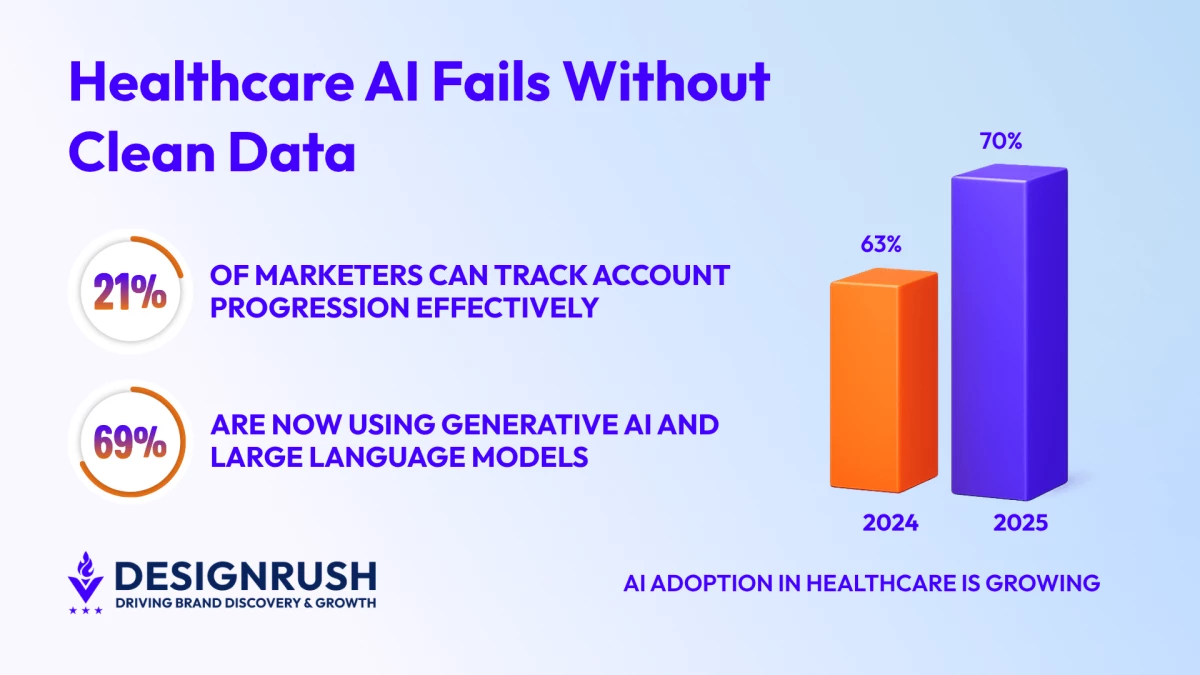

Healthcare AI adoption is rising, yet only 21% of healthcare marketers currently measure account progression.
That’s according to Health Launchpad, a healthtech marketing agency and consultancy.
Given how many aren’t tracking how accounts move through the funnel, it becomes harder to understand what’s actually driving business.
Companies such as MCH Strategic Data have focused on that layer for years, working with verified healthcare contact data that reflects how quickly roles and responsibilities actually change.
Peter Long, CEO of MCH Strategic Data, explains that in a sector where buying decisions rarely sit with one person, outdated information doesn’t just slow campaigns down.
“In many cases, outreach campaigns fail before they even begin, and often target people who no longer hold the roles marketers think they do,” Long says.
That breakdown becomes more visible as AI takes on a larger role in campaign execution, relying on the same underlying data to drive targeting, scoring, and personalization at scale.
When that data is incomplete or no longer current, the impact isn’t isolated. It carries through every touchpoint, making it harder for campaigns to reach the right people in the first place.
A campaign aimed at hospital procurement leaders, for example, may still be reaching contacts who’ve already moved into entirely different roles.
“AI doesn’t fail because the technology isn’t there. It fails because the data behind it isn’t accurate enough to support real decision-making,” Long says.
AI Adoption Is Rising. Results Aren’t
AI has quickly moved from experiment to expectation in B2B healthcare marketing.
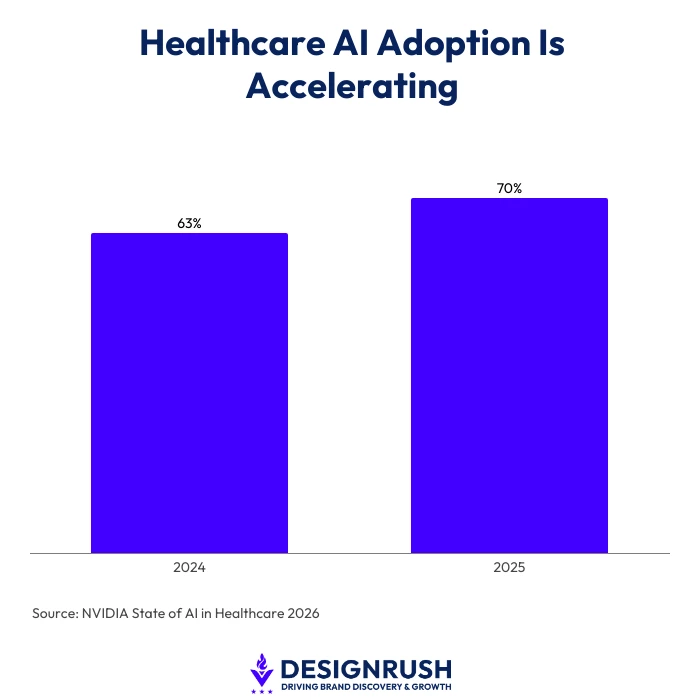
According to NVIDIA’s State of AI in Healthcare 2026 survey, 70% of organizations actively used AI in 2025, up from 63% the previous year, while 69% say they’re using generative AI and large language models, up from 54%.
That growth is already reshaping how marketing teams operate. Lead scoring, segmentation, and personalization are now deeply embedded in how campaigns are executed. Yet those systems often rely on contact data that hasn’t kept pace with real-world changes.
Budgets are following suit. More than one-third of high-performing organizations are now allocating over 20% of their digital budgets to AI, according to McKinsey & Company’s State of AI in 2025 report.
But higher spend hasn’t solved the more basic issue. In many cases, it means investing more in systems that are quietly underperforming. Teams are still missing the people who actually make decisions.
Messages land in inboxes that are no longer active. And lead scoring models keep ranking accounts based on roles that may have changed months ago, creating a sense of precision that doesn’t hold up in practice.
“That’s where a lot of teams get stuck,” Long says. “The system looks like it’s working, but it’s optimizing around information that’s no longer relevant.”
That’s usually the first sign that something deeper is off.
🚀 Email response rates 5–13x higher?
— MCH Strategic Data (@mchdata) April 21, 2025
That’s what B2B education marketers are seeing with AI-powered targeting.
📬 Smarter lists. Better engagement.
👉 https://t.co/yRXpQIyFch#EdTech#EmailMarketing#AI#K12Marketing#B2BMarketingpic.twitter.com/nlhflNADi8
Bad Data Undermines AI
AI works by finding patterns and acting on them. However, when the data informing those patterns is outdated or incomplete, the results quickly become unreliable.
The healthcare sector’s complexity makes that harder than most industries. Titles shift. Teams restructure. Decision-making spreads across multiple stakeholders, often without clear visibility from the outside.
If contact data isn’t keeping up, campaigns start optimizing toward the wrong people. Personalization loses relevance. Timing falls apart.
“Once inaccurate data enters the system, everything downstream is affected,” Long says. “This means you’re not just missing opportunities, but actively reinforcing the wrong signals.”
Industry analysts have increasingly pointed to data integrity as a limiting factor in AI performance, particularly in complex sectors like healthcare where accuracy decays quickly.
It doesn’t always show up all at once. It starts with small inefficiencies, then compounds into missed pipeline and wasted spend that are harder to trace back.
Why AI Measurement Falls Short
The 21% tracking account progression figure seen previously points to something bigger than reporting gaps. It highlights how difficult it still is to see real movement across healthcare accounts.
According to the same Health Launchpad report, most teams lack clear visibility into how accounts progress, not just whether they engage.
And even when teams try to track what’s going wrong, another issue surfaces. If the underlying data is flawed, the measurement itself becomes unreliable.
“AI outputs can look polished, but without accurate inputs, it’s difficult to tell whether campaigns are reaching the right people or just generating surface-level activity,” Long says.
For teams under pressure to prove ROI, that disconnect becomes harder to justify.
The issue doesn’t stop at measurement. It carries through execution as well.
YouTube channel, The AI Imperative, outlines how healthcare providers can leverage conversational AI to transform patient interactions and drive business growth:
Outdated Data Derails Campaigns
There’s a tendency to see AI as a fix for long-standing marketing challenges. Faster insights, better targeting, less manual effort.
But AI depends on the quality of its inputs.
That’s where companies like MCH Strategic Data come in, focusing on verified and continuously refreshed healthcare contacts so teams aren’t working off assumptions. The value isn’t just cleaner data, but giving every system downstream something accurate to work with.
“Accurate data isn’t a one-time investment. It’s something that needs to be maintained constantly,” Long says. “Otherwise, even the best tools lose their effectiveness over time.”
Without that, even well-built campaigns struggle to land where they should, and teams are left questioning performance that was compromised from the start.
MCH Strategic Data’s new dedicated healthcare division empowers B2B marketers with purpose-built marketing data solutions and digital marketing tools:
Data Quality Is the Advantage
At this point, access to AI isn’t the differentiator.
What’s starting to separate teams is how seriously they treat the data behind those tools.
Organizations that invest in keeping contact data accurate are seeing clearer targeting, more consistent engagement, and fewer wasted cycles. Not because their AI is more advanced, but because it’s working with something reliable.
To achieve this, Long advises leaders to:
- Audit contact data as closely as campaign performance
- Expect data to decay and plan for it
- Tie AI investment decisions to data quality, not just capability
“AI can amplify what’s working, but it can just as easily amplify what’s broken,” Long says. “If the data isn’t right, the scale just makes the problem bigger.”
AI will scale whatever it’s given. When the foundation is strong, that creates momentum. But when it’s not, inefficiencies scale just as quickly, only this time they’re harder to catch and more expensive to fix.
Want to learn more about digital marketing and the world of AI?
Take a look at our list of the Top Digital Marketing Agencies of 2026.