
Scalable Development for 2026: Key Findings
- Validation gaps trigger scale failure, with many non‑technical founders launching SaaS products without testing assumptions, increasing the risk of costly rebuilds.
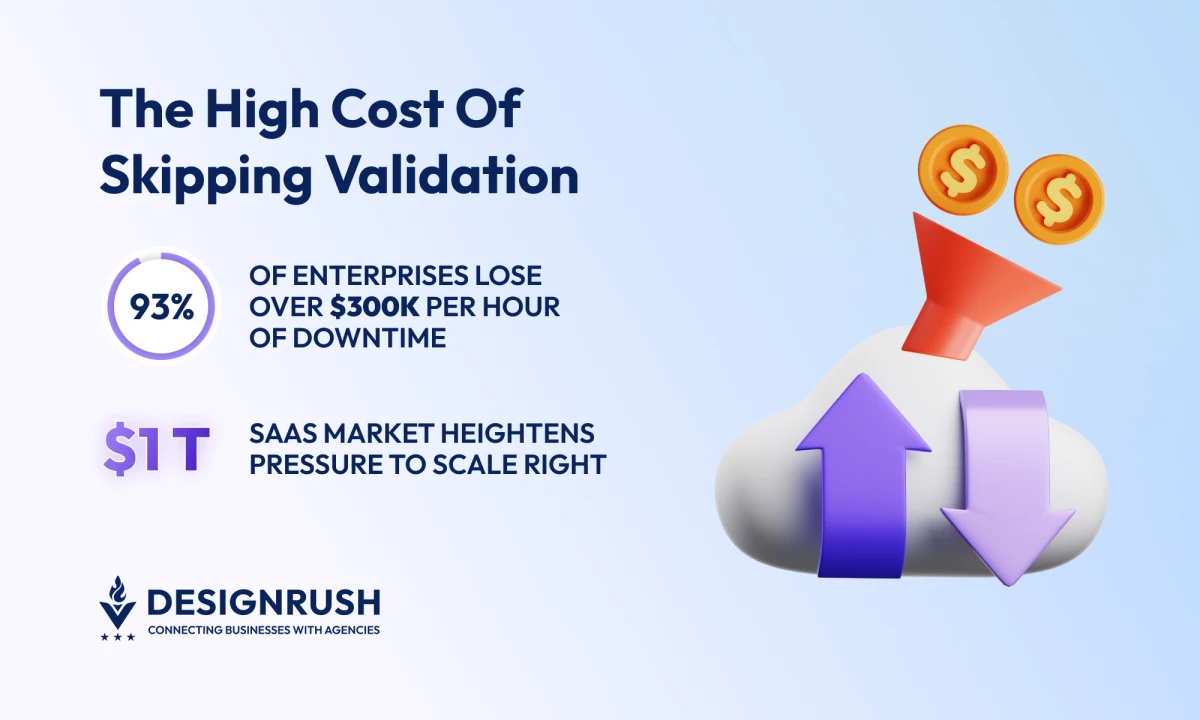
- Infrastructure mistakes carry heavy financial consequences, with 93% of enterprises citing losses over $300,000 for just one hour of downtime.
- Designli’s two-phase SolutionLab and Engine process gives founders a clear roadmap to validate early and scale without rewriting core systems.
SaaS startups are launching faster than ever, but many skip the steps that make growth possible.
As more non-technical founders enter the space, the step too often overlooked is validation.
This refers to the process of testing early assumptions to prove that users care, workflows make sense, and the product fits real needs.
The Founder’s Nightmare: When You’re Everyone and No One
— Designli.co (@DesignliCo) May 20, 2025
You’re the CEO, and also QA, support, project manager, growth marketer, and part-time therapist for the team.
You’re pulled in a hundred directions, stuck fixing instead of scaling.
At first, it feels like hustle. But… pic.twitter.com/3uu0AZmsYK
Designli emphasizes that the leap from idea to scalable software requires far more than code.
“Without a product validation strategy, you risk overspending on features nobody needs, choosing the wrong tech stack and ending up with a product that cannot scale,” Designli Co-Founder and CEO Keith Shields told DesignRush.
The software development firm’s validation-first strategy helps founders align features, tech choices, and user needs before writing a single line of code.
In 2026, this approach is what will separate scalable products from costly false starts.
According to ITIC’s 2023 Global Server OS Reliability Report, 93% of enterprises say one hour of downtime costs more than $300,000, evidence that poor scalability is a major financial risk.
Editor’s Note: This is a sponsored article created in partnership with Designli.
Rushing to Build Leaves Users Behind
Founders often feel the pressure to build quickly.
Yet skipping validation often means building features users don’t want, selecting a tech stack that fails under load, or showing up to investors without proof of demand.
Designli identifies four common risks that can derail early SaaS development:
- Costly reworks from investing in features that later get discarded
- Burned budgets when development starts before confirming user interest
- Infrastructure strain from selecting tech stacks that can’t support long-term growth
- Investor pushback caused by launching without validated demand.
Each of these issues drains time, money, and momentum, often before the product even reaches its first users.
“Validation is the foundation for building scalable products that grow with your business,” Shields explained.
“It gives founders the clarity to focus on what matters, the confidence to make the right technical decisions early, and the proof points that investors look for before they commit.”
When non‑technical founders follow a process that centers on early testing, they avoid making blind tech-related decisions and align features with real user needs.
Building the Right Foundation
Designli’s process divides build‑up into two structured stages.
First comes SolutionLab: a two‑week sprint where founders validate their concept, define technical requirements, and plan a development roadmap centered on quality.
This stage suits non‑technical founders who are either starting fresh, recovering from a bad build or scaling an existing product.
QA isn’t just bug hunting anymore.
— Designli.co (@DesignliCo) October 2, 2025
It’s strategy, collaboration, and building the confidence to ship fast without sacrificing quality.
From shaping requirements in sprint planning to keeping CI/CD pipelines steady, QA has become the backbone of modern software delivery.
Our Sr.… pic.twitter.com/8PGZ9wOUnV
Then comes the Designli Engine: an automated backend code generator that creates a custom foundation including database, admin panel, and core codebase.
Ownership remains with the founder and the structure is built to adjust for growth.
“A product that can handle hundreds of users today and tens of thousands tomorrow without rewriting the entire codebase is what scalable custom software looks like,” Shields emphasized.
These stages combined give founders a structured path that reduces guesswork and sets the foundation for long-term product stability and scale.
⛔ 4 Product Mistakes Founders Can’t Afford to Make
— Designli.co (@DesignliCo) September 16, 2025
By 2026, 75% of organizations will be stuck with heavy technical debt. For SaaS founders, that means lost momentum, brittle code, and frustrated users.
The biggest traps we see?
1️⃣ Speed without strategy → noise instead of… pic.twitter.com/5tdp8Lrcjz
Designli references two examples that highlight validation‑driven growth:
- Secur.Space validated a truck‑parking marketplace before development, aligned features to demand and avoided wasted spend.
- Paidback built only the highest‑impact features first, like banking sync and light social tools, to launch a scalable product.
These case studies prove that non‑technical founders can launch confidently when they structure early validation and scale architecture from the start.
Continuous measurement keeps startups from building tech for its own sake.
Scaling With Purpose in a $1 Trillion Market
In 2026, non-technical SaaS founders face more pressure than ever to not just launch quickly, but to build something that lasts.
It’s not enough to have a strong idea.
Without early validation and a solid technical foundation, even promising products risk falling apart under the weight of user growth, rework, or investor doubt.
Designli’s model offers a way through. And this kind of structure is what the current SaaS industry demands.
“The goal isn’t just to launch, but to build something that can handle what comes next,” Shields said.
“We help founders think beyond day one so they don’t end up rebuilding six months later.”
The SaaS market is on track to reach over $1 trillion by 2032, up from $316 billion this year.
Growth at this scale rewards teams who build deliberately, with systems that support both traction and long-term adaptability.
The founders who succeed will be the ones who build with purpose, proof, and the right process behind every line of code.