
AI & SaaS Product Strategy: Key Findings
- Designli’s new 2026 report reframes AI as an operational advantage, showing SaaS teams switching from experimentation toward execution-driven adoption.
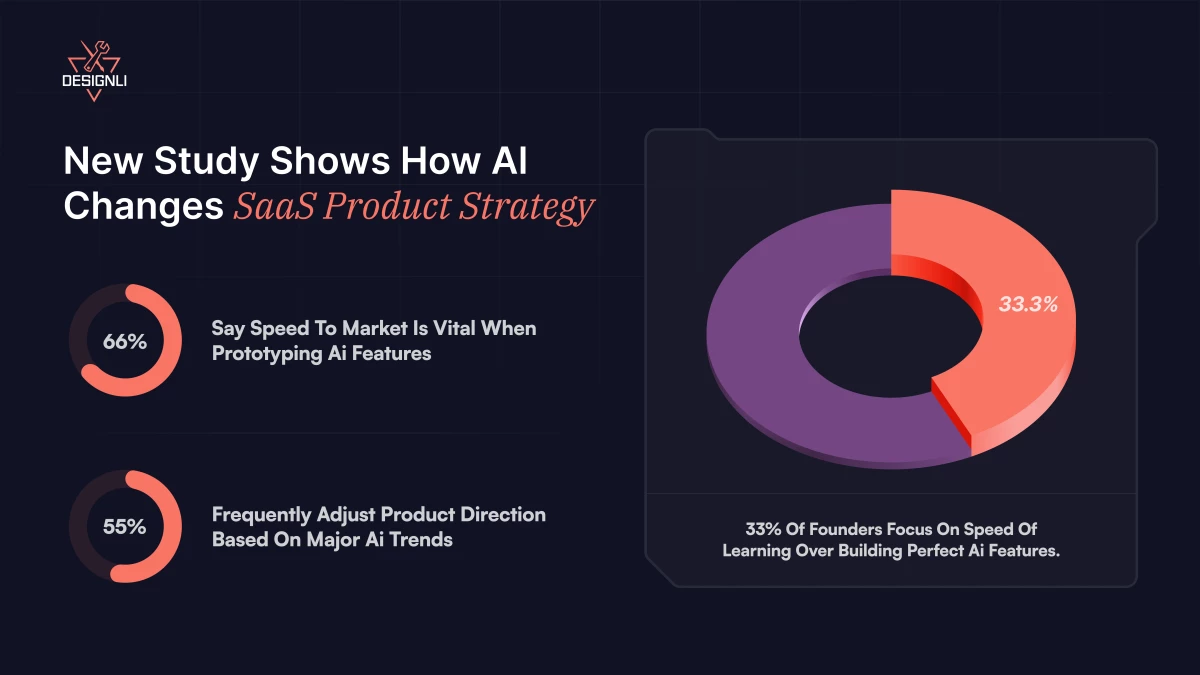
- 66.7% of founders now optimize AI development for speed to market, making rapid prototyping the dominant validation strategy.
- 55.6% of SaaS leaders actively adjust roadmaps based on AI trends, reinforcing the move toward adaptive, signal-driven product planning.
AI has revolutionized multiple industries, but have you ever wondered how it’s changing the software and app development industry it comes from?
That’s exactly what Designli, a leading mobile app, web, and SaaS development agency, decided to find out.
The agency recently released its 2026 field report, “How AI is Reshaping SaaS Product Strategy,” examining how advancements in AI have reshaped the strategies and outlooks of both technical and non-technical SaaS founders.
The research draws from structured founder surveys and direct industry interviews across multiple SaaS sectors, creating a practical snapshot of how real teams are making real AI decisions.
Topics covered in the report include:
- How SaaS teams actually adapt to AI and what holds them back
- How technical vs. non-technical founders evaluate AI differently
- Where AI delivers real value internally and for users
- How founders validate AI features before investing in them
- Why some of the most promising AI ideas remain unbuilt
“Our intention with this report was neither to glorify AI nor warn against it,” said Keith Shields, CEO of Designli.
“We wanted to map how teams are learning, experimenting, and adapting.
What this report makes clear is that organizations have moved on from the experimentation stage when it comes to AI. Now, AI adoption is all about creating an operational advantage.”
What The Research Uncovered
Rather than presenting AI as a silver bullet, the report revealed that founders are prioritizing speed of learning over feature volume and operational efficiency over novelty.
This can easily be seen in three key findings from the report:
1. Operational automation takes priority
According to the report, internal automation emerged as the clear priority, with 44.4% of founders citing it as AI’s highest immediate business impact.
Smarter onboarding (22.2%) and AI-assisted workflow and productivity features (22.2%) were the next most common responses.
These stats indicate how SaaS founders are pivoting away from flashy front-end features toward behind-the-scenes changes that quietly improve margins and execution speed.
2. Rapid prototyping dominates the validation strategy
Among the surveyed founders, 66.7% of them claimed that “speed to market” was the most important thing to them when prototyping AI-powered features.
The rest were an even 11.1% split among:
- Vision alignment
- UX clarity
- Ethics
This isn’t to say that prototyping is done quickly just for the sake of speed.
For 33.3% of founders, the goal was to release features early to get real feedback from real users, allowing SaaS teams to shorten feedback loops and iterate in public.
3. Trend alignment influences roadmaps
Additionally, 55.6% of founders said they frequently adjust product direction to align with major AI developments.
Yet the report also shows that this influence is conditional.
After all, AI trends only shape awareness. They don’t dictate decisions directly.
In other words, founders aren’t asking, “Can we build this?”
They’re asking a far more important question.
“Should we build this now?”
Together, these signals point to AI being used to remove friction inside teams as much as to improve user-facing experiences.
SaaS Leaders Must Reassess 2026 Roadmaps
“Move fast and break things” has always been the mantra for tech companies.
However, the results from Designli’s report make it clear that while speed is still an integral part of the development cycle, the reasons for it have changed.
“Instead of ‘moving fast to break things,’ it’s now about racing to break assumptions, validate ideas earlier, and eliminate waste before it reaches production,” Shields said.
This change in mindset requires a change in how roadmaps should be built in 2026.
For SaaS leaders, that means acting on the data from Designli’s report rather than admiring it.
Practical next steps include:
- Replace rigid annual roadmaps with rolling quarterly planning. Lock long-term direction, but keep execution flexible so teams can pivot when validation data changes.
- Tie AI initiatives to business KPIs from day one. Require clear success metrics such as retention lift, cost reduction, or cycle-time improvement before approving scale.
- Audit internal workflows before building customer-facing AI. Many efficiency gains are hiding inside operations, not on the product surface.
- Standardize experimentation playbooks. Give teams shared frameworks for prototyping, testing, and rollout so speed does not come at the cost of alignment.
Build a Smarter Product Mindset for a Smarter Product Blueprint
Designli’s field report points to the need for a recalibration inside most SaaS organizations.
Product strategy is becoming less rigid and more adaptive, shaped by continuous testing, faster feedback, and clearer signals from real users.
And when teams are able to focus on intentional development over blind acceleration, they’ll be able to adjust earlier, waste less effort, and make better decisions under pressure.