
Software Quality Strategy: Key Findings
- Poor software quality costs the U.S. an estimated $2.41 trillion annually, according to CISQ.
- Fixing software defects before release can reduce remediation costs by up to 90%.
- Clean, testable code enables faster deployments and significantly reduces long-term risk.
Poor software quality costs the U.S. an estimated $2.41 trillion annually, according to CISQ.
That’s more than the GDP of many nations, underscoring how hidden defects can erode margins and stall growth.
At the same time, global cybercrime losses are projected to hit $9.5 trillion in 2024 as per DBServices, illustrating the security risks baked into unchecked codebases.
In the latest, Designli’s white paper, "Our dual approach to code review ensures the quality of your SaaS," outlines a dual code review method that combines automation with expert oversight, catching issues before they escalate into costly crises.
Editor’s Note: This is a sponsored article created in partnership with Designli.
Adopting the 2 Pillars of Exceptional Code Quality
Designli’s analysis of dozens of SaaS codebases during its Impact Week intensives reveals that top teams excel at two disciplines:
1. Automated Quality Control
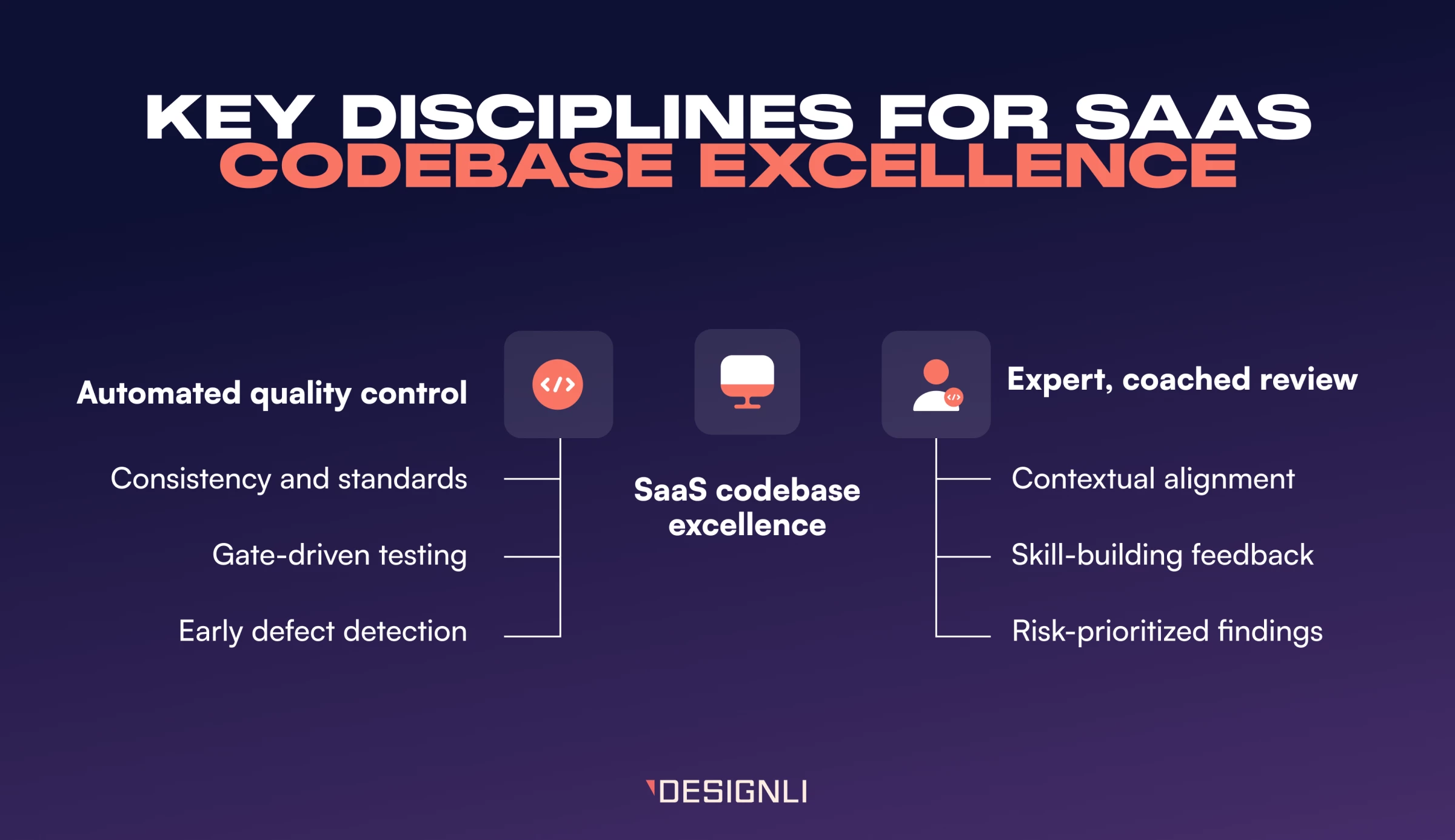
- Consistency and Standards: Tools like ESLint, Prettier, and SonarQube enforce uniform formatting, detect dead code, and flag security hotspots on every pull request.
- Gate-Driven Testing: Continuous integration pipelines run unit and integration tests, type checks, and security scans, and block merges until all checks pass.
- Early Defect Detection: Automation captures common errors, including unhandled edge cases and unreachable code, reducing fix costs by up to 90% compared to post‑release patches.
This level of automation cuts remediation expenses and improves time‑to‑market, so executives can confidently invest in rapid feature rollouts.
2. Expert, Coached Review
- Contextual Alignment: A senior Tech Lead verifies that each change meets business requirements, covers edge cases, and conforms to the project’s architecture.
- Skill‑Building Feedback: Reviews emphasize constructive guidance — highlighting best practices, recommending alternatives, and linking to documentation — so teams learn with every cycle.
- Risk-Prioritized Findings: Critical issues (such as security and data integrity) surface immediately, while lower-impact style suggestions are queued, ensuring focus on the highest-value fixes.
Organizations can foster the leadership mindset needed for lasting impact by combining automated gates with expert coaching.
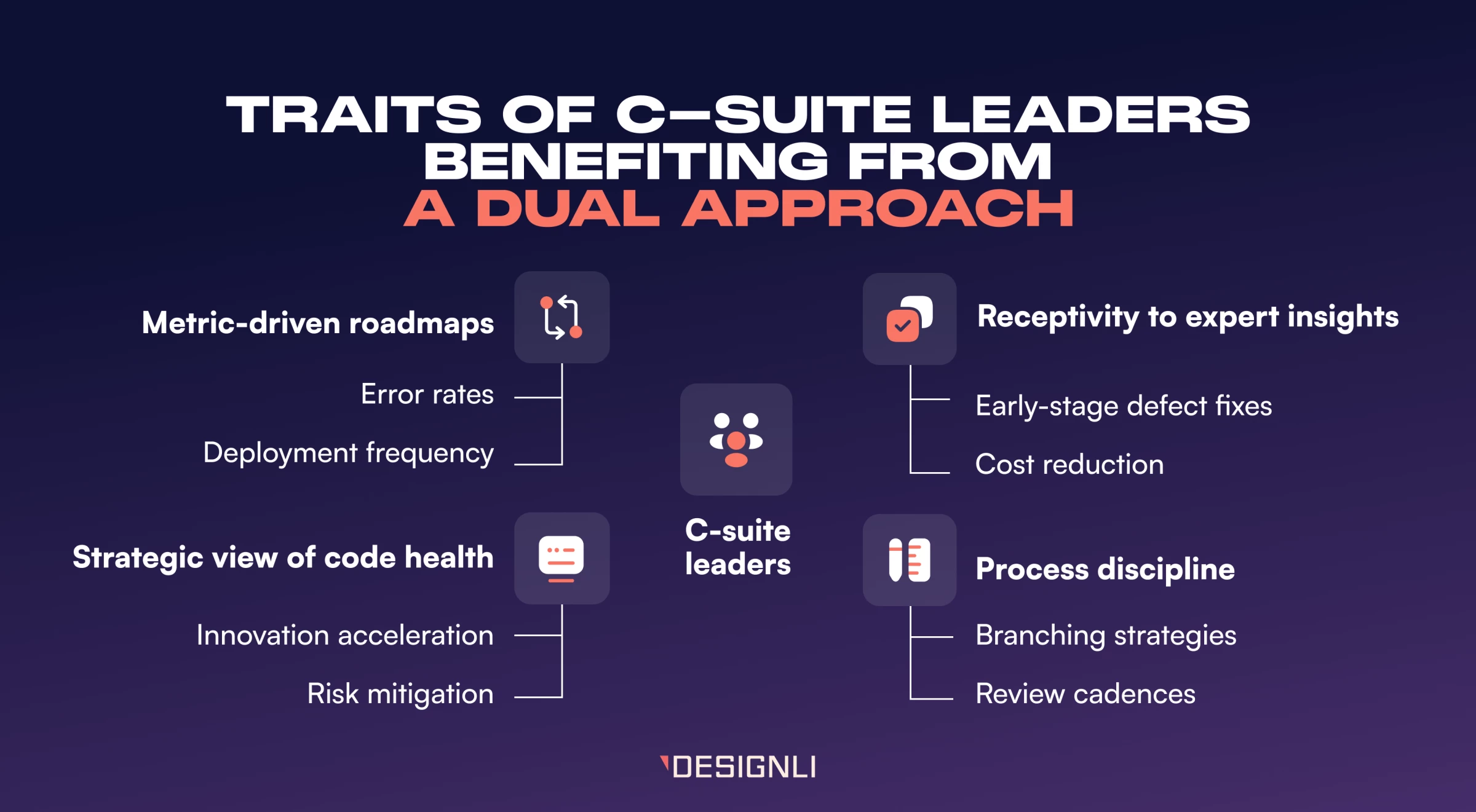
C‑suite leaders who gain the most from this dual approach share these traits:
- Metric‑Driven Roadmaps: Every code change ties to clear KPIs, including error rates, deployment frequency, or mean‑time‑to‑restore, so technical work delivers measurable business impact.
- Receptivity to Expert Insight: Teams that welcome candid, coached reviews fix early‑stage defects at a fraction of the post‑release cost.
- Process Discipline: Formal branching strategies, gating rules, and review cadences replace tribal knowledge, creating scalable, repeatable workflows.
- Strategic View of Code Health: Treating maintainable, clean code as strategic capital accelerates innovation and mitigates risk as products evolve.
The takeaway?
Executives who embed automation and coached reviews into their engineering culture unlock faster time‑to‑market, lower operational risk, and a clear roadmap for continuous innovation.
Foundations: From Repositories to Environments
After securing executive buy‑in for a dual review strategy, the next step is solidifying the technical foundations that make it possible.
Just as a restaurant’s “Master Recipe Book” holds every dish’s instructions, a code repository archives each change, configuration file, and documentation update.
Branches offer parallel lines of work. In other words, experimentation that won’t contaminate the main menu. Designli’s engineering teams align three elements to these branches:
- Development: A playground for new features and internal QA.
- Staging: A mirror of production where client‑facing testing validates that new code meets real‑world needs.
- Production: The live platform where end users interact, demanding stability and performance.
By pairing repository features with gated environments, leaders ensure that every ingredient, every line of code, has passed rigorous checks before it reaches paying customers.
With repositories and environments locked down, the stage is set to implement the recipe and fortify your code in just five days.
The Recipe in Action: Impact Week Code Assessment
Designli’s one‑week intensive transforms raw code into a hardened foundation:
- Context Gathering: Align on business goals, existing processes, and technical docs.
- Baseline Automation: Spin up CI pipelines to surface instant metrics on style adherence, test coverage, and security posture.
- Expert Dive: With limited‑privilege access to repos and databases, review architecture, data models, and critical flows.
- Customized Roadmap: Deliver a report outlining quick wins, strategic refactors, and governance best practices.
By the end of five days, leadership teams hold a playbook and a pathway, knowing precisely which “ingredients” to adjust for cleaner, safer, and more scalable software.
The value of a clean, testable codebase is no longer up for debate. What matters now is how quickly teams can uncover what's working, what’s not, and what needs to change.
Unchecked code debt slows teams, weakens products, and inflates long-term costs.
A dual approach of automation and coached review gives leadership clear oversight and faster decision-making. It prioritizes predictability, speed, and reduced risk over chasing perfection.
For executives under pressure to deliver, this is what quality assurance needs to look like in 2025.