
Hypothesis-Driven Development for Startups: Key Findings
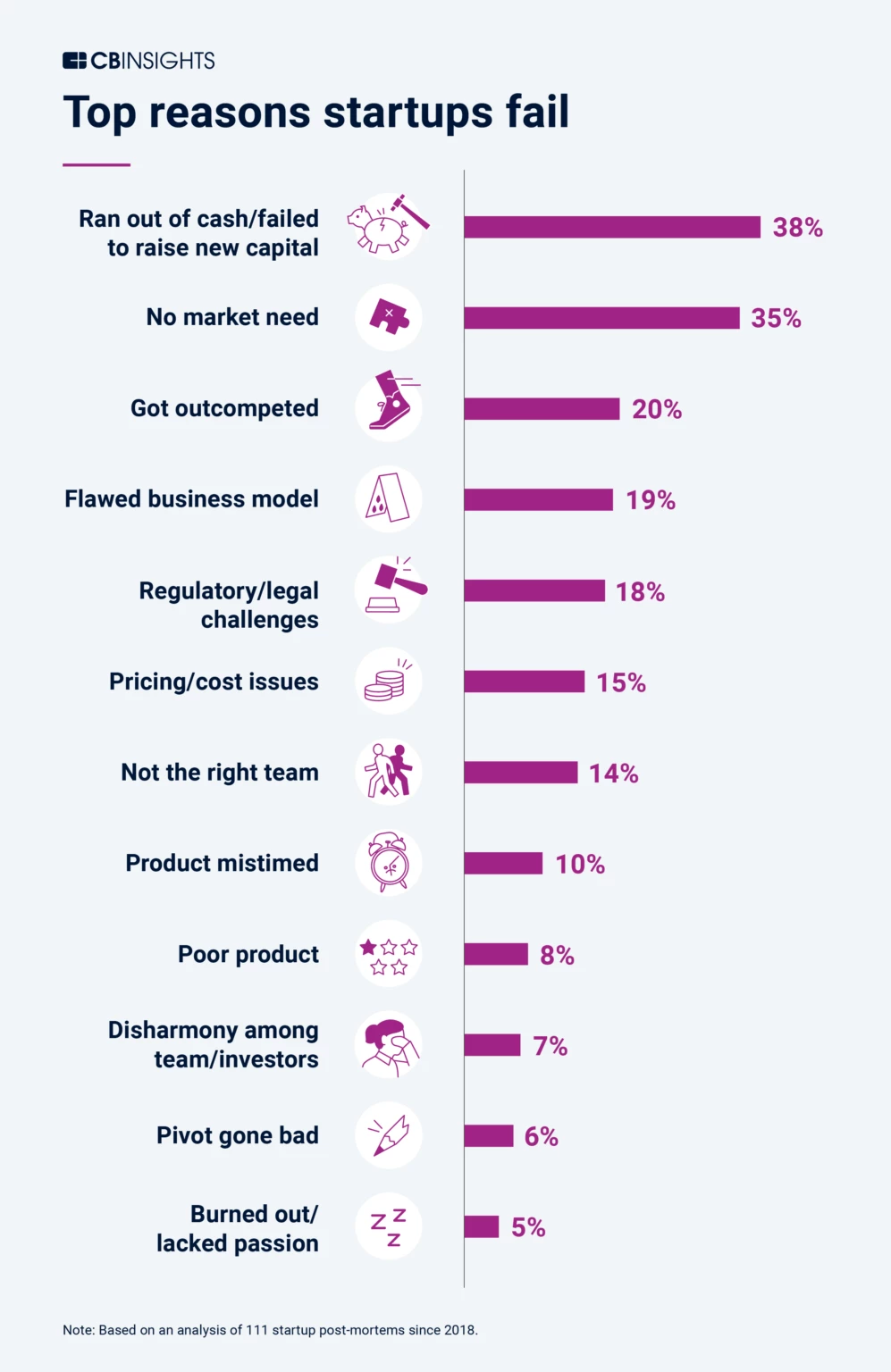
- 35% of startup failures cite poor product-market fit, proving how vital early validation is.
- A significant portion of shipped features go unused, showing how costly assumption-driven roadmaps can be.
- Companies that apply structured testing and validated learning improve product decisions and learning speed.
Product development just hit a reality check.
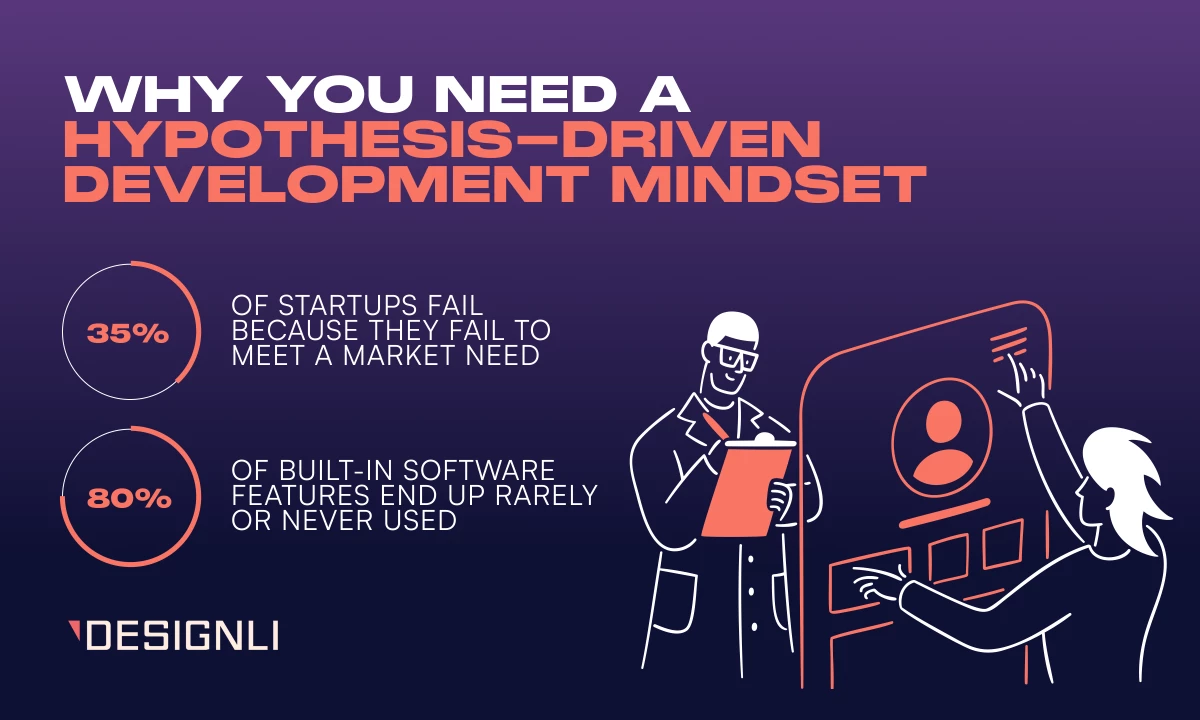
With 35% of startups failing due to “no market need,” founders are learning that feature output is a weak predictor of real traction.
And the risks compound: research shows that in many software products, roughly 80% of built features end up rarely or never used.
This means teams often spend time building things nobody ever sees or uses.
Hypothesis-Driven Development (HDD) is gaining traction because it replaces assumptions with evidence.
Instead of asking “What should we build?”, HDD pushes teams to ask “What must be true for this to matter?”
That simple shift reframes product work from execution to learning.
“The biggest mistake founders make is building too much too early,” said Keith Shields, CEO at Designli.
“HDD gives teams a structured way to test ideas before any heavy development happens. It protects both budget and focus.”
And the timing matters.
Markets are noisier, acquisition costs are rising, and users are more selective.
Teams need a way to remove guesswork from their roadmap.
HDD offers that structure by treating every product idea like a testable and measurable experiment.
1. Start With a Clear Hypothesis, Not a Feature List
HDD begins with a simple structure:
- An assumption
- An expected outcome
- A metric that proves success
This turns opinions into testable statements and aligns teams around what they must learn — not what they hope will happen.
The approach builds on validated learning principles popularized in Lean Startup methodology.
A strong hypothesis might predict that “changing onboarding flow X will increase activation by Y%.”
A weak one is simply “users will like this.”
The difference determines whether a team learns something or just ships something.
2. Run Lightweight Experiments Before Writing Code
Once the hypothesis is clear, teams move into a cycle of identifying assumptions, designing an experiment, measuring results, and deciding whether to pivot or persevere.
A/B testing frameworks have proven valuable here because they help teams compare alternatives objectively and reduce bias.
Experiments can be as small as a landing page smoke test, a pricing mockup, a prototype demo, or a staged onboarding flow.
Whatever you decide to pursue, what will matter most is the speed and not the polish.
Many companies discover at this stage that the majority of their planned features wouldn't have produced meaningful user impact.
That realization alone can save months of development.
3. Build a Culture Where Learning Outweighs Output
HDD is a team mindset, just as it is a process.
Designli encourages clients to tie experiments directly to Objectives & Key Results (OKRs), use shared tracking tools, and ensure experiments influence roadmap priorities.
View this post on Instagram
Analytics platforms such as Google Analytics, Mixpanel, and Amplitude help teams validate outcomes and avoid gut-feel decision-making.
When experiment results flow into planning cycles, teams reduce the risk of scaling prematurely, which is a mistake many struggling startups report.
“Validated learning becomes the real progress metric,” Shields added.
“Teams that reward experimentation outperform those that reward output.”
Most product teams fail not from lack of effort, but from building the wrong things.
HDD fixes that by running structured experiments, founders get clearer signals, faster feedback, and better bets.
All while protecting the runway and improving user understanding.
Marketers, Take Note
The numbers don’t lie, and the message is clear.
Teams have to start treating every roadmap item as a hypothesis until proven otherwise.
Start with the riskiest assumption and test it with the smallest possible experiment.
Reward learning over output so teams optimize for impact, not activity.
Because when you learn compounds, product momentum becomes predictable.
And that makes everything significantly more efficient.