
IT Modernization Risk: Key Findings
- Modernization delays are increasing operational risk, as financial institutions rely on aging systems to maintain uptime and security.
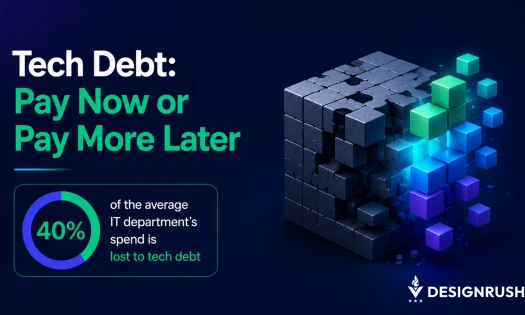
- Legacy systems and technical debt are draining IT budgets and slowing innovation, leaving CIOs stuck maintaining infrastructure instead of advancing strategy.
- Incremental custom modernization provides a safer path forward, helping CIOs reduce risk and modernize systems without disruptive full rebuilds.
Inside many financial institutions, there is a quiet contradiction playing out every day.
While leadership talks about digital transformation, faster delivery, and future-ready platforms, IT teams are spending most of their time keeping aging systems stable enough to avoid disruption.
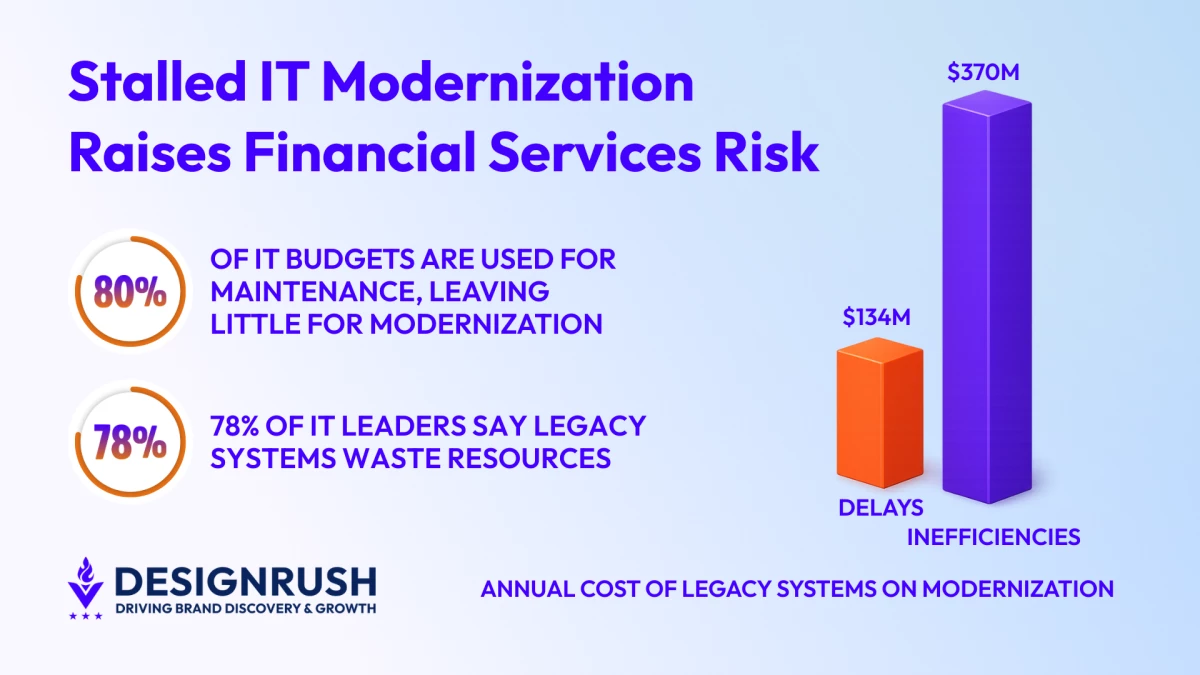
Industry analysts have long estimated that as much as 80% of enterprise IT budgets can be consumed by maintaining existing systems, leaving limited capacity for modernization or growth-focused initiatives.
Jerry Doyle, Senior Delivery Manager at leading custom software development company, Kanda Software, says that for CIOs, that gap between ambition and reality is not just theoretical.
“In an industry where uptime equals trust and security failures carry real consequences, stalled modernization turns into a growing source of operational and competitive risk.”
This client testimonial below highlights how Kanda Software partners with financial services organizations to address complex legacy challenges and support long-term modernization goals:
Editor's Note: This is a sponsored article created in partnership with Kanda Software.
Why Modernization Gets Delayed
Most CIOs don't need to be convinced that modernization matters. What they actually struggle with is finding the space to do it.
As systems progress, they pick up integrations, dependencies, and workarounds designed to solve short-term problems. But over time, those initial quick fixes become permanent fixtures.
This results in organizations falling into an infrastructure trap where maintaining complexity absorbs the majority of IT infrastructure services and leaves little room for progress.
“In financial services, this often means delayed core upgrades, brittle integrations, and release cycles that slow down just as customer expectations and regulatory pressure increase,” Doyle says.
Clynt Taylor, Principal Advisor at Kanda Software further explains why IT modernization is a risk management decision in the post below:
When Technical Debt Drives Risk
At a certain point, technical debt stops being a back-office concern and begins shaping business outcomes.
Operationally, even small changes become high-risk events.
Every new dependency adds another piece to secure and monitor. At the same time, flexibility slips as new initiatives take longer to reach the market than those of competitors or fintech challengers.
Over time, these layered setups create vulnerabilities and compatibility issues that become harder to unwind.
“For financial institutions operating in tightly regulated environments, this fragility is more than inconvenient,” Doyle says. “It directly affects resilience, audit readiness, and long-term confidence in the technology stack.”
The Numbers Behind the Maintenance Trap
This is where the conversation gets real. Ask most technology leaders where the IT budget goes, and the answer often comes with a sigh.
Research by Digitalisation World shows that the average global organization now loses around $370 million each year to inefficiencies tied to legacy systems and technical debt.
Of that total, $134 million is lost to transformation initiatives slowed or compromised by outdated methodologies.
Moreover, $58 million is lost to projects that fail outright due to obsolete infrastructure, and $56 million is spent on the ongoing cost of maintaining and integrating legacy technology.
Perhaps most telling, 78% of IT leaders say resources locked into aging systems could be better deployed elsewhere, while only 9% of organizations have successfully retired or replaced a meaningful portion of their legacy applications.
Simply put, legacy systems are quietly draining time, budget, and momentum, costing organizations hundreds of millions each year while keeping IT teams tied up in maintenance work that most leaders know is holding the business back.
Why Custom Modernization Is Rising
This moment has prompted many financial institutions to pause and reassess.
Stacking another tool onto fragile foundations no longer feels like progress.
Custom modernization, on the other hand, creates space to move forward while still meeting the security, compliance, and operational demands of the business.
This is where firms like Kanda Software align closely with CIO priorities.
Rather than treating modernization as a one-time event, custom development enables incremental progress. Core systems can be refactored, simplified, and secured without destabilizing the business.
“The focus shifts from speed at all costs to sustainable change,” Doyle says.
“Architectures become easier to maintain. Risk management becomes part of the development process instead of an afterthought. And technology strategy begins to support broader enterprise goals rather than constrain them.”
This healthcare example from Kanda Software illustrates how environments with little margin for error demand custom-built systems, a challenge financial institutions increasingly face as modernization stalls:
Regaining Control Without Rewrites
Modernization does not require tearing systems down to the studs.
It does, however, require intention.
This can be achieved by:
- Reducing unnecessary infrastructure overhead frees teams from constant firefighting.
- Simplifying architectures reduces operational risk and strengthens the security posture.
- Embedding compliance and risk considerations early prevents costly rework later.
- And most importantly, CIOs regain control of their roadmaps.
“When maintenance no longer dominates the agenda, technology leaders can make proactive decisions instead of reacting to the next incident or integration failure,” Doyle says.
The Question CIOs Now Face
The real danger is not that legacy systems will fail overnight. It is that they quietly dictate what the business can and cannot do.
Every year spent prioritizing maintenance over modernization narrows the organization’s options and raises the cost of future change. This said, custom modernization must form part of every CIO’s IT strategy.
“For financial services CIOs, modernization is no longer about chasing innovation headlines,” Doyle says.
“It is about restoring flexibility, reducing exposure, and ensuring that technology once again serves strategy instead of limiting it.”